The Albany Herald ... We're All About You!
The Albany Herald

Wednesday, May 14
,
2008
Today's Paper
Headlines
Sports
SouthView
Opinion
Obituaries
Weekend News
Weddings & Engagements
Birth Announcements
Search Archives
Classifieds
Subscriptions
Policies
Contacts

Local & State Headlines

The Zone

Albany budget amended

  • City officials question the return on investment of some of the organizations which they help fund.

ALBANY — Spending changes and the Albany City Commission’s decision not to raise the millage rate have brought its total expenditures over revenues for fiscal years 2008 and 2009 to $5.85 million, documents show.

Unbudgeted expenditures for FY 08 were $4.1 million, said City Finance Director Kris Newton. Departmental management controls resulted in $1.86 million in unspent funds, resulting in FY 08 unbudgeted net expenses of $2.2 million.

“It’s a budgeting move on our part,” City Manager Al Lott, speaking of reducing department expenses, said during the commission’s 8:30 a.m. work session Tuesday.

Unplanned expenses during the fiscal year that ends June 30 include $1.64 million in property tax rollback/appeals and $1.49 million on the group health plan shortfall as well as $300,000 in emergency financial aid to the Flint RiverQuarium.

For FY 09, which starts July 1, planned expenditures over planned revenue begin with $2.07 million in reserves to balance the $100.63 million budget proposed on April 1.

Add to that figure revisions of $300,000 for the RiverQuarium subsidy; a $407,897 reduction in estimated property tax revenue; $639,725 for a revised calculation of intergovernmental revenue; $15,000 for a youth program; $105,000 for the downtown manager; and $100,000 for an additional city attorney, and planned expenses over planned revenue total for fiscal year 2009 $3.63 million.

“There’s a choice: Cut expenses, go out for new taxes or take some of this out of fund balance,” said Newton. “What the commission decided is that we have the fund balance, it’s there and it’s healthy and we don’t want to increase taxes.”

Despite the hefty sum of nearly $6 million, the extra expenses aren’t making city leaders nervous: Albany has an unreserved fund balance of $24.24 million, of which $13.2 million is “cold hard cash,” Newton said.

“We can use the reserves rather than add to the current tax bill” for fiscal 09, said Newton.

A reduction in department spending is one of the reasons the city has more than $20 million in reserves.

“It’s taken us about eight or nine years to get to $24 million,” Newton said. “It’s an accumulation of years of ‘surpluses’ here and there.”

Of the $24.24 million in the unreserved fund balance, 25 percent, or $13.14 million, represents three months’ worth of expenses for the city. The 25 percent is a rainy-day fund of sorts.

That leaves a remaining $11.1 million that can be used for unexpected expenditures, Newton said.

Subtract from that the $5.85 million in unexpected expenses for fiscal years 2008 and 2009, and the remaining discretionary funds total $5.25 million.

During their meeting, commissioners questioned specific planned FY 09 expenses.

While the city will likely subsidize the RiverQuarium, commissioners said Tuesday they want details of how the funds will be used and a game plan for reducing the facility’s dependence on public assistance.

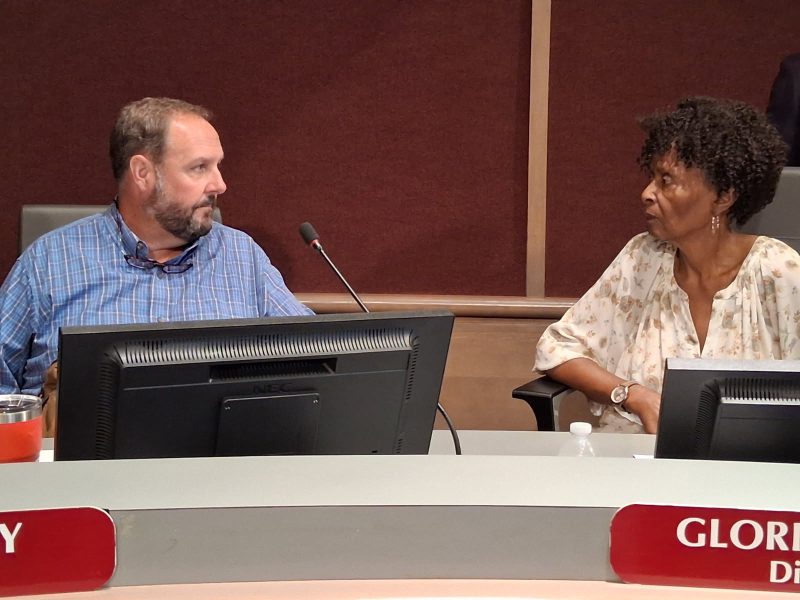
For better oversight, Commissioner Bob Langstaff asked City Attorney Nathan Davis to research possibilities for getting a commissioner on the board of the RiverQuarium, a private nonprofit organization which officials conceded is a quality-of-life asset.

“When we’re making this sizeable a contribution,” Langstaff said, “the city should have a voice in how the RiverQuarium does business.”

Although RiverQuarium Director Scott Loehr said from the beginning — last spring when he initially came to the city and Dougherty County commissions for emergency funds — that the facility would need years of aid, that fact seemed to escape at least one commissioner, who seemed surprised that the RiverQuarium would need funds for FY 09.

In regard to funding assistance, Langstaff revisited the $150,000 the city gives to Albany Tomorrow Inc. on condition of economic development.

“The bulk of the stuff (the city told ATI) to do they haven’t done,” Langstaff said, noting examples such as development in downtown Albany.

Some commissioners said they were open to the possibility of ceasing funds to ATI if the organization doesn’t meet the performance goals set by the city.

“I just encourage my fellow commissioners to look at the contract and come to their own conclusions,” Langstaff said.

Per Davis, the city transfers funds to the Albany-Dougherty Inner City Authority (ADICA), which by contract channels the funds to ATI.

In speaking of expenses, commissioners again took up the issue of crosscharges by the Water, Gas & Light Commission, which is part of the city.

“We need to find out what they do for us,” said Langstaff. “The major part of the (city) budget is revenue, and they are a major part of revenue.”

According to city officials, WG&L charges the city for things such as fiber-optics cable. Meanwhile, the city doesn’t charge the agency for services such as human resources and information technology nor tenant fees for the city-owned building from which the utility service operates.

“It’s not inappropriate for the city to also do cross- charges,” Langstaff said.

Added Commissioner Tommy Postell, “We have not received one red cent from nonmetered revenue,” which he said totals about $10 million.

The city does expect to receive $4 million from the Municipal Electric Authority of Georgia (MEAG) through WG&L.

All commissioners but Jon Howard voted for Davis to “research the probability of having the WG&L chairman (Mayor Willie Adams) be a voting member” of the WG&L board.

Newspapers for Knowledge

Subscribe


© 2008 The Albany Herald/Triple Crown Media