
Specialist knows electricity of heart
Jim West
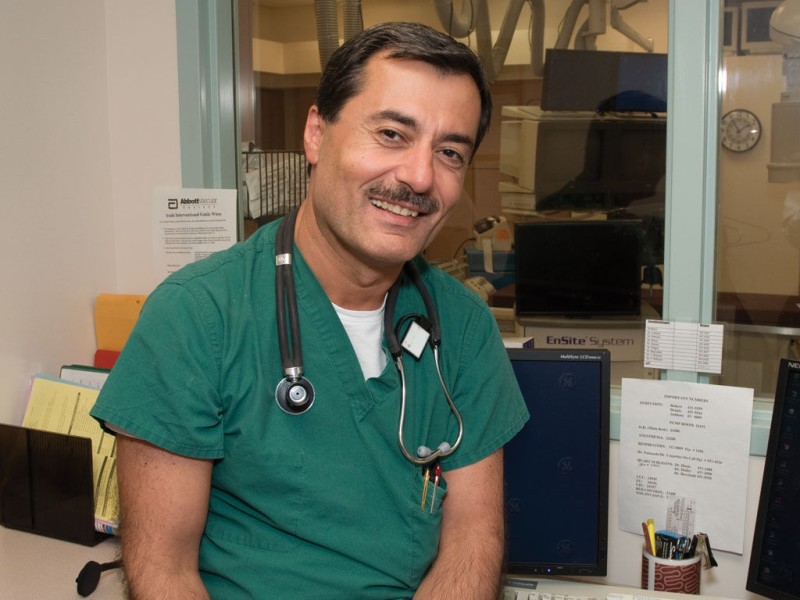
ALBANY — Dr. Kamil Hanna is the kind of electrician you want to have around for a real emergency.
In addition to practicing cardiology, Hanna’s subspecialty is the “circuit board” of the heart. He’s an electrophysiologist — one of about 1,500 in the nation, he says, and the only one between Macon, Columbus and Tallahassee, Fla.
Any sort of heart arrhythmia, or electrical misfiring, is Hanna’s daily concern, he says, whether it be a slow heart, fast heart or the electrical storm of life-threatening cardiac arrest.
“Heart attacks don’t kill people,” Hanna said. “What kills them is the electrical storm that happens to the heart muscle.”
According to Hanna, a heart attack itself is a simple thrombosis or blockage. The problem comes as the dying downstream muscle triggers ventricular fibrillation — wild and crazy contractions of 300-400 beats per minute.
“There’s no meaningful pumping of the blood during fibrillation,” Hanna said. “No pumping means no blood pressure, and so you have about seven minutes on this planet.”
Hanna said that without a pre-implanted defibrillator, or someone present with classic paddles to shock the heart externally, death is nearly always certain. Hanna installs between 180 and 200 defibs a year, he said, all of them in patients at strong risk of sudden cardiac death. The devices are mandated by the American College of Cardiology and the American Heart Association to be monitored regularly.
“An implanted defibrillator does not let you wait even a minute,” Hanna said. “It detects the defibrillation event and shocks your heart to normal. There is also a pacemaker to adjust heart rate. It addresses both ends of the spectrum.”
Hanna said he had a patient who was unaware his life had been saved as he slept peacefully in his bed.
“He was on his way out,” Hanna said, “didn’t even know he’d been shocked. He came in two weeks later for his checkup feeling great.”
While surviving a first cardiac arrest is rare, the lucky ones who do qualify immediately for an implanted defibrillator, Hanna says. Others who may have experienced only a classic heart attack or other damage must wait 90 days, according to ACC guidelines, even if their heart function is below 30-35 percent.
“If, by some miraculous event, you survive (a cardiac arrest) before the 90 days are up, that’s a different ballgame. You can have the defibrillator,” Hanna said.
Hanna did say that if the patient is judged to be truly at risk for sudden death, the option is there for a life vest, an external device designed for the same purpose as an implanted defibrillator to keep the patient alive. While the vest is removable, Hanna recommends taking quick showers and otherwise wearing it only during the time you want to stay alive.
“It can’t save you when it’s on the couch,” Hanna said.
In addition to being the area authority on debrilators, their maintenance and application, Hanna sometimes performs ablations to bring a heart’s electrical firings into better balance. Heart issues may arise from irritations caused by smoking, drinking, genetic disease or other stimuli, Hanna said, resulting in areas of the heart sending signals which are not normal. In those circumstances, Hanna burns specific points inside the heart to destroy those triggering abnormal firings.
To guide him in the delicate ablation procedure, Hanna employs the use of an elaborate 3D computer mapping system.
Hanna, who has practiced with Cardiology Associates for nearly five years, speaks six languages, he says, with mastery of English and Swedish, as well as his native Lebanese.
Related Articles
Albany Herald – July 18, 2026
Georgia Trust for Local News partners with… Adult leadership group spreads concept to… Lee County homeowners have until Aug. 1 to claim…

Classifieds – July 18, 2026
Classifieds; Legals;

Albany police make arrests in murder, robbery cases
Officials with the Albany Police Department have announced a number of arrests in cases that involved a homicide and a pair of thefts.
