
American heroes make up Ex-POW chapter
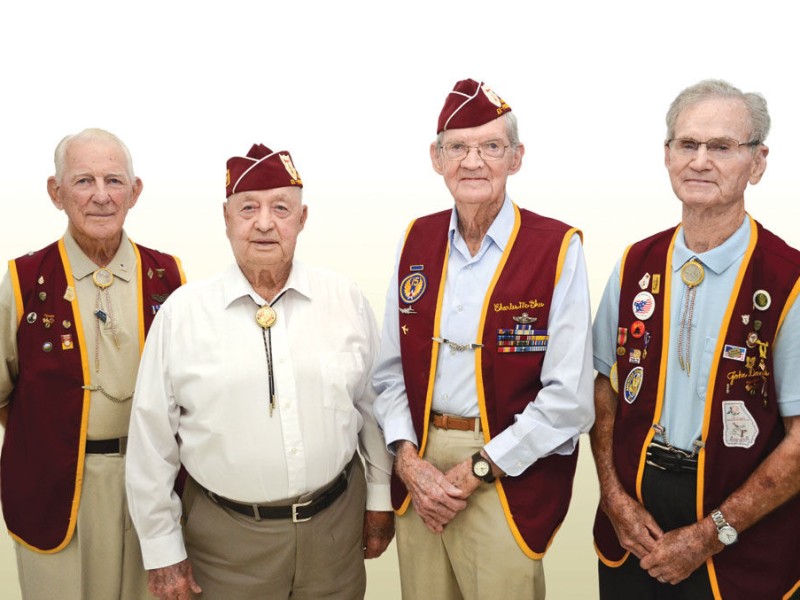
Carlton Fletcher
ALBANY, Ga. — As her husband Lee and three other members of the Southwest Georgia chapter of American Ex-POWs tell their stories, Palma James offers a sobering assessment.
“I think it’s sad,” she says, “that World War II has been condensed down to a page and a half in the history books. We’re losing a very important part of American history.”
Lee James, John Henry Daniels, Silas Barnes and Charles McGhee are the embodiment of that history, shining examples of the best of the Greatest Generation. Each served his country with honor during the Great War, and each brought home sobering memories of his time as a prisoner of war in German and Japanese encampments.
“We ran out of ammmo, and we fought the Germans hand-to-hand with our bayonets until our unit had to surrender,” Daniels said. “We were taken (to prison) in cattle cars, a four-day ride with no food or water. They had so many of us stuck in those cars, you couldn’t lay down even if you died.
“The Germans would sometimes line us all up in formation, take a prisoner and tie his hands, then shoot him in the head in front of everyone. It’s just so hard for me to talk about this, to remember it. When I do, it starts playing like a tickertape in my head.”
Each of the remaining active members of the local Ex-POW chapter, which meets for lunch at a local restaurant the first Monday of each month, has his memories of captivity, some as harrowing as Daniels’, some a little lighter. That they’ve managed to compartmentalize those memories and live their lives well in the six and a half decades since the war’s end is a testament to the courage that sustained them while in captivity.
“(Prison camp) made me a better person, taught me to control my anger and learn to live with people,” McGhee said.
Barnes, a Marine in D Company’s 1st Battalion who was held by the Japanese from May of 1942 to September of 1945, said he tried to make the most of his time as a prisoner.
“Don’t get me wrong, people suffered all kinds of handicaps in the prison camps,” he said. “If the Japanese didn’t like you or they got mad about something, they’d pull their swords and cut people’s heads off.
“But I learned as much as I could while being held. We were forced to work in lead mines, and I learned how to operate all the machinery. Of course, while on the way to Funotsu (Japan) and the mines, we were marched and whipped through the streets as a demonstration for the civilian population.”
James, who was a B-17 co-pilot with the 8th Air Force’s 365th Bomb Squadron operating out of England, was shot down on his ninth mission and held for eight months in Stalag Luft I in Barth, Germany. He was not, however, captured by enemy soldiers.
“Our escape instructions were, after landing hide your parachute and run for about a half-hour to get out of the immediate area,” James said. “I did that, but when I stopped to check my map, I realized I had run further into Germany. I took off running again, passed the place where I’d originally landed and kept going.
“I came to a small town a while later and saw an old man on the road. We’d been told that the German citizens were sympathetic to the Allies and would help us escape. I used my translation book to try and talk with the man, and he pulled a pistol and took me to the local jail. I was later transfered to the German prison camp.”
McGhee, too, was a co-pilot whose B-17 was forced into an emergency landing while on a bombing run. During his 23rd mission with the U.S. Army Air Corps’ 15th Air Force Bomb Squadron, a loss of oil pressure forced his plane to lose altitude. When the crew encountered an enemy flak camp, they had to dive and eventually made a “belly landing.”
McGhee, whose squadron flew missions out of Italy, was captured by an old man and a young boy in Hungary. They fed him but later turned him over to German forces, who transported him to Stalag Luft III. He remained there for eight months before being liberated by Gen. George Patton’s troops.
“Since I was an officer, I was neither tortured nor forced to work at the camp,” McGhee said. “I was at the camp where the ‘great escape’ took place. I did not, however, see that guy go by on a motorcycle (a reference to a famous scene in a classic Steve McQueen movie.)
“I actually stayed in the Air Force after we were liberated and returned to the States. I flew the first jet fighter up to F-86 and eventually went to Korea and flew 100 missions against the Russians and Chinese before retiring in 1961.”
Daniels, called “Doc” because he volunteered as a medical technician during his internment, was with the Army’s 141st Infantry Regiment, 36th Division when he was captured in January of 1944. Before being liberated by the Russian Army 16 months later, he “had a lot of boys die in my arms.”
“I think me volunteering to become the ‘Aid Man’ saved my life,” Daniels said. “I had no medical training, but I did what I could. I’ll never forget the cries of those young boys as I tried to help them. They’d say, ‘I don’t want to die now, I don’t want to go to hell.’ You just don’t forget something like that.”
Pushed — gently — to tell their stories, the veterans almost casually recall their acts of bravery, the years having dulled for the most part the horrors that sometimes still infiltrate their nightmares.
Barnes tells of taking the bayonet he’d just been stabbed with and using it to kill his Japanese attacker … McGhee recalls a four-day forced march to Austria that left several of his fellow prisoners dead … Daniels notes that he weighed 178 pounds when taken prisoner but only 90 when he was liberated … James recalls that it was years after the war that the tail gunner from his crew found out he and other crewmen had survived because the gunner had followed a “bail out” order on a mission moments before the pilot righted the plane.
“(The gunner) saw an explosion and assumed we had been shot down,” James said. “It was several years later at a reunion in the States that he found out what had happened.”
For their bravery in the face of these and other unimaginable horrors, the four Albany Ex-POWs received chestsful of medals: James the Distinguished Flying Cross for taking over and successfully landing a plane after the pilot had been hit with flak and “lost the top of his head”; Daniels receiving two Purple Hearts with clusters and a Bronze Star; Barnes a Purple Heart with Gold Star and a Bronze Star; McGhee a Purple Heart and Distinguished Flying Cross.
“Some of the boys were so weak in the prison camp, they weren’t hardly able to stand up,” Daniels said. “But one day the Germans allowed us to put a small American flag up, and someone started singing ‘The Star-Spangled Banner.’ Everyone in there stood at attention, and we all sang with tears running down our faces.
“I love this country so much; I don’t have any regrets.”
Finding each other in the Southwest Georgia Ex-POW chapter has given these four true American heroes an opportunity to remember and discuss often painful shared experiences.
“It’s been good therapy for them,” Ellen Barnes, Silas’s wife of 67 years, said.
Added Daniels’ wife Lucille: “There are so many things that John had gone through that I didn’t know anything about until he became a part of this group.”
The chapter is down to four active members now, but that doesn’t deter McGhee, James, Daniels and Barnes. They have a plan.
“We’ve already decided,” Barnes said. “We’re going to hang in there until there’s just one of us left standing. Then he’s going to pack up the gavel and go home.”
Related Articles

Albany police make arrests in murder, robbery cases
Officials with the Albany Police Department have announced a number of arrests in cases that involved a homicide and a pair of thefts.
Dougherty Jail graduates first class of female GED recipients
“It was an escape. I can say this has been challenging. I want to express my gratitude for being able to attend this program.”
From cotton to cloud: In the data center debate, is rural Georgia once again being asked to carry the cost?
Across much of rural Georgia, the abandoned cotton warehouses and shrinking tax bases remain — enduring reminders that industries built to serve distant markets do not necessarily stay rooted in the communities that first sustained them.
