
Bill will boost Southwest Georgia economy
Carlton Fletcher
ALBANY, Ga. — For the radical “no taxes” crowd, whose reaction to recent media information about House Bill 386 and its impact on motor vehicle taxes in the state has resulted in typical knee-jerk commentary, an area state legislator has a suggestion:
Read the bill.
“Unfortunately, the typical media response to any new legislation is ‘let me show the worst case from the bill without looking at the whole thing,'” state Rep. Ed Rynders, R-Leesburg, said. “And, also unfortunately, so many folks respond to what they read and see in the media. They don’t bother to read the entire bill.
“A lot of the people who complained about members of Congress not reading the (federal) health care bill before passing it are complaining about HB 386 without reading it. I believe they’d see things differently if they did.”
Rynders said that while most of the emphasis on HB 386 has surrounded the new motor vehicle tax that will tax casual automobile sales for the first time, Southwest Georgians should take a much closer look at the legislation before criticizing.
“Who is the second-leading user of energy in the state right now? Procter & Gamble,” Rynders said. “And what has Procter & Gamble been trying to do for years? Get rid of the energy tax in the state. And since Georgia is the only state in the Southeast with an energy tax, I would think people in Southwest Georgia would be particularly happy to see legislation — like HB 386 — which phases out the energy tax.
“And did you know that Thrush — right there in Albany — is one of only two manufacturers of cropdusters in the United States, and its competitor in Texas gets a tax break on every plane it sells? Were you aware that HB 386 helps make Thrush more competitive?”
Rynders said the economic development advantages of HB 386 do not end there.
“I’m sure you’re aware of the complaints married couples have had about deductions they’re allowed,” he asked. “Did you know the bill increases significantly the deduction married couples now get?
“By looking only at some of the worst-case scenarios — the unintended consequences of this sweeping piece of legislation — we’re overlooking the positive impact it will have, specifically on Southwest Georgia.”
Even highly publicized complaints about the cost for car leases under HB 386 are premature, Rynders said.
“That’s one of those unintended consequences I’m talking about,” the House District 152 representative said. “And it’s being addressed as we speak. This thing is like steering a ship. We have to adjust until we get it right, but we’ve got to get it on its path before we can adjust.”
Rynders said even the provision of HB 386 that calls for those moving into the state to pay a 6.5 percent tax on the value of their vehicles before they’re given a state title is a provision that will be addressed by the Legislature.
“There are a lot of good things in this bill,” he said. “In addition to the energy tax, the Thrush situation and the marriage deductions, counties have been guaranteed under the provisions of the bill that they won’t lose money. I’d say it’s got quite a lot going for it.”
Local economic developers say there is definitely plenty of upside to the legislation.
“As a whole, HB 386 is a huge step forward,” Albany-Dougherty Economic Development Commission Director Ted Clem said. “It’s a comprehensive tax bill that is a step forward for Georgia. There are a lot of good things in this bill, and from everything I’ve heard our legislators are working now to tweak and improve it.”
Former state Sen. Michael Meyer von Bremen, who currently serves as chairman of the Albany Area Chamber of Commerce’s Legislative Affairs Committee, said he’s confident the Legislature will work to eliminate unintended consequences that could result from the bill as it is currently written.
“I think the issue with leasing vehicles could negatively impact the state from an economic development standpoint, especially when you consider companies that have large fleets of vehicles,” Meyer von Bremen said. “I don’t know if that’s a make-or-break issue, but it could be a factor that, when taken with others, might lead businesses to reconsider (locating in Georgia).
“But these consequences arise around this kind of legislation. I’m pleased to know that the House has already started taking up this issue. I’m certain they did not intend for (HB 386) to have any kind of negative impact on our economy.”
Related Articles
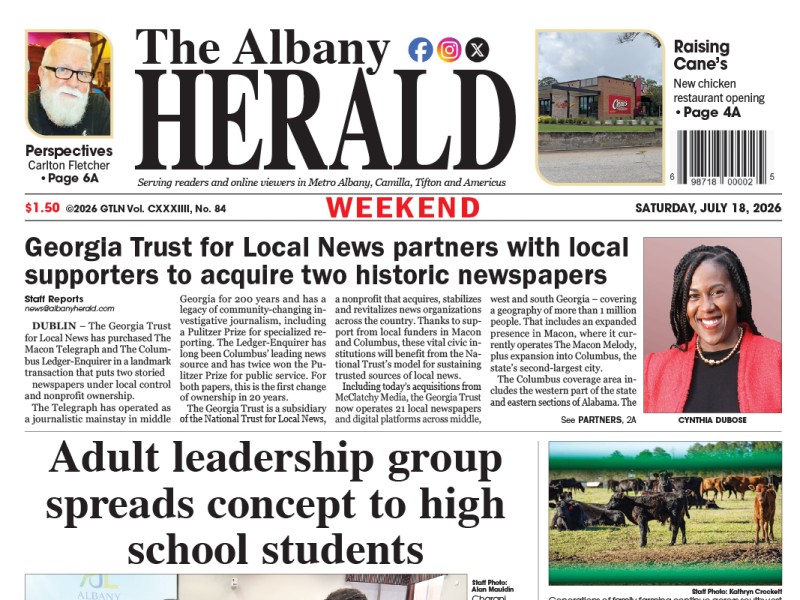
Albany Herald – July 18, 2026
Georgia Trust for Local News partners with… Adult leadership group spreads concept to… Lee County homeowners have until Aug. 1 to claim…

Classifieds – July 18, 2026
Classifieds; Legals;

Albany police make arrests in murder, robbery cases
Officials with the Albany Police Department have announced a number of arrests in cases that involved a homicide and a pair of thefts.
