
Luncheon places focus on colorectal cancer
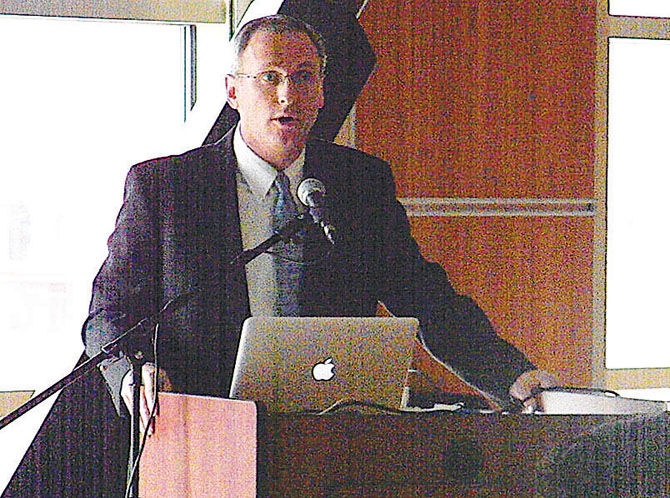
Jennifer Maddox Parks
ALBANY, Ga. — Drs. Chirag Jani and Troy Kimsey of the Phoebe Cancer Center were the speakers at a free luncheon at Darton State College on Friday planned as part of an effort to draw attention to National Colorectal Cancer Awareness Month.
Jani is director of medical oncology, while Kimsey is the director of surgical oncology at the Phoebe Cancer Center.
Sponsored by the cancer center, the Southwest Public Health District, the Cancer Coalition of South Georgia, the American Cancer Society and 100 Black Men of Albany, the program and complimentary lunch focused on prevention, detection, screening and treatment of colorectal cancer.
Colorectal cancer, Kimsey said, accounts for 11 percent of all cancer deaths, costs the United States $6 billion a year to treat and is the third leading cause of cancer death for both men and women.
The majority of cases start with the development of a polyp and progress from there. The presence of the polyps, inflammatory bowel disease, a diet high in saturated fats, personal or family history, obesity and smoking are among the other risk factors.
The diet factor is something more unique to this country, as shown by cancer rates in other parts of the world.
“What’s interesting is that when we look at an eastern country, such as Japan, they have a high risk of gastric cancer,” Kimsey said. “When they move here, within a generation, they have just as high of a risk of getting colon cancer (than those who have been living here).”
Screenings are generally recommended for people beginning at age 50. Colonoscopy, virtual colonography, fecal occult blood testing and sigmoidoscopy are among the methods generally used.
Colonoscopies alone reduce mortality rates by 76 to 90 percent, Kimsey said.
Colonoscopies and bioposies are performed to confirm the presence of cancer, while a computed tomography (CT) scan can confirm the stage of the disease, Kimsey said.
From there, the treatment options depend on the stage of the disease. By the time the cancer has reached Stage 4, that typically means it has spread to other parts of the body, Kimsey said.
Surgery, chemotherapy and targeted radiation therapy are the three basic options. Surgery in colon cancer patients generally involves taking out the cancerous tissue and reattaching the healthy segments.
“It’s like fancy plumbing,” Kimsey said. “We are removing parts and putting them back together, and we don’t get to test it.”
Up to a certain point, Jani explained, the treatment of choice is generally surgery — with a subset of people also receiving chemo if they are at a high risk of recurrence.
“At Stage 3, surgery may be done, but chemo is the most important thing,” he said. “(The treatment process) is an entire team approach, and all (of those involved) need to talk to each other. Otherwise, the treatment is not comprehensive.
“The intention of treatment is not usually a cure, but to (maintain) a high quality of life.”
After the treatment process is over, the follow-up regimen includes a colonoscopy a year after removal of the cancerous tissue, Jani said.
The lunch program, which was attended by about 180 people, was followed by door prize presentations and eligibility screening for a free or reduced cost colonoscopy for individuals 45 and older.
Related Articles

Albany Herald – July 18, 2026
Georgia Trust for Local News partners with… Adult leadership group spreads concept to… Lee County homeowners have until Aug. 1 to claim…

Classifieds – July 18, 2026
Classifieds; Legals;

Albany police make arrests in murder, robbery cases
Officials with the Albany Police Department have announced a number of arrests in cases that involved a homicide and a pair of thefts.
