
Law enforcers learn to handle mentally ill
J.D. Sumner
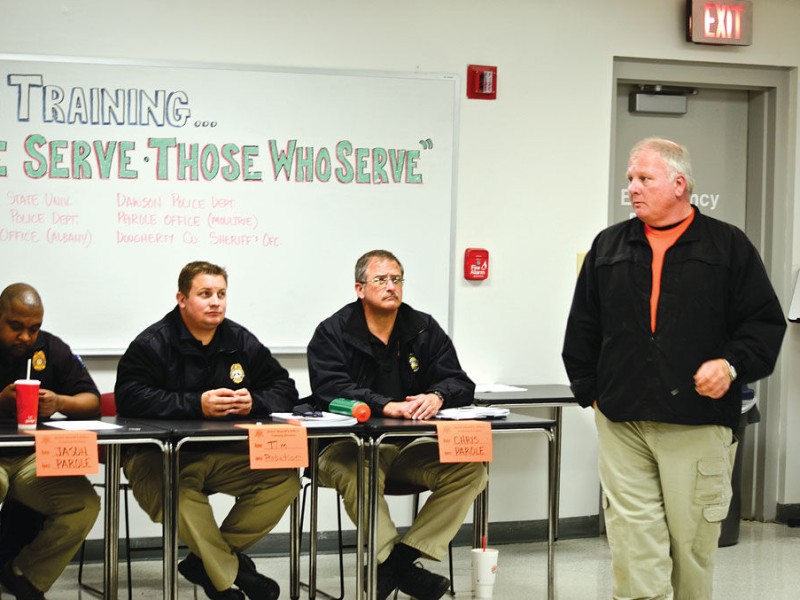
ALBANY, Ga. — Law enforcement officials from around the region have spent the last week learning how to properly handle situations involving people who may be considered mentally ill.
The training was coordinated through the Dougherty County Sheriff’s Office, the National Alliance for Mental Illness and the state of Georgia’s Crisis Intervention Team program and included officers from various agencies throughout the region.
The point? To help officers identify the mentally ill and be better trained on what resources are available outside of the traditional jail environment for them to get the treatment they need.
“One out of four people, in any given year, will have a mental health diagnosis, and a lot of people don’t know that it’s that prevalent,” Sue Marlow, the regional coordinator for NAMI, said. “As services have gone away over the years, it’s getting harder and harder for people to find help, and so law enforcement is having to run into people with untreated or mistreated mental illness over and over again.”
For the person with the mental illness, it means they often get caught in the cog of the U.S. Justice System’s machine rather than getting the help they need to be more productive members of society.
For taxpayers, it means higher bills due to increased medical costs, higher occupancy rates and higher risk liability for people who often wouldn’t have been in jail in the first place had they been properly treated for their mental illness.
Deputy Thomas Kendrick, one of the trainers who assisted during the 40-hour class, estimates that officers could run into someone with a mental illness as often as once or twice each day, a fact that underscores the need to know both how to properly handle them and where to point them to get the help they need.
“I’d say that an officer on the streets probably comes into contact with someone with a mental health issue every day,” Kendrick said. “Now how that officer deals with that person … That’s where the CIT training comes into play, because that training gives them the option of offering assistance to the individual rather than actually taking them to jail.”
Frederick Wells, a housing supervisor at the Dougherty County Jail, said that the weeklong training was eye-opening for him and reinforced the notion that people with mental health issues are still people.
“I think it will help me by … understanding how people with disabilties and mental illnesses function in the community and in our facility,” Wells said. “I think what will help me the most is to think of people with disabilities and mental health issues as … people … and they’re real life people, and we have to deal with them in a certain way that is going to help them deal with the community more effectively.”
Now that their initial 40 hours of training are over, the ones who passed their final exams are eligible to come back in May for a special class to become CIT trainers, a certification that will allow them to go back to their home agencies and share what they’ve learned.
Related Articles

Albany police make arrests in murder, robbery cases
Officials with the Albany Police Department have announced a number of arrests in cases that involved a homicide and a pair of thefts.

Dougherty Jail graduates first class of female GED recipients
“It was an escape. I can say this has been challenging. I want to express my gratitude for being able to attend this program.”

From cotton to cloud: In the data center debate, is rural Georgia once again being asked to carry the cost?
Across much of rural Georgia, the abandoned cotton warehouses and shrinking tax bases remain — enduring reminders that industries built to serve distant markets do not necessarily stay rooted in the communities that first sustained them.
