
Georgia Southwestern University group hopes to help Muckalee crayfish fend off invasive species
Stephen Snyder
AMERICUS — Ask any scientist and he or she will till you “crayfish” are observed for research and “crawfish” are meant for low country boils.
Tom Lorenz, an assistant professor of biology at Georgia Southwestern State University, and four senior seminar students are studying “crayfish” this semester from the Flint River and local creeks. Some of their early findings indicate that a certain species native to Southwest Georgia, the Muckalee crayfish, could be in trouble.
“The Muckalee has a chance of going extinct, so this is important research,” Lorenz said. “Crayfish, in general, serve an important role for the ecosystem as recyclers.”
Crayfish, which are sometimes known as freshwater lobster, are decapods (i.e. ten legs). Ecologically, they are excellent recyclers, eating leaves, other dead creatures and some living (including other crayfish). There are 550 species around the world, 440 in North America, and 70 in Georgia. Nearly 20 species live only in Georgia, and one of those is the Muckalee.
A species that is not native to Georgia, the Creole painted crayfish or “painteds,” are threatening the Muckalee’s existence.
“The painted crayfish are almost entirely confined to the Flint River, from Lake Blackshear down close to Lake Seminole, but they are starting to go up into the creeks,” said Lorenz. “And just recently in a creek near Newton, that has Muckalees, painted crayfish were discovered. Now that the painteds are getting into the creeks, it’s becoming a big concern.”
Of the four senior seminar students researching crayfish, two are Lorenz’s students: Elizabeth Craddock of Duluth and Alejandra Palacio of Lawrenceville, and two are professor Ian Brown’s students: Cameron Baxter of Leesburg and Karl Guyton, II of Pitts. They are studying these freshwater creatures to see how they respond in various habitats.
“Part of our experiments look at habitat complexity, which allows us to see if there is a better or worse habitat for the Muckalees or for the painteds,” Lorenz said. “For the most part, invasive species do well in disturbed habitats. However, just east of Leesburg, we saw painted crayfish in a nice habitat. It seems like they are doing quite well. They are outnumbering the natives everywhere.”
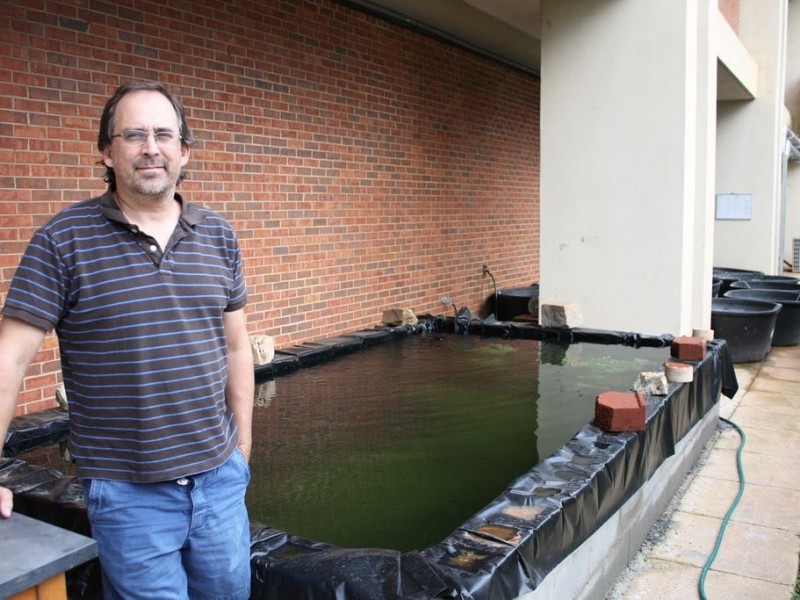
The research team is doing all they can to ensure this Muckalee crayfish doesn’t disappear. This semester they are mostly collecting data. Lorenz and his students keep the crayfish they study in make-shift ponds built on campus, thanks to a GSW faculty instruction grant awarded to Lorenz.
The invasive Creole painted crayfish are being paired with non-invasive species and observed by video to see how they interact. Lorenz says each trial lasts approximately half an hour, and there will ultimately be 120 trials. He said these trials will take time to analyze because “you don’t look at each trial only once.”
“It’s basically set up in the biological context of what’s actually happening,” Lorenz said. “We have the natives there first. Then, we see what happens when the native is introduced to the invasive species and whether or not it defends its territory.”
Palacio is observing how long it takes for the native species to surrender their habitat to the invasive species. Nearly 100 percent of the time, the invasive species takes over in minutes.
“We are all using the same crayfish but looking at different angles of observation to get as much information as we can from analysis,” she said.
Craddock is observing the likelihood of the native species reclaiming their territory. She says the real-life experience is beneficial for her future.
“It’s all about experience,” said Craddock, “especially when you are in lecture. It’s all well and good to know the scientific method and to know the perfect way to plan a research project, but actually doing it, there could be hiccups. You have to know how to adapt.”
Guyton agrees. “When I first transferred, I wasn’t sure yet whether I wanted to do pre-med or go to grad school in zoology or something like that,” said Guyton. “When I got here and started taking the field classes, I made up my mind that I wanted to do zoology work. Working with the crayfish is definitely going to help me out a lot when I go to grad school.”
Craddock and Guyton began working with crayfish this semester, Palacio began in the summer, and Baxter started in the spring.
“Last semester, I did something very similar,” Baxter said. “I actually used this species of crayfish, but I also used another species of crayfish, which is not the invasive species that we are talking about. It’s another species of crayfish called ‘Marmorkrebs’ that is potentially invasive.”
Lorenz and his students are not working on this project alone. “Dr. Chris Skelton at Georgia College is essentially the current crayfish expert in Georgia,” stated Lorenz. “He’s been helpful in this research process.” Lorenz is also working with the Joseph W. Jones Ecological Research Center in Newton, and the non-game division of the Georgia Department of Natural Resources.
“For me, it’s exciting that I can do this much research at Georgia Southwestern,” said Lorenz. “With all of the research I was doing in New Orleans, I was concerned if I’d be able to do that here.
“Not only did GSW provide the faculty instruction grant but also the space and other biology professors are helpful, as well. And, good students to work with and the senior seminar really set up well.”
While observing crayfish behavior will help scientists understand how crayfish interact in various habitats, Lorenz says additional efforts are necessary to maintain healthy populations of each species. Relocation/removal, education and a few “crawfish” boils will be in order.
Stephen Snyder is director of university relations at Georgia Southwestern State University.
Related Articles
Albany Herald – July 18, 2026
Georgia Trust for Local News partners with… Adult leadership group spreads concept to… Lee County homeowners have until Aug. 1 to claim…

Classifieds – July 18, 2026
Classifieds; Legals;

Albany police make arrests in murder, robbery cases
Officials with the Albany Police Department have announced a number of arrests in cases that involved a homicide and a pair of thefts.
