
Albany City Commission OKs Rails to Trails agreement
Carlton Fletcher
ALBANY — Most of the observers who were surprised by the testy exchanges among members of the Albany City Commission during that board’s business meeting Tuesday night missed out on the real fireworks.
During a prebriefing held before the meeting, heated verbal exchanges were flying left and right as the commission discussed the agreement with South Georgia Rails to Trails that was drawn up to give the Albany Utility Board access to a 13.6-mile swath of land from downtown Albany to Sasser that utility officials hope will pave the way for a significant new revenue stream.
It was after the commission passed that measure with a 6-1 vote that the meeting heated up. Ward II Commissioner Bobby Coleman criticized the “process” by which citizens are allowed to address the commission because his “friend” and “constituent” Henry Mathis had been denied an opportunity to speak at the meeting.
Mathis has made it clear that he plans to run against Mayor Dorothy Hubbard in the Nov. 3 municipal election if he is granted civil and political rights he lost when he was convicted of extortion in 2005 while serving on the City Commission.
Coleman said Mathis had been told by Assistant City Manager Wes Smith that he could sign up to speak at the commission meeting prior to its start but that he’d been denied that opportunity. That’s when things got interesting.
“What’s the value of any comments Mr. Mathis might make now, we’ve already voted on the issue?” Ward VI Commissioner Tommie Postell asked.
Smith offered to explain his part in the matter, but interim City Manager Tom Berry said that was not necessary.
Hubbard said that she, as presiding officer of the meeting, should have been consulted about Mathis’ request and that she had the authority to allow an unscheduled speaker, so she granted Mathis five minutes to speak.
Quoting English philosopher John Locke, Mathis admonished the board, “The people should tell elected officials how to vote.”
The former city official then asked a series of questions about the Rails to Trails project, focusing on potential customers along the former rail line and the cost of infrastructure needed to provide utility services.
“What would running a new gas main down this right-of-way to serve any potential expansion cost?” Mathis asked. “What would be the cost of resolution of a (water pressure problem in northwest Albany) and who would bear the responsibility of paying for this? How much is bringing fiber into this area going to cost and where is the money coming from for the infrastructure?”
Referencing “unbudgeted potential expenditures” such as the renovation of the Utility Board’s offices, plans to buy the SunTrust Bank building, a recent deal with the South Georgia Regional Information Technology Authority and conversion of city vehicles to compressed natural gas, Mathis said, “We don’t have a visionary plan, we’re taking a shotgun approach. Questions about the Rails to Trails project should have been asked and answered before a vote was taken.”
The commission did not reply to Mathis’ comments, but there was plenty of conversation in the prebriefing.
Coleman, responding to Berry’s comment that the city would “partner” with South Georgia Rails to Trails in maintenance of a multi-use walking trail that will be built along the pathway by the city as part of the agreement, accused Berry of “planning just to plan.” The Ward II commissioner said city leadership focused only on “what’s being talked about in the media.”
“We were talking about the ‘doomsday’ of 2019 — Ward III Commissioner B.J. Fletcher corrected by saying “218,” a reference to the year that millions of dollars in credits from the Municipal Electric Authority of Georgia will end — and all of a sudden we forgot all about that and moved on to Rails to Trails,” Coleman said. “And now this agreement has changed where you’re talking about ‘partnering’ with Rails to Trails over the cost of maintenance.
“No ‘partner’ is going to take on the costs alone.”
Berry pointed out that the Rails to Trails agreement drawn up by City Attorney Nathan Davis addressed every concern mentioned by commissioners during their work session discussion of the issue. He later responded angrily to Coleman’s comment about planning.
“I don’t plan just to plan,” Berry said. “Ask the people who work with me. What I’m trying to do is find ways to make this city money.”
Hubbard said the Rails to Trails agreement, which calls for the city to pay $150,000 for the former rail bed and, within the next five years, build a trail — projected to cost as much as $1.2 million — along the property for citizen use, offers the promise of future financial reward.
“No one can say for certain what may happen, but I have no doubt if we sit here and do nothing, one day we’ll be sitting here crying and someone else will be reaping the rewards,” the mayor said.
“I understand risk and reward as well as anyone in this room,” Coleman replied. “But I think we should table this matter until we know exactly what we’re supposed to do.”
Berry told the board that, with telecommunications expansion along the Rails to Trails property alone, the Utility Board would realize enough new business to pay for the cost of the trail.
“By the time that trail’s built, it will be paid for,” the city manager said.
Also at Tuesday’s meeting, the commission gave final approval to sign ordinance amendments that will, among a list of other changes, allow businesses with multimessage electronic signs to change messages on the signs every 20 seconds. The previous sign ordinance allowed changes only every 60 seconds, and a Sign Ordinance Task Force had recommended that changes be allowed every 30 seconds.
Ward IV Commissioner Roger Marietta pushed for the 20-second interval so that other area jurisdictions — including unincorporated Dougherty County — would not have a “business advantage.”
The commission also approved the refinancing of the loan that helped finance construction of the downtown Hilton Garden Inn, a move that should save the city more than $300,000 over the terms of the loan.
Related Articles
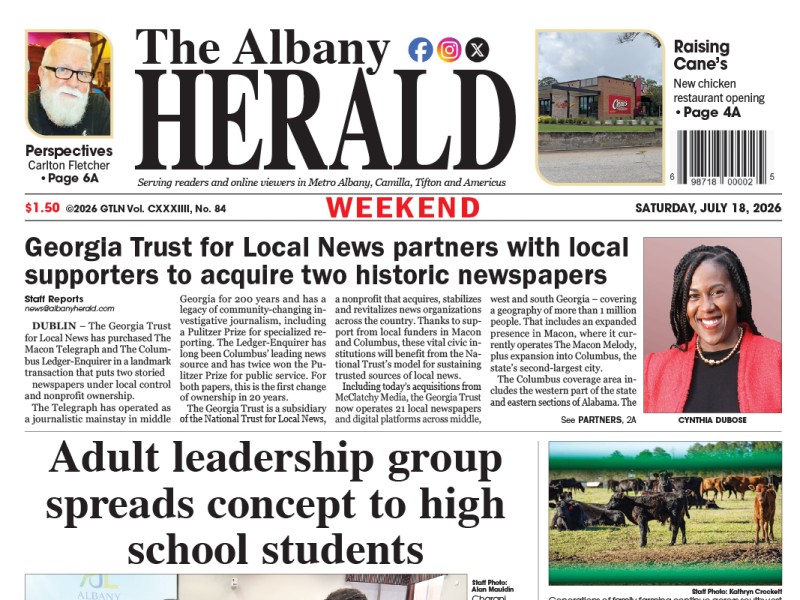
Albany Herald – July 18, 2026
Georgia Trust for Local News partners with… Adult leadership group spreads concept to… Lee County homeowners have until Aug. 1 to claim…

Classifieds – July 18, 2026
Classifieds; Legals;

Albany police make arrests in murder, robbery cases
Officials with the Albany Police Department have announced a number of arrests in cases that involved a homicide and a pair of thefts.
