
Willson Hospice House blends palliative health care with nature
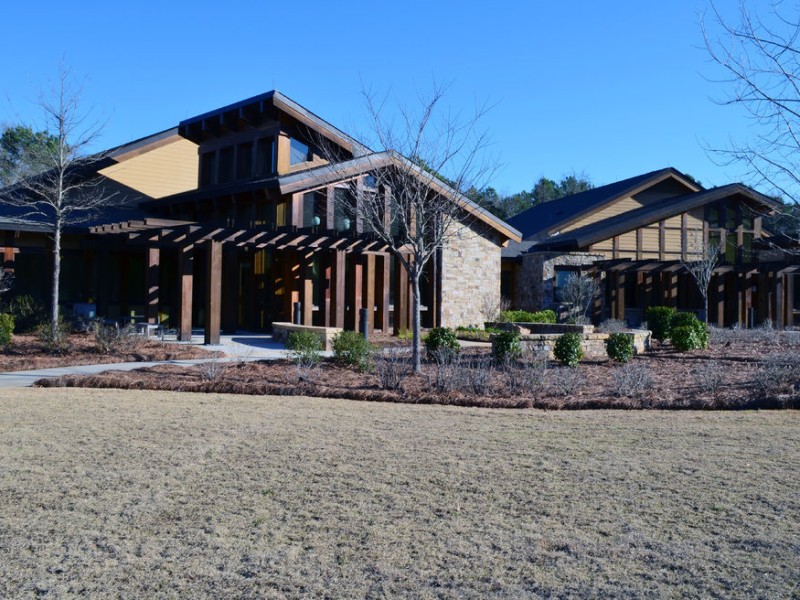
Willson Hospice House, located adjacent to Darton State College, has 18 patient rooms spread out over three pods to provide inpatient hospice care. (Staff photo: Jennifer Parks)
Jennifer Parks and Carlton Fletcher
ALBANY — There’s a special place in Phoebe Health System CEO Joel Wernick’s heart for hospice.
Hospice care has been defined as a special kind of end-of-life care that while administered is meant to neither hasten nor prolong death. Through the Willson Hospice House, Albany Community Hospice and Palliative Care provides hospice care on an inpatient basis to patients who live in Baker, Calhoun, Clay, Crisp, Dougherty, Lee, Mitchell, Quitman, Randolph, Terrell or Worth County and either have a terminal illness or are seeking comfort care after exhausting cure options.
“I always think of angels when I think of hospice,” Wernick said. “It brings to mind angels, hovering at a family member’s bedside, ready to assist.”
Willson Hospice House, which opened in May 2010 adjacent to Darton State College, is a 39,000-square-foot facility that includes 18 patient rooms in three separate pods. It was a $13 million undertaking that provided a new home to Albany Community Hospice. The inpatient care program is located on one side of the building, with a home care program for patients who are stabilized and able to return home operated from an administration area.
After officials “kicked a good bit of red dirt,” according to Wernick, to find the right setting for Willson Hospice House, philanthropy played a significant part in eventual construction of the facility. This included contributions from the Phoebe Putney Health System work force and the $1 million donation from Jane Willson and her family that became the singular lead gift securing its establishment.
“Our work force gave nickels, dimes, $5, $25 … $1 million total,” Wernick said. “Fifty percent (of overall funding) was through philanthropy and 50 percent was through hospital operations.”
Jennifer Stephens, the regional executive director of Albany Community Hospice, said that while Willson Hospice House is part of Phoebe Health System and Phoebe Putney Memorial Hospital, emphasis at the facility is making it a “non-hospital setting.”
“We encourage family members to be at the bedside of their loved ones, to touch and interact with them,” Stephens, a licensed social worker who has been executive director of Albany Community Hospice since June, said. “Our patient suites are made to look as much like a home setting as possible, and each one opens onto a patio that looks out onto our natural grounds.
“We’re green-certified with plenty of open, natural lighting, and some of the facility’s features include a private chapel, sun rooms, a family kitchen, a kids’ playroom and outdoor walking trails. Willson Hospice House is peaceful, quiet, conducive to family.”
Patient Care Coordinator Jennifer Roberts notes that even closets used for linen storage open both into the hallway and into individual patient suites so that staff do not enter patient rooms and disturb them.
“We also have a very small patient-to-health professional ratio, about one nurse for every six patients,” Roberts said.
Stephens said that while her staff of around 40 is crucial to the inpatient and home care received by referred patients under hospice care, an equal number of volunteers also plays an essential role.
“As important as our paid staff members are, our volunteers are equally as vital,” she said. “They do a variety of things that are essential to the overall well-being of our patients. They offer bereavement counseling, help patients achieve some of their ‘bucket-list’ items, run errands, cook and maybe one of the most important aspects of hospice care: They sit down and talk to the patients. Our volunteers are vital to the concept of maintaining dignity at this stage of patients’ lives.
“Most people look at a hospice facility as a place where patients come to die. I think Willson Hospice House is a place of healing, of warmth, of compassion.”
When Martistene Williams’ grandfather was in the latter stages of his life, the educator read an article in The Albany Herald that mentioned hospice care. Intrigued, she decided to look further into the concept.
“It’s a fact of life that people die,” Williams, who’s now been a hospice volunteer for 31 years, said. “I did research on hospice and end-of-life care and decided to volunteer. Albany Community Hospice has about a six-week training program, and I went through it at the same time I was going through a divorce. The classes ended up being a two-for-one deal for me. I found myself learning about patient care and how to deal with my own grief.”
Williams worked with a number of patients over the years, even bringing her young children along on some of her hospice deliveries. The experiences helped her deal with her sister, Marjorie Dent’s, recent terminal illness.
“When it came time for my sister to receive hospice care, I went from being her caregiver to being her sister again,” Williams said. “She didn’t want to stay at the hospice house, but I helped convince her that she needed the care they provided. We had some wonderful talks outside on the patio, talked a lot about her final days.”
Before Dent finally succumbed to cancer, she and her sister were able to mark a key item off Dent’s bucket list.
“Ms. Marty’s sister told us she wanted to go to the beach before she died, to put her feet in the sand and feel the ocean water,” Stephens said. “We helped her plan the trip, and they spent three days together at Daytona Beach. That was in July, and Marjorie died in September.”
Adds Williams: “Now I have to take her ashes to Daytona Beach.”
Williams lauds Albany Community Hospice’s bereavement program, which follows the progress of surviving family members of hospice patients some 13 months after their loved one’s death. The program also includes a memorial at the facility six months after each patient’s death.
Known for its emotional support, hospice is also meant to offer symptom control, specifically by alleviating the pain and distress sometimes associated with a person’s final days of life. The team at Willson Hospice House is made up of physicians, registered nurses, social workers, home health aides, chaplains, bereavement counselors and volunteers working in a setting that includes offices, a conference room, computer work stations and an employee break room alongside the common areas.
“All of us know that we deal with death in different ways, and for those who do it in an empathetic and direct way, community hospice like ours is health care at its best,” Wernick said.
In addition to symptom control, inpatient hospice care is offered as respite for patient caregivers. Patients stay up to five days at the facility while caregivers use the time to recover from the often physically and emotionally taxing experience.
“We encourage family caregivers to rest, recuperate and vacation while the patient receives the same kind of care they’d been providing,” Stephens said.
Nature was a significant aspect in the design of the Willson Hospice House, as was an effort to minimize the human footprint and promote biodiversity. Developed on 12 of nearly 210 acres, the facility gives access to the outdoors as a way to promote a calm and peaceful setting for patients and family members. It has a wood-framed building design inspired by Frank Lloyd Wright and features a decent amount of glass windows that provide open views to the outside.
“We spent a lot of time on the design to blend with nature,” Wernick said.
Built by Brasfield & Gorrie, Willson Hospice House was constructed to target Leadership in Energy and Environmental Design certification, which is meant to protect and enhance the site’s natural resources from beginning of construction through the lifetime of the property.
Shortly after the building’s opening, Phoebe Putney Memorial Hospital received certification from Audubon International for Willson as an Audubon Silver Certified Sanctuary, ensuring the building is designed to achieve both economic and environmental objectives as well as resource management practices applied to long-term stewardship of the property.
Stephens said that even in the beautifully designed Willson Hospice House and its peaceful surroundings, the reality that death is a part of the life cycle and grief over the loss of a loved one is a part of the process as well are never far from staff or patients’ minds. That’s the essential reason staff and volunteers at Willson Hospice House are trained to help patients and their family members deal with those parts of the process.
“This is a special place,” she said. “Our patients receive private, intimate care. They and their family members become a part of our extended family.
“We live in such a cruel world. To see goodness in this setting, to know there are still good people out there, is refreshing for us all.”
Related Articles

From cotton to cloud: In the data center debate, is rural Georgia once again being asked to carry the cost?
Across much of rural Georgia, the abandoned cotton warehouses and shrinking tax bases remain — enduring reminders that industries built to serve distant markets do not necessarily stay rooted in the communities that first sustained them.
Dawson Council approves $400,000 lifeline in emergency meeting as financial accountability remains elusive
Less than a week after city officials publicly acknowledged the City of Dawson cannot continue operating without additional financing, the Dawson City Council convened a hastily called emergency meeting Tuesday evening and unanimously approved authority to borrow up to $400,000 through a tax anticipation note.

Lee County homeowners have until Aug. 1 to claim property tax exemptions
Lee County homeowners have until Aug. 1 to apply for homestead and other property tax exemptions for the 2026 tax year, a deadline members of the Lee County Board of Tax Assessors highlighted Monday as they encouraged eligible residents to take advantage of available tax relief.
