
Albany Civil Rights Institute Dinner focuses on community
Event attracts largest crowd in Albany Civil Rights Institute’s history
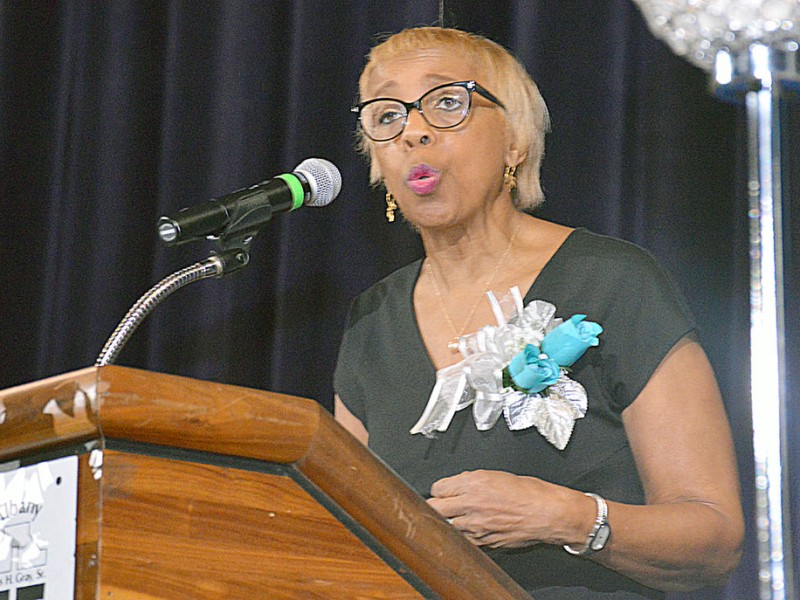
The speaker for the The ACRI’s Annual Boyd-Grant Community Service Dinner Friday was Carolynne Grant Williams, the daughter of late Mt. Zion Baptist pastor E. James Grant. She is canon for pastoral care for the Episcopal Cathedral of St. Philip in Atlanta. (Staff photo: Terry Lewis)
By Terry Lewis
ALBANY — Catch phrases like “one community” and “community involvement” can get tossed around quite a bit these days, but Friday night at the Albany Civic Center, those words took on meaning.
The largest crowd in the history of the Albany Civil Rights Institute was on hand for the 3rd Annual Boyd-Grant Community Service Dinner and, as ACRI Executive Director Frank Wilson surveyed the gathering from his perch on the elevated dais, he said he was struck by what he saw.
“When I looked across the floor, I saw every part of our community there. Bankers, lawyers, educators, black and white. How much money we raised is secondary to what I saw,” Wilson said. “I was looking at a community, and that is the most important thing — One Albany; the civil rights tent is big enough for us all. One Albany, we were truly One Albany last night.”
The speaker for the evening was Carolynne Grant Williams, the daughter of late Mt. Zion Baptist Pastor E. James Grant. She is currently the canon for pastoral care for the Episcopal Cathedral of St. Philip in Atlanta.
She brought with her Wilson’s message of community and a cautionary take about not forgetting lessons of the past.
“I’m excited to be here,” Williams said. Then, she held up a copy of former ACRI Executive Director Lee Formwalt’s book “Looking Back, Moving Forward.”
“This book is the story of how ordinary people became agents of change in the ’60s. It documents the history of the Albany Movement. I grew up attending Mt. Zion, and we lived across the street from (Shiloh Baptist Church Pastor H.C. Boyd) on Whitney. How we grew up in the ’60s is a whole lot different than what we see today.
“I graduated from Monroe High School in 1965. The Voting Rights Act was signed into law in 1964 and in 1965 the Civil Rights act was passed. The reason this book is so important is if you don’t know your history, you don’t know who you are.”
Williams then drew a comparison to life in the ’60s and today.
“The biggest difference is we were a community back then,” she said. “The same people went to church together, went to school together, went shopping together. We went to the mass meetings at Mt. Zion and Shiloh because that is where we socialized.
“We were a community. We seem to have forgotten that today.”
And that, Williams said, is a detriment to society as a whole and and has caused an erosion of that sense of community.
“All of us have a gift, and we must use this gift to help people,” she said. “Every person in this room works somewhere, but we are nothing without community. We are meant to help others. Take advantage of the time we are given.”
Williams then veered into the political world.
“I’ve never seen politics like we’ve got today,” she said. “If you are not registered to vote please go and register. We are now in a place where we can all support one another. If you are registered to vote, do it so we can help our children. Remember these are the kids who will be adults when you and I get old, and we’ll need them to take care of us.”
The ACRI handed out two Community Service Recognition Awards at the event — one to the Freedom Singers and the second to WALB-TV.



Related Articles
Improper payroll deductions among seven findings in Terrell school audit; corrective action planned
Terrell County school officials are working to correct payroll, purchasing and recordkeeping weaknesses identified in a fiscal 2025 audit, with Superintendent Shereca Harvey outlining the findings and additional reviews during an Oct. 6 school board work session.
A promise to one student grows into a districtwide pink-out
For two days in 2013, an eighth grader sat alone at the far end of a gym at Robert Cross School. When Tee Taylor asked what was wrong, Olivia Charles told her that her mother had breast cancer.

Dawson drops fire charge after Georgia Supreme Court ruling
Dawson will not implement its approved $8 monthly fire service charge following a Georgia Supreme Court ruling, and residents have never been billed for it, City Manager Roxie Powell said.
