
Federal appeals court orders second environmental study for Sabal Trail pipeline
United States Court of Appeals for the District of Columbia rules on pipeline controversy
By Jennifer Parks
ALBANY — The United States Court of Appeals for the District of Columbia issued an opinion on Tuesday stating that a second environmental review is needed for the Sabal Trail pipeline now being built through Southwest Georgia as well as in Alabama and Florida.
While the ruling does not provide a definitive idea of the ultimate outcome, some officials said it does offer an opportunity to learn more about the anticipated impacts of the project and make some alterations to existing plans.
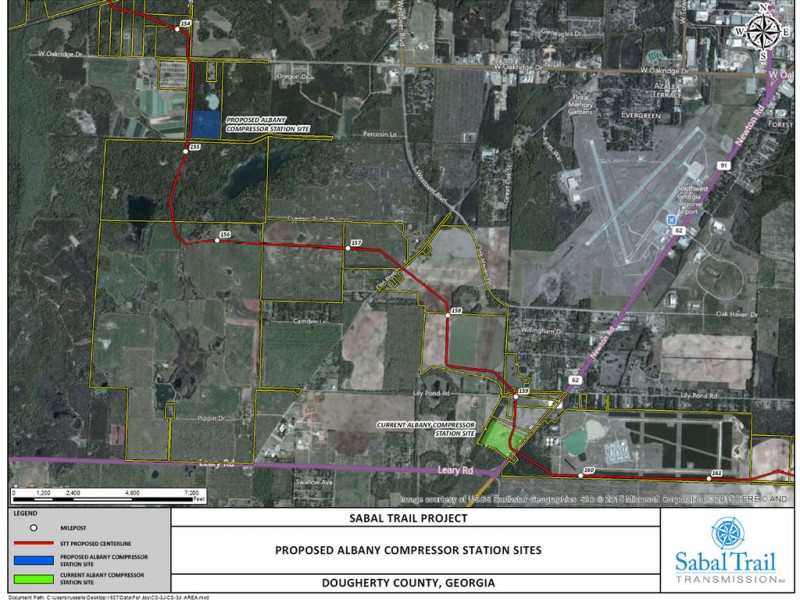
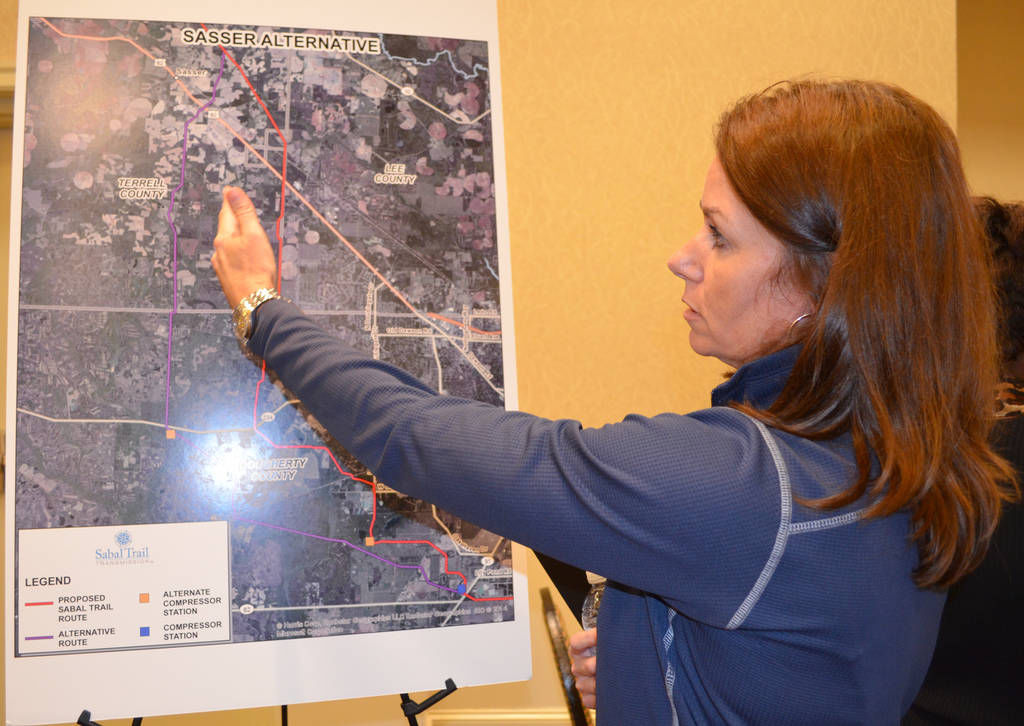
Dougherty County Commissioner Gloria Gaines said the court’s decision offers an opportunity for another look at plans for the trail, which include a compressor station that is to be built in a highly-populated area of Dougherty County.
“We don’t know what the alterations will be or how broad the scope, but at a minimum, we do hope it will look at alternatives (that will impact us),” Gaines said. “(My impression is that the review will) be confined to emissions. If it is just limited to that analysis, it will not help us on that.”
If the compressor is moved to a more remote area, Gaines said that is be an outcome she would be happy with.
“We would like to see it in a more remote area, and there are alternatives to that, but it would be more costly (for development),” she said. “(Also, taxpayers) bear the cost for (the pipeline’s) bottom line, and I am not comfortable with that.
“We will support the environmental groups as best we can.”
By its scheduled completion of the Sabal Trail pipeline in 2021, the project will be able to transport more than one billion cubic feet of natural gas per day. The project was the result of a demand for natural gas in populous areas of north Florida and has sparked controversy from several organizations, primarily environmental groups, contending it would hasten climate change and have potentially catastrophic consequences.
Landowners in the pipelines’ path have objected to the seizure of their property by eminent domain. Communities on the project’s route are concerned that pipeline facilities will be built in low-income and predominantly minority areas already impacted by industrial polluters.
The Federal Energy Regulatory Commission launched an environmental review of the proposed project in the fall of 2013. The agency prepared an environmental impact statement before approving the project, as the National Environmental Policy Act of 1969 requires for each “major federal action significantly affecting the quality of the human environment,” Tuesday’s court opinion said.
The Sierra Club argued to the appeals court that FERC’s environmental impact statement failed to adequately consider the project’s contribution to greenhouse gas emissions in an area “already overburdened with pollution sources” and its impact on low-income and minority communities. The group also contends that Sabal Trail’s service rates are based on an invalid methodology.
“We do not comment on pending litigation,” Andrea Grover, a spokeswoman for Sabal Trail Transmission, said on Wednesday of the opinion. “However, we do not anticipate that the court’s decision will have an adverse effect on Sabal Trail’s operations at this time.”
The landowners allege further oversights should have been part of the first study and assert that FERC used an insufficiently transparent process to approve the pipeline certificates.
In its opinion, the appeals court stated, “We see no deficiencies serious enough to defeat the statute’s goals of fostering well-informed decisionmaking and public comment,” and that the input of the public was taken seriously.
Court documentation shows the first environmental impact study explained that 83.7 percent of the pipelines’ proposed route would cross through, or within one mile of environmental justice communities, defined as census tracts where the population is disproportionately below the poverty line and/or disproportionately belongs to racial or ethnic minority groups.
The percentage varied from 54 to 80 percent for the alternative routes proposed by stakeholders and the public, with one option below 70 percent.
The study also considered four route alternatives proposed by the Sierra Club and its fellow environmental petitioners that would have partially or completely avoided Albany, but they were all rejected primarily on the ground that they would have had a greater overall impact on residences and populated areas.
FERC concluded that the alternatives “would affect a relatively similar percentage of environmental justice populations,” and that the preferred route thus would not have a disproportionate impact on those populations. The Sierra Club contends that the federal agency misread “disproportionately high and adverse” when characterizing the project’s anticipated impact on the population.
FERC has raised the argument that it is impossible to know exactly what quantity of greenhouse gases will be emitted. The appeals court said FERC “must either quantify and consider the project’s downstream carbon emissions or explain in more detail why it cannot do so.”
FERC held 13 public meetings on the project’s environmental effects and made modifications to the project plan in response to public concerns before releasing a draft impact statement in September 2015 and a final impact statement in December 2015.
Pipeline developers formally applied for certificates in September and November 2014. On Feb. 2, 2016, FERC granted the requested certificates and approved construction of all three project segments. Opposing parties, including the Sierra Club, sought rehearings and a stay of construction. The FERC agreed to hear their arguments but denied a stay.
Construction on the pipelines began in August 2016. On Sept. 7, 2016, FERC issued its Rehearing Order, denying rehearing and declining to rescind the pipelines’ certificates.
Sierra Club officials objected to FERC’s decision to allow Sabal Trail to base its rates on a “hypothetical capital structure,” arguing that, having concluded that Sabal Trail’s proposed return on equity was too high, FERC should either have cut the rate of return or denied the pipeline a certificate altogether.
The court found that FERC adequately explained its decision to allow Sabal Trail to employ a hypothetical capital and that the Sierra Club’s objection stems, in part, from “a misunderstanding of FERC’s role in the rate-setting process.”
Judges Judith Rogers, Janice Brown and Thomas Griffith heard the case. The vote was 2-1, with Brown dissenting in part.
Related Articles

Dougherty Jail graduates first class of female GED recipients
“It was an escape. I can say this has been challenging. I want to express my gratitude for being able to attend this program.”

From cotton to cloud: In the data center debate, is rural Georgia once again being asked to carry the cost?
Across much of rural Georgia, the abandoned cotton warehouses and shrinking tax bases remain — enduring reminders that industries built to serve distant markets do not necessarily stay rooted in the communities that first sustained them.
Dawson Council approves $400,000 lifeline in emergency meeting as financial accountability remains elusive
Less than a week after city officials publicly acknowledged the City of Dawson cannot continue operating without additional financing, the Dawson City Council convened a hastily called emergency meeting Tuesday evening and unanimously approved authority to borrow up to $400,000 through a tax anticipation note.
