
Willie Adams recounts journey from tobacco fields to Albany’s first black mayor

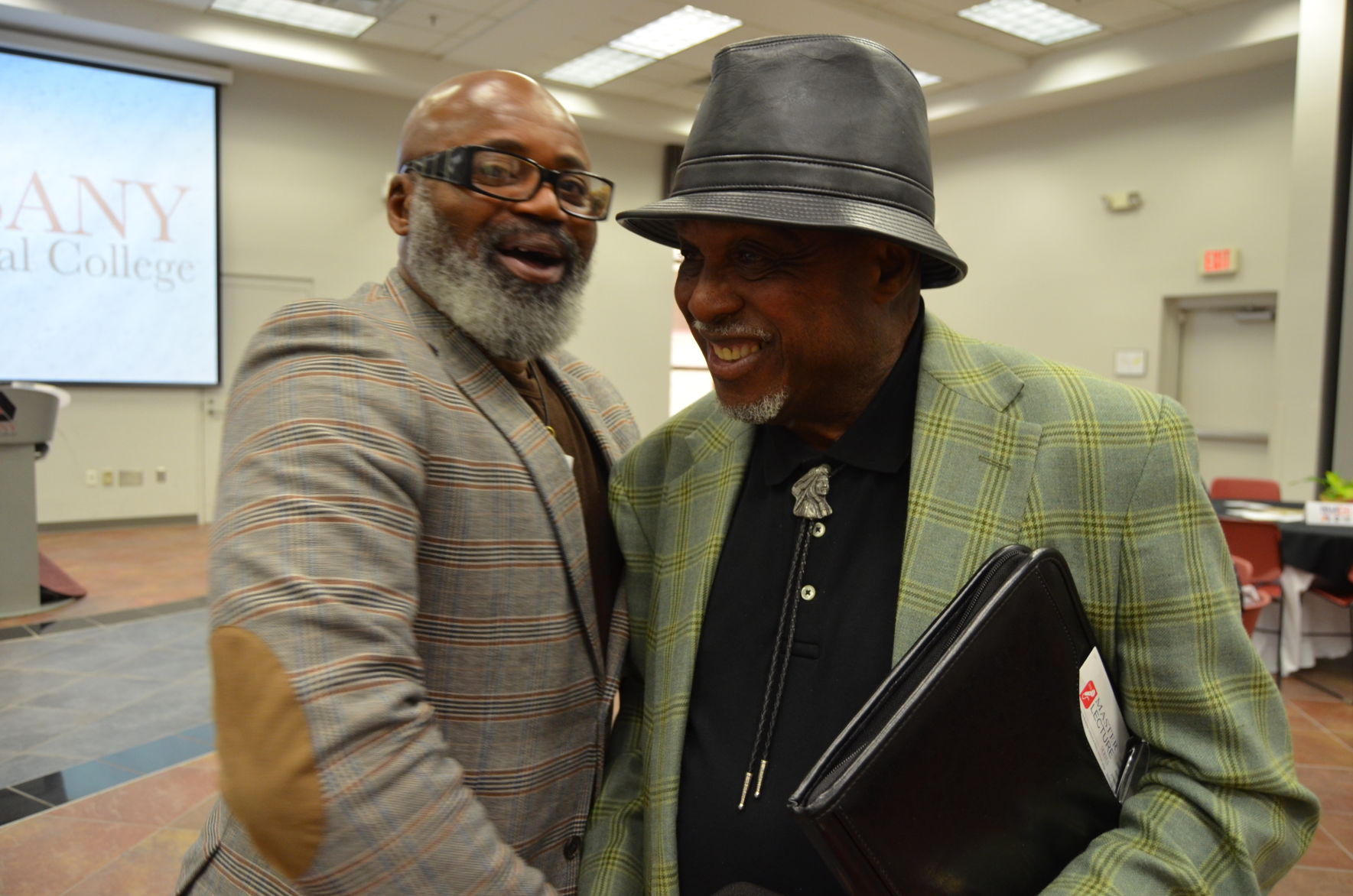
Staff Photo: Alan Mauldin
By Alan Mauldin
[email protected]
ALBANY — When former Albany Mayor Willie Adams told his mother on her deathbed that he wanted to be a doctor, the odds would have seemed stacked against him.
The son of a single mother with a sister seven years his junior, Adams was a teenager in high school when Maybell Lifred died of leukemia. Adams would become the first in his family to graduate from high school and, with his wife Constance working as a nurse to help him through medical school, he would fulfill the dream he shared with his mother during their final conversation.
The time was the mid-1960s in rural Florida, and for a poor black boy, many avenues were closed. He had started accompanying his mother to the field, earning $1 a day for carrying the cut tobacco, at the age of 6. But the values and faith that his mother instilled in him served as a blueprint.
“Maybell worked for $3 per day in tobacco,” Adams, the first speaker in a master lecture series being hosted by Albany Technical College, said during his Wednesday talk. “I don’t remember any strong hugs or kisses or bouncing on her knee, but neither do I remember going without.
“We lived in a house, had to call it a shack — no running water, no electricity, wooden windows. We had to bathe in a tin tub. A meal consisted generally of one item. You had beans or you had greens, and on a special occasion, chicken. But I never remember being hungry in my life.”
Adams then explained, for the younger members of the audience, what a slop jar is and how it was used, which explained the original title he suggested for his talk: “From the outhouse to the White House.” Adams accepted an alternate title suggestion: “From poverty to purpose.”
Lessons were simple. At the age of 14 or 15, Maybell gave Adams his sex education lesson.
“If you get a girl pregnant, you’re going to marry her,” Adams recalled her telling him.
Housing areas were segregated at that time, but that was in some ways a good thing, he said. When it was time for the evening meal, the mother of the children with whom he was playing after school let him know it was time to go home to eat. An elderly woman would remind him that he needed to go do his homework instead of shooting marbles all afternoon.
“Not only did they discipline you, they looked after you,” Adams said.
Adults and teachers were authorized to administer reinforcement with a belt or ruler when needed, he said.
“Before (his mother) passed — I want to explain this for you in the audience who are Christian — she said: ‘Son, what would you like to be when you grow up?’
“I said I would like to be a doctor. She said: ‘OK, take care of your sister.’ Her last words. I believe in predestination. Never did I realize (then) my life was determined at the moment she called me to her bedside.”
After completing high school and earning a degree from Florida Agricultural and Mechanical University in Tallahassee, Florida, Adams had to do a stint in the army during the Vietnam War era. He initially was steered toward helicopter pilot training in a class of 10, but medical personnel learned he had an issue with depth perception that disqualified him from flying.
So he ended up at Valley Forge General Hospital, where Dr. Kenneth D. Orr took an interest in the aspiring doctor. He made Adams a lieutenant in administration, where he could experience what doctors’ work was like.
“I consider him the father I never had because he followed me throughout my early career,” Adams said.
Adams also remembered other adults whose influence meant a lot, from a memorable English lesson by a teacher, to those who taught him to fish and hunt, a neighbor who took him in after the death of his mother, and a funeral director whose only charge for the arrangements was the wholesale cost for her casket when she died.
After graduating medical college in Tennessee, Dr. James Hubbard saw Adams read a research paper in 1973 and invited the aspiring doctor to join him in Albany. After visiting the city, Adams decided to take him up on the offer.
Adams, retired from medicine, estimated he delivered some 8,000 babies during his career. He also bought a farm in Terrell County and participated in various business interests.
In 2004, he received a new trajectory, thanks to two late-night bathroom visits, he said.
“Elected or selected?” he asked of his successful run for mayor. “ I say selected because I had a spiritual revelation. One morning at 4 o’clock, I was awakened from my sleep. I went to the bathroom as men are prone to do. It came across: ‘Get my people together.’ The next night, 4 a.m. I awakened and went to the bathroom. It said. ‘Run for mayor.’
“It was the easiest thing I’ve ever done in my life. Money became available. People became available. Because if He gives you an assignment, He will make the (resources) available.”
After serving two terms, Adams, the city’s first black mayor, said he didn’t hear the voice telling him to seek a third term, so he didn’t.
These days Adams, who has four grown children and seven grandchildren. He’s taken on a new special project. A friend called him about a young man living in Atlanta who had a single mother and father who had been killed who wanted an opportunity he wouldn’t receive.
“I said send him down,” Adams said. “I consider this to be an assignment.
“I’ve come to the conclusion that poverty is no excuse for failure. Even though growing up we didn’t have many material things, the community cared for you. I was taught work-fare, not welfare. Poverty can kill you or motivate you. I chose motivation.”
Author
Related Articles

Classifieds – June 20, 2026
ALBANY HERALD CLASSIFIEDS JUNE 20, 2026
Albany Herald – June 20, 2026
City Albany faces shortfall for police… Women’s Anchorage tentatively set to… Commissioner, school leaders clash over…
Public safety drives Leesburg’s $4.2 million Fiscal Year ’27 budget
The adopted spending plan reflects modest growth in city revenues and continued emphasis on maintaining core municipal services, particularly public safety and sanitation, which together account for a significant share of general fund expenditures.
