
Voters give thumbs down to three proposed Cobb cities
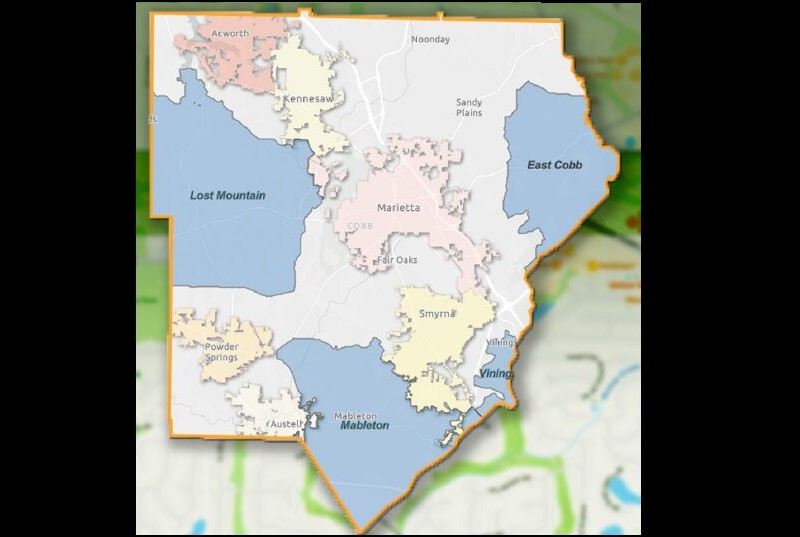
Map: Cobb County Government via Georgia Recorder
By Ross Williams
Georgia Recorder
ATLANTA — Efforts to carve three new cities out of Cobb County failed Tuesday night after voters shot down ballot measures in the eastern, western and southern portions of the suburban Atlanta county.
The proposed city of East Cobb failed by the largest margin with 5,900 in favor, good for 26.6% of the vote to 16,289 opposed, or 73.4%. Lost Mountain in west Cobb failed 42% to 58% with the anti side up over 4,000 votes, and Vinings in the south came closest to passing at 55% to 45%, decided by 255 votes out of 2,555.
“I think it was the right vote,” Marietta state Rep. Don Parsons, the sole Cobb Republican who voted against the legislation in the House that put the referendum on the primary ballot, said. “I think it was the correct vote on part of people within the proposed city limits to vote it down.”
Parsons does not live within the proposed city limits, so the question did not appear on his ballot and he did not campaign against it, but parts of his district were within one version of the boundaries and bordering others.
In a floor speech during the 2022 legislative session, Parsons questioned whether the proposed area was cohesive enough to make up its own city as well as whether the public support was there to do so.
Cityhood proponents said incorporating would allow residents to have more direct say in their government on issues like zoning. Cobb, once a Republican stronghold, has been at the forefront of Georgia’s shift to a purple state as younger, more diverse residents have been moving in.
Some long-time residents say they worry those new neighbors will bring big city problems like crime and traffic to their suburban haven, and proponents warned of looming threats like subsidized housing, laundromats and car washes being built adjacent to their bucolic back yards.
The no vote should not be interpreted to mean west Cobbers want that density, said state Rep. Ed Setzler, an Acworth Republican and sponsor of the bill to create Lost Mountain.
“One thing I know for sure is that, overwhelmingly, the citizens of west Cobb want to preserve the low-density rural, residential nature of west Cobb,” he said. “Overwhelmingly, 85 plus percent do. And the question was, is this objective better accomplished through a municipality, or is it better accomplished through maintaining our current government structures?”
Setzler says the correct answer is the former, and he charges the anti-city contingent with using conservative residents’ mistrust of government to dissuade them from supporting a measure he says would bring the people closer to their representatives.
Warnings of out-of-control density rang hollow to many of the voters Dora Locklear spoke with. She is chair of West Cobb Advocate, a group that opposed cityhood.
“When you show up and you talk to your commissioner, and you’re familiar with zoning, and you know how those decisions are made, then there’s no room for misinformation and assumptions because a city government cannot come in and just arbitrarily rewrite zoning laws. That’s why we have a future land use map,” she said.
Locklear said proponents exaggerated the threat of high density developments being built near their homes. Residents’ current elected official, District 1 Commissioner Keli Gambrill, has been a stickler about zoning, she said.
“There were 40-something cases that took place that involved District 1, in not one of those was she outvoted, and there was only one that was not a 5-0 vote,” she said. “And in fact, in 22 of the cases, applications were withdrawn after she told the developer or the applicant that their request did not meet the future land use map or zoning and therefore she would not be recommending for approval.”
Gambrill said Cobb Commissioners defer to colleagues who represent districts where projects are proposed.
Voters also were skeptical of claims their taxes would not increase, Locklear said.
“What made the biggest difference was when the voters and the people that we were connecting with connected the dots that the franchise fees that the feasibility study was claiming would make a $3 million surplus, once people understood who pays those franchise fees initially and they realized that they had been misled and they realized that it was coming out of their pocket, they were like, ‘No, this is not OK,’” she said.
Cityhood opponents also claimed the process for the three cities was rushed when compared with other cityhood measures including Milton in north Fulton County, which incorporated in 2006.
“This happened very, very quickly,” Bob Lax, a board member of the East Cobb Alliance, which opposed cityhood, said. “The substitute bill was introduced in January, it was voted on in February, it passed the governor’s desk by the end of February. That process in Milton was 14 months. So it was just run through super fast. There were a lot of unanswered questions. The financials of public safety were very concerning for most people, and they were concerned about losing those public safety services, which was my biggest concern as well.”
Smyrna Democratic state Rep. Teri Anulewicz compared east Cobb to its neighbor, Sandy Springs, which incorporated in 2005.
“With Sandy Springs, that process took decades,” she said. “And during that time, there were many, many, many open discussions of what exactly cityhood was going to mean to people who lived within the city limits, and that really didn’t happen with these cities,” she said.
A major bone of contention was the decision to place the measure on Tuesday’s ballot instead of November’s general election as originally planned. Opponents suggested the authors did so under the belief the primary would see higher turnout among Republicans, but the decision may have backfired, Anulewicz said.
“I think they were banking on lower turnout helping them,” she said. “What I think they vastly underestimated was the reality. I mean, everyone knows primary voters tend to be very educated, well-informed and motivated voters. And the cityhood movements clearly did not do an adequate job of making the case. The onus was on them.”
Setzler pushed back against that suggestion. The Lost Mountain vote was held in May so that, if the bill passed, residents could elect their first mayor and council in the November general election, which is likely to have higher turnout, he said.
Lax said he’s planning to petition legislators to take another look at how cities are created. He’d like to create rules specifying that a city’s feasibility study match what’s in the cityhood bill lawmakers vote on, that the studies must be peer reviewed and require a certain amount of time between the release of a study and when a bill can be voted on.
Locklear also wants state action, including expanding feasibility studies to a five-year window and requiring them to consider the fiscal impact on the county new cities exit from.
“We cannot continue to be creating or approving these little piecemeal governments all over the state,” she said. “That’s not what the Georgia constitution is set up for. If we could address it at a state level, it doesn’t mean that no cities would ever form again, what it means is that the cities would be constitutional, and the voters will be informed on what they’re voting for.”
For now, pro-cityhood residents have no recourse but to hope the Board of Commissioners stick with their agreement to honor residents’ desire for a green, uncrowded community, Setzler said.
Other Cobb voters have one last chance at establishing a new city this year, in south Cobb’s Mableton, where voters will be asked to consider incorporating in November.
Mableton briefly became a city in the early 1900s, but disbanded a few years later after a major flood necessitated more money than city coffers could provide.
The fate of Cobb’s other three proposed cities should be a wake-up call to Mableton proponents, Anulewicz said, but efforts there are not doomed.
The added time for discussion helps, she said, and so does the fact that, unlike the three failed cities, Mableton’s proposed city government would operate in a similar way as Cobb’s existing six cities.
“I would recommend that they do a pretty detailed inquiry and post mortem and talk to people to see what happened, because they have six months to make their case to the voters, and I think that the voters didn’t appreciate being rushed for these votes,” she said.
Author

Related Articles
PHOTOS: Albany State’s Got Talent
Click the arrow to scroll through the photos.
The Arc’s ‘beep ball’ tournament opens eyes to a new way of playing baseball
Beep ball is baseball for the blind.
PHOTOS: Albany’s Special Olympics send off
Click the arrow to scroll through the ephotos.
