
Albany State professors’ program helps former inmates with re-entry into society
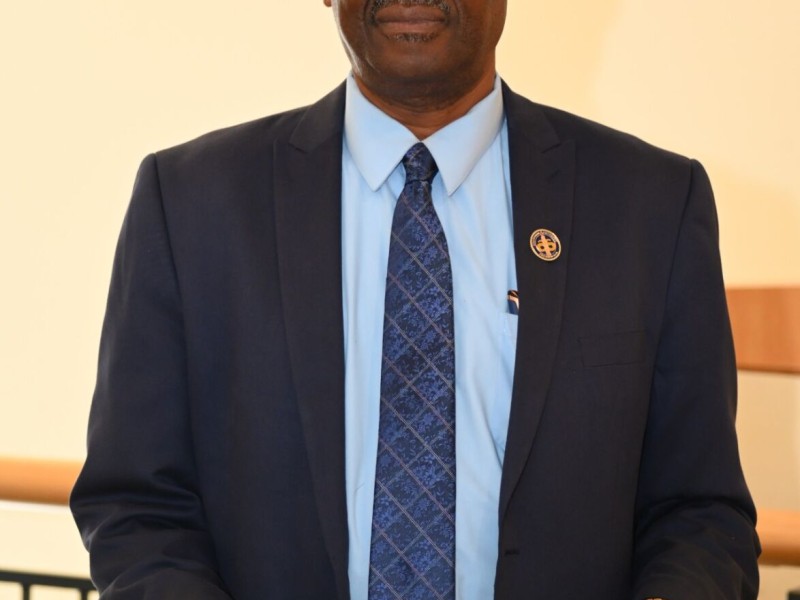
Special Photo: Reginald Christian/ASU
By Carlton Fletcher
[email protected]
ALBANY — Times have changed dramatically since Albany State University professors Charles Ochie and Patrick Ibe, who were alarmed by the growing number of men and women in the region coming out of prison with no family, no job, no money, nowhere to live … simply, people with little or no hope, decided to do something about the growing concern.
The pair started Albany Second Chance, a nonprofit that offers the previously incarcerated an opportunity at returning to society outside prison walls, in essence, a second chance at life, in 1999.
With a spark of interest in the issue of helping individuals avoid the siren song of recidivism ignited by a colleague, Ochie went from a passing interest in the issue to all-in, starting the nonprofit with a simple goal in mind: To lend a helping hand to people who, because of their actions, had been chewed up and spit out by society with scant hope of rejoining it.
“I’d read about recidivism and re-entry, but frankly I didn’t pay it a lot of attention,” Ochie, a Nigerian native who now has been in Albany for the better part of three decades, said. “Then a lady (Joyce Jordan) started talking with me about re-entry. I looked into some materials and decided I could do my part by helping to host a workshop.
“We did the workshop at Albany State University, and the room was full. I was overwhelmed, and it dawned on me right then that there was a great need.”
Ochie and Jordan formed a nonprofit to seek funding to help former inmates with re-entry, but Ochie said differences in how money should be spent and how to raise money in the first place led him to break away from that initial effort. A short while later, though, he and Ibe decided they wanted to continue the work, and Albany Second Chance was born.
“Back then, go back 10-15 years ago, having a criminal record was taboo,” Ochie said. “A background check was all it took; these individuals were typically turned away.
“Slowly, though, as the job market has changed and programs like ours have helped the formerly incarcerated, employers are a lot more open now to hiring someone with a criminal past. You see it especially at restaurants and big chain stores. People are starting to realize that a large percentage of people in Georgia have criminal records.”
Ochie, who now is the dean of Albany State’s Graduate School, was born in the Aguleri village of Nigeria. A rural area in the country located along Africa’s west coast, Ochie said life there centered around school and family.
“Pretty much every day, we’d go to school, come home, eat, play football, swim in the river and do our homework,” he said. “We were encouraged to set goals, and I decided at a young age that I wanted to go to school and get a degree. In our village, there was only one professor, and everyone looked up to him. Education is very important in Nigeria, and my plan was to get a degree, get a job and buy a car and house.”
Upon high school graduation, Ochie decided that attending college in Nigeria was too demanding with all the competition for slots in the academy there. He started looking abroad, initially thinking Italy might be the best place to go.
“Coming to the U.S. was never in my early vision,” he said. “I started looking at Italy, which was cheap enough, but to go there I would have to learn a new language. A friend of mine went to a school in America, ABAC (Abraham Baldwin Agricultural College in Tifton), so I applied there. I was admitted in 1984.”
Ochie, who said English was taught in Nigerian schools as early as the elementary grades, started his U.S. education career in marketing, then switched to journalism. It wasn’t until three semesters later, after he came to Albany State, that he decided to switch his major to criminal justice. He got his undergrad degree at ASU in 1987, completed requirements for a master’s degree in Sociology at Valdosta State University in 1989, and finished up with a Ph.D. in Sociology/Criminology at Oklahoma State University in 1993.
He taught for 2 1/2 years at Troy State University in Alabama, a year at West Virginia State University, and when a position teaching Criminal Justice opened at Albany State in 1997, he came back “home.”
At ASU, Ochie, who now has been at the Albany HBCU for more than 20 years, steadily moved from professor, to chairman of the Criminal Justice and Forensic Science Department, to director of the university’s Graduate School, to executive director of the Grad School, to his current position as dean of the school.
While finishing school at Oklahoma State, Ochie was told about two sisters from Nigeria who were living in Atlanta. He said he was not interested, given his dedication to finishing his education. But he did swap phone numbers with one of the co-eds, who impressed Ochie by calling him shortly after he arrived at Oklahoma State.
“We sent each other pictures, and she met all of my criteria,” Ochie said. “We kept talking, and six months later, we were married.”
Ensconced at ASU, Ochie and Ibe set up Albany Second Chance, a training program that provided heretofore unavailable options for former inmates. They offered expungement services to help the formerly incarcerated clean their records. They offered help in putting together resumes, in teaching interview skills, in grooming, in computer training, in basic financial services, in job searches.
They set up shop in the Arthur Williams Microbusiness Center and sought referrals from local law enforcement agencies, probation and parole officers, churches, and other organizations whose personnel worked with individuals dealing with re-entry issues.
Ochie, who has served on a number of local government-affiliated boards — including the Albany-Dougherty Inner-City Authority, the Downtown Albany Development Authority, the Albany-Dougherty Economic Development Commission, the Albany-Dougherty Planning Commission, the Southwest Georgia Regional Commission, the Albany Police Department Review Board and the area Crime Stoppers Board, to name a few — said he has been a leader everywhere he has lived, and he wants to use his leadership skills to serve his adopted home.
In Albany, he led the successful effort to “Ban the Box,” removing the item on job application forms that required applicants to indicate if they had a criminal record, the thought being that by checking that box, some potentially qualified applicants were disqualified before they even had a chance to talk to would-be employers.
“I’m a sociologist, and I know about humanity,” Ochie said. “I came to America from a country that did not offer a lot of opportunities, and there was a lot of lawlessness. I know that people are going to make mistakes; we all do.
“But I try to help people understand what a privilege it is to live in America. There are a lot of people in the world who would love to be here but couldn’t be. I try to visit my village every year and send money when I can, but Albany is my home, and I want to do things that will help people here. There is a great need here, and I feel helping others is something I should be doing. And I plan to do it until I have a problem getting out of bed in the morning.”
Author
Related Articles

From cotton to cloud: In the data center debate, is rural Georgia once again being asked to carry the cost?
Across much of rural Georgia, the abandoned cotton warehouses and shrinking tax bases remain — enduring reminders that industries built to serve distant markets do not necessarily stay rooted in the communities that first sustained them.
My Grandpa Was Killed in World War II. I Met Him Through His Letters Home
Gina Wolf’s grandfather died before she was born. His letters sent to her grandmother from Europe during World War II made it possible to know what kind of man he was.

‘Sounds Like a Mutiny.’ Secret Recording Exposes Claims of Toxic Leadership After a Marine’s Suicide
This week’s War Horse story follows the systemic failures before and after the death of Cpl. Drew Mobley who was the third in two years at Marine Corps Base Quantico to die by suicide.
