
CAES partners with Spelman College to build diversity in sustainable food systems
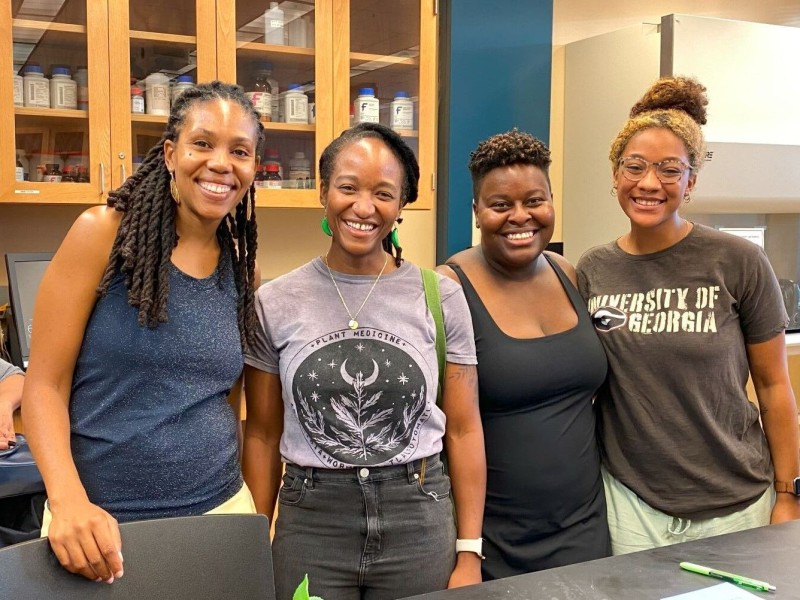
Special Photo: UGA/CAES
By Emily Cabrera
College of Agricultural and Environmental Sciences at the University of Georgia
ATHENS — For Jennifer Jo Thompson, finding solutions to meet the increasing global demands for healthy, affordable and accessible food requires an un-siloed approach in higher education and leadership. To both conserve natural resources and equitably sustain communities, Thompson’s approach draws from a diversity of backgrounds, disciplines and expertise.
An associate research scientist in the Department of Crop and Soil Sciences at the University of Georgia, Thompson is director of the Sustainable Food Systems Initiative and leads the Social Sustainability of Agrifood Systems Laboratory in UGA’s College of Agricultural and Environmental Sciences.
Representation and equitability are important to addressing the food system challenges that are disproportionately shouldered by nonwhite communities, Thompson said. According to the 2021 U.S. Department of Agriculture census, black households experienced food insecurity at nearly twice the rate of white, non-Hispanic communities. The census also showed that black-operated farms make up only 1.7% of U.S. farms, 0.5% of U.S. farmland and 0.4% of U.S. agricultural sales.
Despite the pressing need for diversity and equitability, Thompson said there is a notable lack of diverse talent in the nation’s leading food and agricultural science programs. The National Center for Education Statistics reported that only 3% of agricultural degrees awarded in 2019 went to black students, a statistic that parallels a gap in diverse employment among faculty at land-grant universities. And while predominantly white land-grant universities struggle to diversify faculty and student enrollment, historically black colleges and universities and minority-serving institutions have been identified as two of America’s greatest underutilized resources for strengthening the scientific workforce.
“Together, the ‘wicked problems’ of food system inequality and student underrepresentation point to the need to rethink and recast food and agricultural science education to expand both sustainability and diversity of the field,” Thompson said.
Now midway through a collaborative project funded by the USDA Higher Education Challenge Grant, Thompson is leading UGA’s Sustainable Food Systems Initiative in a collaborative project with the Food Studies Program at Spelman College, a historically black women’s college in Atlanta that offers a minor in the field. Thompson noted that many of the program’s graduates continue their studies in graduate programs in a range of fields, including food and agricultural sciences.
As an international leader in agricultural, environmental and horticultural sciences, UGA offers a wide variety of graduate degrees and research programs that could interest Spelman students, “but their alumnae often receive multiple competing offers for graduate funding. So the question is how do we make UGA an environment that Spelman students want to come to?” Thompson asked.
UGA and Spelman, who will equally split the $300,000 USDA award, are building a resilient partnership in hopes of increasing UGA recruitment of Spelman students who are interested in pursuing food and agricultural science graduate degrees.
Although institutions have attempted to address these challenges, few initiatives have been explicitly co-designed with, rather than for, people from various racial and ethnic backgrounds, Thompson said.
“We anticipate that this program will serve as a model for strengthening cross-institutional partnerships aimed at expanding racially inclusive curriculum and mentoring and increasing the representation of BIPOC (black, indigenous and people of color) undergraduate and graduate students in food and agricultural sciences programs,” she said.
Whitney Barr, who earned an undergraduate degree at Spelman and a master’s degree in landscape architecture at UGA with a certificate in sustainable food systems from CAES, now works as the food systems innovation fellow with the Atlanta Mayor’s Office of Sustainability and Resilience. As a graduate student at UGA, Barr worked with Thompson in 2020 through the National Needs Fellowship grant program. Drawing from her food systems work at Spelman, Barr examined past recruitment efforts Thompson and other faculty members used in trying to attract diverse applicants to National Needs Fellowship-funded graduate projects.
Using a synergistic strategy to build a durable, cross-institutional bridge, the Spelman faculty is expanding the learning community around food and agricultural sciences to increase scholarship among their students. In anticipation of increasing recruitment of Spelman graduates, UGA faculty members are working to build more inclusive curricula and mentorship skills for UGA faculty and graduate students through a series of professional development workshops.
“These workshops aim to provide faculty and future educators the knowledge and skills they need to ensure Spelman graduates and other BIPOC students get the kind of mentorship they’re looking for through graduate studies,” Thompson said.
Author

Related Articles

My Grandpa Was Killed in World War II. I Met Him Through His Letters Home
Gina Wolf’s grandfather died before she was born. His letters sent to her grandmother from Europe during World War II made it possible to know what kind of man he was.

‘Sounds Like a Mutiny.’ Secret Recording Exposes Claims of Toxic Leadership After a Marine’s Suicide
This week’s War Horse story follows the systemic failures before and after the death of Cpl. Drew Mobley who was the third in two years at Marine Corps Base Quantico to die by suicide.

Southwest Georgia artists recognized at packed opening of exhibition
The annual juried exhibition, one of the region’s largest showcases of visual art, features approximately 46 artists and nearly 90 works spanning painting, sculpture, ceramics, photography and mixed media.
