
Contemplating tombstones and our burial rituals
Special Photos: Doug Porter
By Doug Porter
Editor’s Note: First in a two-part series.
ALBANY — We had passed it on Interstate 85 before I realized what I had just seen. It was perched on a hill in the middle of the Exit 35 cloverleaf. Traffic was light on a Sunday afternoon, and for a moment I thought about turning around to explore it. Who, I wondered, had placed it there and how in the world had someone engineered a highway on-ramp to avoid it?
Then, as we drove on and my wife worked her crossword puzzle, my mind really went to work. Why do we need cemeteries in the first place, and why do we go to such extraordinary lengths to preserve them?
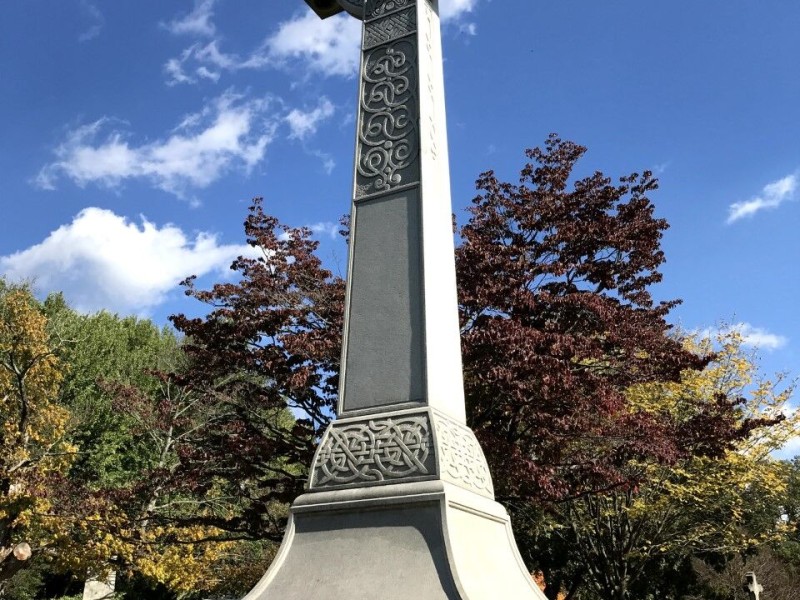
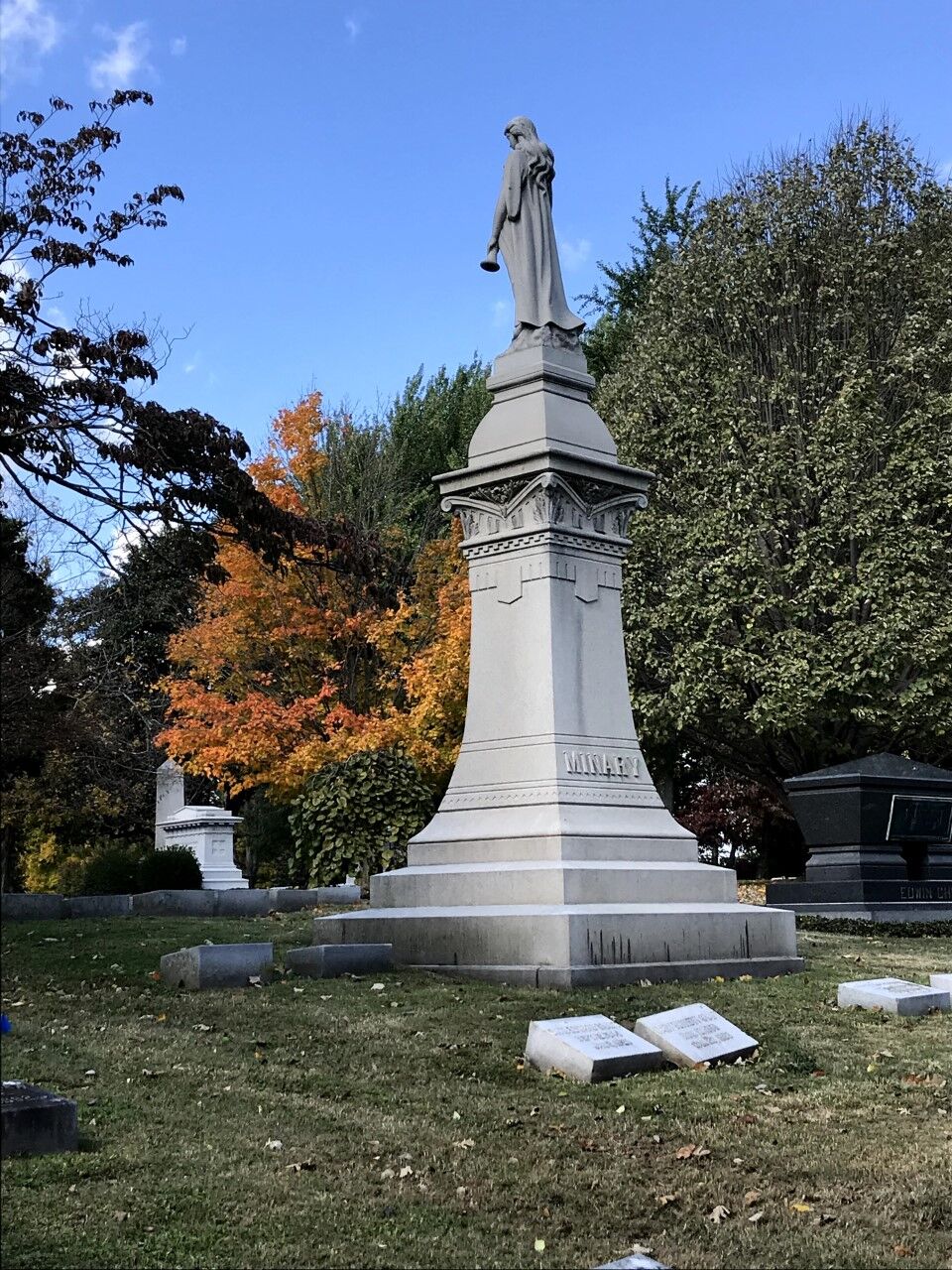
When my wife’s father passed away last year, we buried him in Louisville, Ky.’s Cave Hill Cemetery next to Karen’s mom. Elmer chose the site because it overlooked the property where he grew up. He had played on the cemetery grounds as a boy in the 1930s, and his father had even grazed Liebert Brothers Dairy cattle there before graves began expanding into the area of the property and a wall was erected.
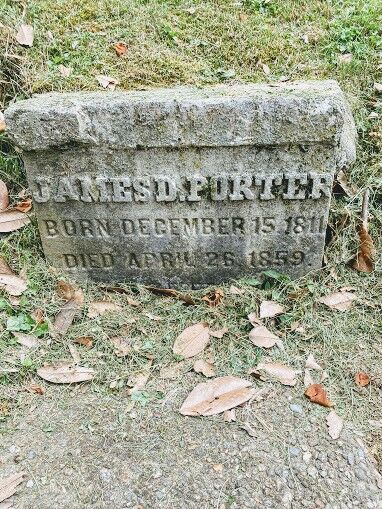
Cave Hill Cemetery is a 300-acre, pre-Civil War-era National Cemetery and arboretum. With its lush plantings, scenic lakes, and sweeping vistas, it is more like a public park than a place where the likes of Col. Sanders and Muhammed Ali are interred. A man by the name of “Big Jim” Porter was buried there in April 1859. I identify with him by more than sharing a name. James D. Porter was also known as the Kentucky Giant. He stood 7 feet ,8 inches tall and weighed 300 pounds. I had to snap a photo of his gravesite.
The word cemetery comes from the Greek word for “sleeping place.” It is a word that originally applied to places like the Roman catacombs and implies that the land is specifically designated as a burial ground. The term “graveyard” is often used interchangeably with cemetery, but a graveyard primarily refers to a burial ground within a churchyard.
The modern cemetery probably originated about a thousand years ago in Europe, when burials were under the control of the church and could take place only on consecrated church ground. When churchyards began to fill up in the early 1800s, new locations were developed outside the population center. These early cemeteries were professionally designed, elaborately landscaped, and served as the first recreational areas in a time before public parks came into use.
Modern cemeteries offer a space that brings comfort to families as they struggle with their grief while remembering loved ones. They provide a serene environment in which to place flowers and remember the person who has passed.
All four of my grandparents are in Memorial Park Cemetery on 49th Street in St. Petersburg, Fla. I could visit their graves anytime and pause in remembrance. I visit my granddaughter’s grave in Louisville whenever I am there. It is comforting to see her name etched in stone and remember her laughter and sweet disposition.
My parents, on the other hand, chose to be cremated. My brothers and I spread their ashes — half outside their cabin in the mountains of Western North Carolina and half at the St. Petersburg beach that we frequented growing up. They have no headstones, monuments, or markers, but for me, sitting in the sand at Pass-A-Grill Beach and reliving my childhood memories is at least as comforting as standing in a cemetery and looking at a granite marker.
I am not opposed to cemeteries, but I don’t plan to have a headstone in one. My wife and I have talked about cremation rather than burial, but cremation seems a needless waste of fossil fuels. That is why we are also investigating more environmentally friendly options.
We could donate our bodies to science, an option that might contribute to the advancement of science and medicine. I wonder what name those med-students would give to my long, skinny cadaver. The name that comes to my mind is the tall, cadaverous Addams Family butler “Lurch” — a nickname that was hung on me in high school.
We briefly considered something called Alkaline Hydrolysis — a water-based dissolution process that uses heat, pressure, and alkali chemicals to gently break a human body down into chemical compounds. But as people who love nature and the outdoors, there are some even more attractive ways to become one with the earth.
We could be buried in something called a mushroom suit — a natural burial shroud made from biodegradable mushrooms and microorganisms. These organic materials aid in body decomposition and neutralize toxins, releasing nutrients into the surrounding environment and promoting new growth. Or we might consider human composting, a process that uses “organic reduction” to convert a human body into soil.
It sounds almost too simple. The body is covered with natural materials such as straw and wood chips and left to decay. The resulting microbial activity breaks it down into clean, odorless soil that’s free of pollutants and toxins. We have been composting organic material for our garden for years. I kind of like the idea that someone will haul my worn-out carcass to the backyard and let it turn back into soil for their garden.
The cemetery inside the I-85 cloverleaf at Exit 35 is the John Coggin Meadows Cemetery. Meadows apparently bought the land on which the graves are located in 1838 for $500. The property in Coweta County was passed down through the family and eventually sold many times, but always with the exception of a small plot at one corner of the lot — a section that came to be known as “the Old Meadows Cemetery”.
When the Department of Transportation was planning the right of way for Interstate 85, surviving members of the Meadows Family objected to relocating the cemetery. The DOT agreed to preserve it and, judging by the fresh flowers and new gravesites, it is still sacred ground to the family. But the garden-like atmosphere left when the interstate highway arrived.
The Easter season and the empty tomb seem an appropriate time to consider our own mortality. Honoring and remembering the departed is an important part of our culture. But cemeteries take up space. And someday when all who know us are gone, what will be the purpose? I wonder about our tenacious insistence on having an “eternal” resting place, as though that plot of ground is where we will reside for eternity.
A hundred years from now, nobody is going to be looking for my grave, anyway. The only problem might be that someone in Louisville — where I lived for a while — might visit Cave Hill Cemetery and mistake me for another James D. Porter. He died 90 years before I was born, and he was known as “the Kentucky Giant.” I’m a foot shorter and a hundred pounds lighter than he was, and after a lifetime of being teased about my height, I don’t particularly want to spend eternity being known as a “giant.”
Author
Related Articles

From cotton to cloud: In the data center debate, is rural Georgia once again being asked to carry the cost?
Across much of rural Georgia, the abandoned cotton warehouses and shrinking tax bases remain — enduring reminders that industries built to serve distant markets do not necessarily stay rooted in the communities that first sustained them.
My Grandpa Was Killed in World War II. I Met Him Through His Letters Home
Gina Wolf’s grandfather died before she was born. His letters sent to her grandmother from Europe during World War II made it possible to know what kind of man he was.

‘Sounds Like a Mutiny.’ Secret Recording Exposes Claims of Toxic Leadership After a Marine’s Suicide
This week’s War Horse story follows the systemic failures before and after the death of Cpl. Drew Mobley who was the third in two years at Marine Corps Base Quantico to die by suicide.
