
Five UGA undergraduates offered 2023 Boren Scholarships
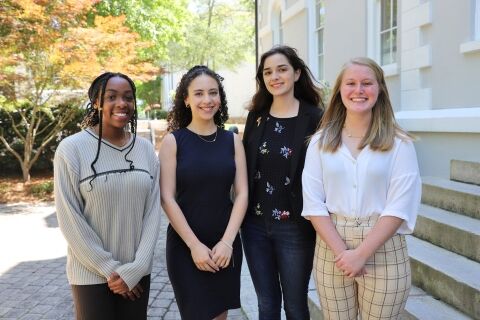
Special Photo: Stephanie Schupska/UGA
By Alan Flurry
UGA/CAES
ATHENS — The Boren Scholarships are designed to add important international and language components to students’ educations by giving them the opportunity to study overseas in world regions critical to U.S. interests.
The national initiative is administered by the Institute of International Education on behalf of the National Security Education Program. Boren recipients commit to working in the federal government for at least one year after graduation in exchange for up to $25,000 in funding.
For the third year in a row, the Boren Awards named the University of Georgia a top-performing institution for Boren Scholarships. With five UGA undergraduates selected as Boren Scholars this spring, UGA is ranked in the top five of institutions nationwide.
The UGA students named as Boren Scholars for 2023 will study three different languages — Arabic, Swahili and Russian — in three distinct regions of the world.
UGA has had 94 Boren Scholarship and Fellowship offers to date, and 57 in the last 10 years. The university also was named a top-performing institution for Boren Scholarships in 2021 and 2022.
“Our students are excelling at critical language studies, and we are proud to be among the top institutions for Boren Scholarships,” Meg Amstutz, dean of the Morehead Honors College, said. “I am grateful for the support of their faculty and the Office of Global Engagement. The university continues to develop global citizens through its strong commitment to the study of critical languages.”
In 2023, 210 undergraduates across the country received Boren Scholarships, and 108 graduate students received Boren Fellowships. The selected Boren Scholars and Fellows intend to study in 43 countries — with the top countries being Taiwan, Kazakhstan, Jordan, Japan, Morocco, South Korea, Tanzania and Brazil. They will study 33 different languages; the most popular languages include Mandarin, Arabic, Russian, Portuguese, Korean, Swahili, Turkish, Japanese and Indonesian.
Faculty and staff in Franklin College units worked to provide instruction opportunities in Arabic (department of religion), Swahili (the department of comparative literature and intercultural studies), Russian (department of Germanic and Slavic studies), and Portuguese (Latin American and Caribbean Studies), as well as many other languages.
Author

Related Articles

My Grandpa Was Killed in World War II. I Met Him Through His Letters Home
Gina Wolf’s grandfather died before she was born. His letters sent to her grandmother from Europe during World War II made it possible to know what kind of man he was.
‘Sounds Like a Mutiny.’ Secret Recording Exposes Claims of Toxic Leadership After a Marine’s Suicide
This week’s War Horse story follows the systemic failures before and after the death of Cpl. Drew Mobley who was the third in two years at Marine Corps Base Quantico to die by suicide.

Southwest Georgia artists recognized at packed opening of exhibition
The annual juried exhibition, one of the region’s largest showcases of visual art, features approximately 46 artists and nearly 90 works spanning painting, sculpture, ceramics, photography and mixed media.
