
Incorporating alfalfa in forage systems could lead to environmental benefits
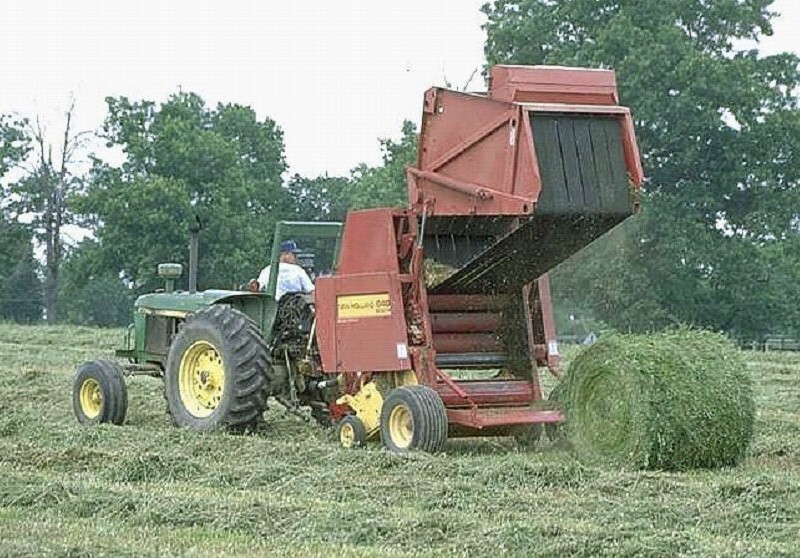
Special Photo: UGA/CAES
By Maria M. Lameiras
CAES News
TIFTON — Alfalfa, once a dominant forage in Georgia, is the third-highest crop for economic returns in the United States. Combined with cheap nitrogen prices, difficulty growing the desirable forage crop in Georgia’s challenging climate led to a decline in alfalfa production in the state after its peak in the 1960s.
Now University of Georgia grazing specialist Jennifer Tucker is doing her part to restore alfalfa production to the state for the benefit of both producers and the land.
Tucker, an associate professor in the Department of Animal and Dairy Science in the College of Agricultural and Environmental Sciences, is working with colleagues from Auburn University, the University of Florida and the University of Tennessee on grants from the U.S. Department of Agriculture’s National Institute of Food and Agriculture Alfalfa Seed and Alfalfa Forage System Program to develop best management practices to restore grasslands and sustainably increase alfalfa production in the Southeast.
“There are many positive benefits for increased alfalfa production, but they’re all very much linked to improved land and animal performance and sustainability of grazing systems,” Tucker, who runs the Better Grazing Program on the UGA Tifton campus, said. “We are looking to improve alfalfa establishment in perennial grasses and the varied uses of alfalfa grass systems either for harvest as baleage or for grazing.”
In Georgia’s humid environment, weed control, as well as disease and insect pressure, caused producers to move away from using alfalfa, but long-time UGA plant breeder Joe Bouton spent years developing alfalfa varieties that grow well in the region, Tucker said.
“Currently all of the evaluations in Georgia are using alfalfa varieties developed by Dr. Bouton that were bred specifically for disease and insect resistance, as well as the heat and environment in Georgia, increasing alfalfa’s adaptation and ability to survive tough growing conditions,” she noted.
In recent years, Tucker’s program has been awarded multiple USDA-NIFA Alfalfa Forage and Research Program grants focused on increasing the use of alfalfa in the region. The most recent awards will culminate in a five-year project that will measure how much carbon is being sequestered in these alfalfa systems, as well as how it influences nutrient cycling in the soil and in the grazing animals.
Alfalfa is used as a feed source for dairy and beef cattle and can reduce the need for costly nutritional supplements when cattle are primarily fed other types of diets, Tucker said.
“Our work is focused on increasing alfalfa utilization in Georgia and across the Southeast to restore grasslands while adding a profit point into pastures or hay fields, land our producers are already investing in, to provide alfalfa as a high-quality feed source,” she added.
Tucker has worked with many producers in Georgia to incorporate alfalfa into Bermuda grass forage systems, but this research will provide more concrete data to guide producers in establishing and managing alfalfa grasslands.
Beginning in late September, Tucker’s team began working on a university-industry collaboration with Forage Genetics International to introduce alfalfa into research fields at the UGA-Tifton Animal and Dairy Science farm that have been used in field crop production for almost two decades to determine how alfalfa production can improve soil health and carbon sequestration.
“We’re taking this land out of annual crop production for livestock feed and putting it into a short-term perennial forage crop for livestock feed — that’s the advantage of the alfalfa crop, you’re going to have it for five to seven years in this area with no soil disturbance,” Tucker said. “We know forages are great for carbon sequestration, but now we want to draw that picture more clearly. Especially with the carbon emission discussions that are going on and the carbon credits movement, we don’t have any way to actually quantify a lot of this information.
“We see a lot of people who are in animal livestock forage areas, and that’s where you’re seeing your greatest carbon effects in the ground — because they’re not reserving those areas just for crops. They’re utilizing that animal for the benefit of the system. The industry is very interested in seeing the results of this.”
Tucker said she became interested in the carbon-capturing potential of her work in forages after learning about experiments in which men’s cotton underwear (think “tighty-whities”) are buried in various soils under different management systems to see how active the soils are by how degraded the cotton is when it is dug up later. In healthy, active soils, the process happens fairly quickly — some changes can be seen in as little as a week — but most tests last much longer to get a good representation of soil activity.
“Some of these soils have so much activity that all that is left is the elastic waistband,” Tucker said. “Basically, this is to show that, if you have really healthy soil that has all the things in it that are doing what they’re supposed to and working together, it will degrade the cotton. And if not, then you just have dirty underwear.”
The new focus on carbon capture and the environment is bringing validation to age-old agricultural practices, including the incorporation of livestock into growing systems to improve soil fertility and productivity.
“Livestock systems are contributing to carbon sequestration, probably as much if not more than the concern with greenhouse gas emissions,” Tucker said. “Much of it is looked at from a negative perspective, but there are things being done within the animal production industry that are offsetting a lot of these concerns that have been advertised as harmful to the environment.”
The Tifton research team’s recent addition of animal and dairy science assistant professors Francine Henry and Darren Henry will expand collaborative work on forage and livestock systems from beginning to end with a focus on the different aspects of grazing systems, feeding systems and methane emissions in livestock production from “pasture to plate.”
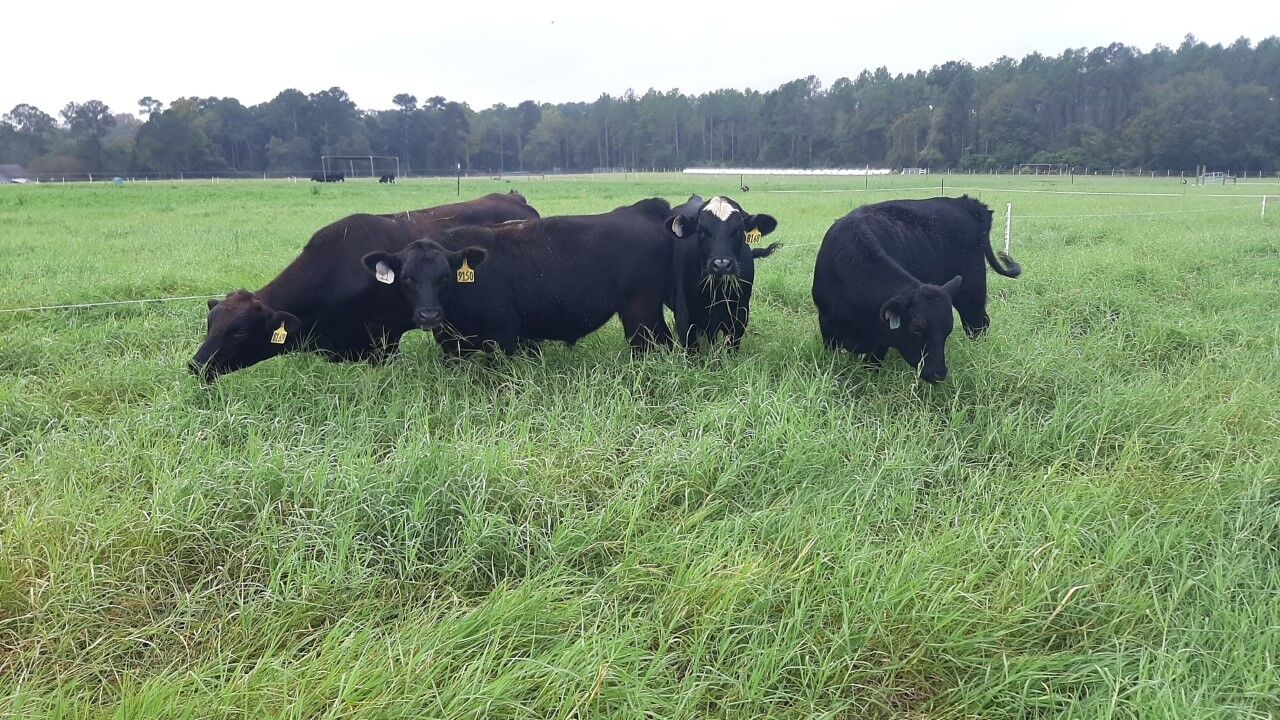
Rotational or management-intensive grazing is a core principle in many of Tucker’s research projects.
“If you had one field and you just put all your cattle in that and left them, depending on the number of animals you had, eventually they will continue to remove plant material and you get down to bare ground, which is creating problems in the soil,” she explained. “If we rotationally graze, we would take that same area of land and split it up into four pieces. You put your cows in this piece for a week, then rotate them into another section every seven days. Now that first section has had 28 days to rest and regrow and you are getting high-quality forage for that animal. It is a management tool for forages that benefits the land and the animals.”
While installing permanent fencing to facilitate rotational grazing could be cost-prohibitive, Tucker said there are many tools available to help mitigate costs, such as temporary fencing that is easily moved.
“There is technology out there that makes these practices easier to implement and maybe that’s why we’re seeing that increase,” she said. “We have mobile technologies that now make these practices easier to achieve. Nothing we do is new; it’s just how we repurpose what we are doing with newer technology.”
Related Articles

My Grandpa Was Killed in World War II. I Met Him Through His Letters Home
Gina Wolf’s grandfather died before she was born. His letters sent to her grandmother from Europe during World War II made it possible to know what kind of man he was.

‘Sounds Like a Mutiny.’ Secret Recording Exposes Claims of Toxic Leadership After a Marine’s Suicide
This week’s War Horse story follows the systemic failures before and after the death of Cpl. Drew Mobley who was the third in two years at Marine Corps Base Quantico to die by suicide.
Southwest Georgia artists recognized at packed opening of exhibition
The annual juried exhibition, one of the region’s largest showcases of visual art, features approximately 46 artists and nearly 90 works spanning painting, sculpture, ceramics, photography and mixed media.
