
Tifton church’s labyrinth leaves visitors open to religion, spirituality
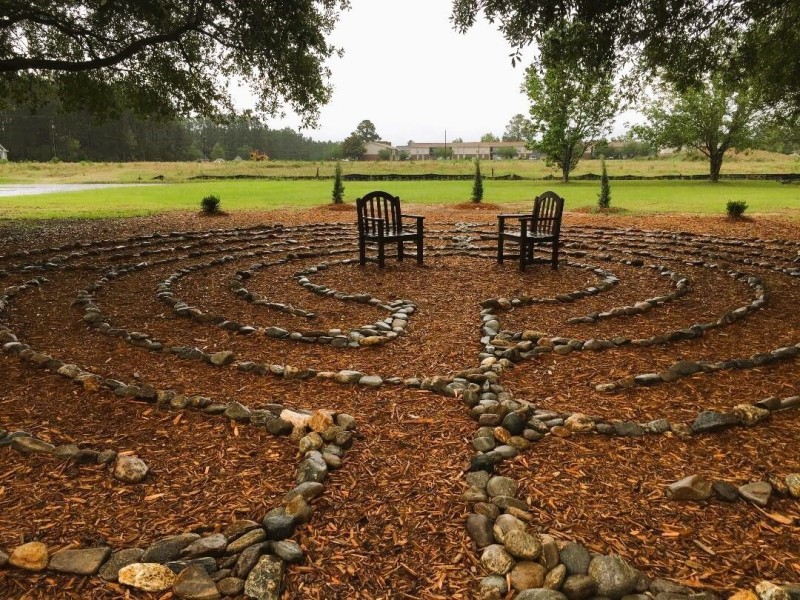
Special Photo: Ellen Richardson
By Tara Fletcher
[email protected]
TIFTON — I am not a particularly religious person. I believe there are good things to be found in all religions, but I’m not sure who or what “God” is. I am also not a churchgoer, but through my son and daughter-in-law, I have taken part in a baptism and children’s Christmas program at St. Anne’s Episcopal Church in Tifton.
I found the historic pageantry of the services to be beautiful and interesting, but still I was not moved to change my religious views.
But, one day, my son told me something that made me think: If ever there was a church for me, it would be St. Anne’s.
He said he had gone for a run to St. Anne’s, where he had walked to the center of the church’s labyrinth and sat to meditate. I had never heard of a church with a labyrinth or of one encouraging meditation. I wanted to know more.
In 2016, St. Anne’s officials brought in a canvas labyrinth (on loan from St. Barnabas’ Church in Valdosta) to see how their congregation would respond. While on loan, the indoor labyrinth was used in programs for children, youths and adult congregants.
Once the labyrinth was returned to St. Barnabas’, a report was written, by the sabbatical/labyrinth group, about the experience. They found that both the youths and children’s groups were “attentive and receptive” to the labyrinth experience, but the adult participation was very low. Assessing the information in a later meeting, the group decided that a labyrinth “attracts more people of an introverted nature,” and for it to be effective, it should be accessible at all hours.
They decided to build a semi-permanent labyrinth that was available to anyone at any time. The labyrinth was built and opened to the public in early 2017.
But, of all things, why a labyrinth?
Ellen Richardson, the assistant rector at the time the labyrinth was built, responded to an inquiry with the following:
Why a Labyrinth?
Difference between religion and spirituality: Religion is the outward container with the processes of liturgy, acts of worship that teach, praise and giving thanks to God. Spirituality is the inward activity of growth and maturation that happens within each of us.
If we are spiritually healthy, our religion upholds and supports our spirituality. Spirituality without religion risks loss of focus and purpose. Religion without spirituality risks shallow idolatry to dogma and habits of practice.
When we are open to both religion and spirituality, we try to know meaning and purpose in what we believe, and what we do to grow in wisdom and compassion.
We are born with a sacred imagination to help us seek and understand mystery. The longing to know and understand the mystery of God leaves us adrift in the world when we neglect to nourish and nurture that soul/heart part of ourselves that we need for our sacred imagination to flourish.
We seek guidance to walk our sacred path to find the invisible thread to the God within us that has long been ignored or forgotten and need touchstones to help us: silence, music, poetry, nature, rest, freedom from distraction and meditation to help us release our self-focus are just some touchstones. A labyrinth is just one kind of touchstone or tool that can illuminate our own individual sacred path.
Labyrinths in one form or another have been found all over the world, the oldest pattern dating more than 3,000 years ago. They have been found on clay tablets and carved into massive stones and on 2,000-year-old coins in Crete and in Egyptian tombs. There are theories that labyrinths are connected to the universal experience of looking to the night sky for common patterns. They were constructed in mosaic by the Romans and built into the ground on isolated islands in Scandinavia.
The earliest use of labyrinths in Christianity was in the Middle Ages when the labyrinth was built in the church in Chartes, France, some time in the 12th-13th century. Christian adaptation of earlier labyrinth patterns created a larger center, switchback turns and symmetry.
The labyrinth as symbol of the sacred path can be seen as a three-part journey:
- The journey in from the beginning to the center is for releasing, emptying, quieting, shedding, letting go of the things we try to control;
- The second part is found in the center, a place for meditation and prayer, opening of heart and mind, coming to clarity as individual lives or heartaches are illuminated as if transformed by God;
- The third part is the way back from the center to the beginning, following the same path that brought us in. This is a time of grounding, healing, empowerment, insight, energy, replenishment and reintegration of contemplation with action in the world.
After experiencing this ancient path, I found it to be very forward-thinking. If you visit St. Anne’s labyrinth, at the beginning, you’ll see a sign with these things to remember:
The path is wide and gracious. It takes as long as it takes. It is OK to move with others at different paces, to pass or to step aside for others. It is OK to cry, to stop when needed, to struggle.
Before you begin:
♦ Take off your shoes (for an indoor labyrinth/socks are OK);
♦ Turn off your phone;
♦ Be aware of your breathing; slow it down;
♦ Let your intrusive thoughts go;
♦ Take your time;
♦ Listen in your own silence.
By the time you come to the end of the labyrinth, you may have found your new favorite place.
Related Articles

From cotton to cloud: In the data center debate, is rural Georgia once again being asked to carry the cost?
Across much of rural Georgia, the abandoned cotton warehouses and shrinking tax bases remain — enduring reminders that industries built to serve distant markets do not necessarily stay rooted in the communities that first sustained them.
My Grandpa Was Killed in World War II. I Met Him Through His Letters Home
Gina Wolf’s grandfather died before she was born. His letters sent to her grandmother from Europe during World War II made it possible to know what kind of man he was.

‘Sounds Like a Mutiny.’ Secret Recording Exposes Claims of Toxic Leadership After a Marine’s Suicide
This week’s War Horse story follows the systemic failures before and after the death of Cpl. Drew Mobley who was the third in two years at Marine Corps Base Quantico to die by suicide.
