
Albany State receives National Science Foundation grant

Special Photo: ASU
From staff reports
ALBANY — Albany State University received $199,997 from the National Science Foundation Catalyst Program. The grant “Technically Speaking: Building Scientific Communication Self-Efficacy” will focus on improving science, technology, engineering, and mathematics students’ academic competency and science efficacy. The project’s goal is to support and retain undergraduate STEM students and improve scientific communication skills.
The NSF Catalyst Projects provide support for Historically Black Colleges and Universities to establish the research capacity of faculty to strengthen science, technology, engineering and mathematics in undergraduate education and research.
“ASU is honored to have been chosen for this grant by the National Science Foundation,” ASU President Marion Fedrick said. “Our students will benefit from the activities that are being added to the curriculum that will expand their knowledge and explore their respective interests within the science field. This is a testament to our institution’s continued commitment to academic excellence and student success.”
The project is led by Florence Lyons, professor of speech and director of the Velma Fudge Grant Honors Program. Other project members include Louise Wrensford, Anta’Sha Jones, Ronda Porter, Pamela Pitman Brown, and students Tia Pitts and Sha’Ariel Jones.
The grant will utilize two learning communities: the Analyzing the Rhetoric of Chemistry Learning Community and the Raising the BAR (Biology and Rhetoric) Learning Community. The ARC pairs a chemistry class with a public speaking class to coincide with speeches on experiments conducted in a chemistry lab, while the BAR pairs a biology class with a public speaking class to coincide with speeches on experiments conducted in a biology lab. At the end of the semester, students in the ARC will present their final research to the Albany Boys & Girls Clubs at a Speaking of the STEM Symposium.
“The students in the Analyzing the Rhetoric of Chemistry Learning Community have, so far, delivered several presentations,” Lyons said. “During their development, it has been gratifying to see the students effectively explain their research so that audience members who do not have a STEM background can clearly understand it.”
The project aligns with the university’s strategic plan by expanding and strengthening academic programming and services, and implementing best practices that strengthen programs and services to address the learning needs of students.
Author

Related Articles
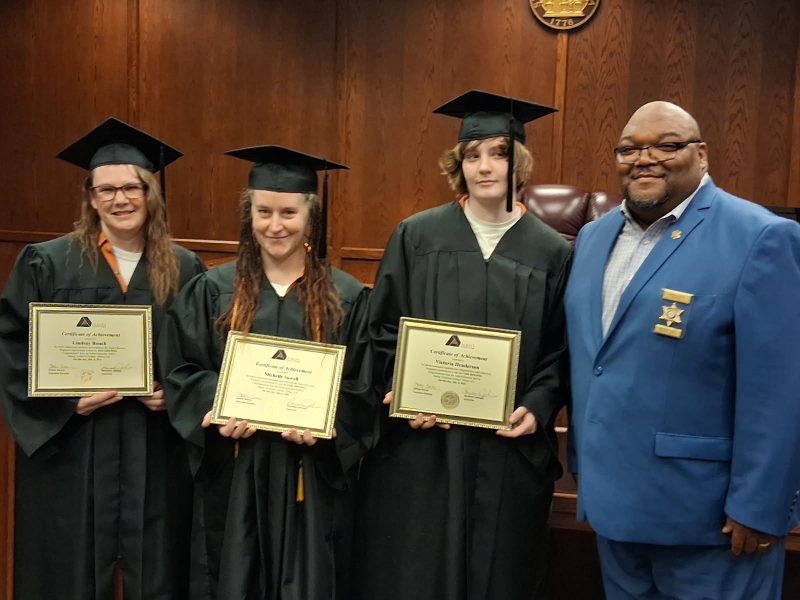
Dougherty Jail graduates first class of female GED recipients
“It was an escape. I can say this has been challenging. I want to express my gratitude for being able to attend this program.”

From cotton to cloud: In the data center debate, is rural Georgia once again being asked to carry the cost?
Across much of rural Georgia, the abandoned cotton warehouses and shrinking tax bases remain — enduring reminders that industries built to serve distant markets do not necessarily stay rooted in the communities that first sustained them.

Dawson Council approves $400,000 lifeline in emergency meeting as financial accountability remains elusive
Less than a week after city officials publicly acknowledged the City of Dawson cannot continue operating without additional financing, the Dawson City Council convened a hastily called emergency meeting Tuesday evening and unanimously approved authority to borrow up to $400,000 through a tax anticipation note.
