
House Committee on Fishing Access finalizes report
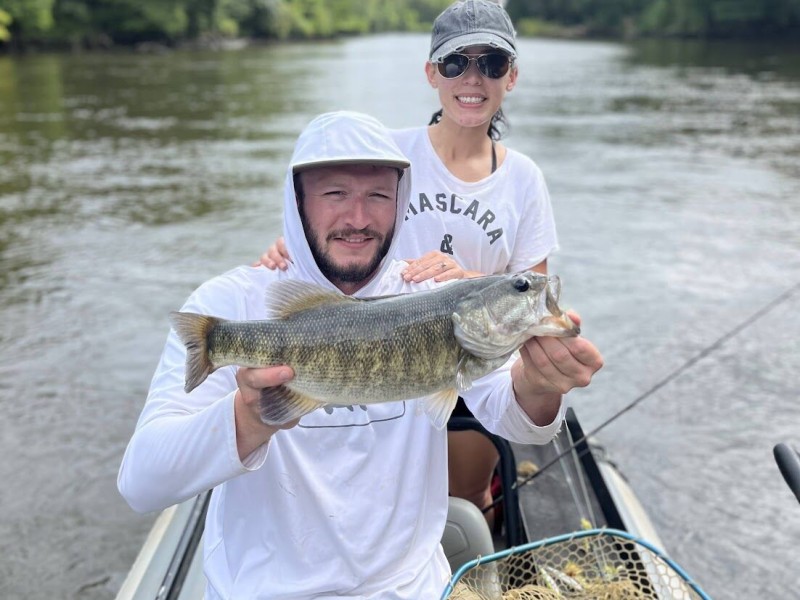
Special Photo: Quint Rogers
By David Dixon
[email protected]
ALBANY — During the 2023 legislative session, the Georgia House of Representatives passed Resolution 519 (HR519) creating a House Study Committee on Fishing Access to Freshwater Resources. The committee held four public meetings around the state in October to gather comments. The meetings were well-publicized and -attended, held in Gay, Clarkesville, Blue Ridge and Statesboro.
A final report was issued on Dec. 1 with the following recommendations:
1. Determine and delineate the navigability of each of Georgia’s rivers and streams based on the statutory definition;
2. Preserve the definition of the state’s navigability set forth in the Official Code of Georgia Annotated (OCGA) 44-8-5a;
3. Maintain the underlying purpose of Senate Bill 115 while removing references to the public trust doctrine in statute and recognition of the doctrine’s standing as a common law provision;
4. Clarify the statutory language in regards to trespass and stiffen the penalty under the Hunting and Fishing Code to enforce existing law;
5. Ensure the protection of the right of passage for navigable stream as found in OCGA 52-1-31;
6. Recognize the importance of the Georgia trout industry, including its unique ecological needs and economic benefits, and seek to the protect state’s trout waters;
7. Support additional investment in public fishing properties.
The importance of clarifying fishing rights to the public and private property rights of land owners adjacent to these streams is of primary importance in Georgia. While the public has a constitutional right to hunt and fish, it must be managed by law under clear regulations.
Currently the Department of Natural Resources manages more than 4,000 miles of trout streams, 12,000 miles of warm-water streams, and 500,000 acres of impoundments for the public good and general welfare. The DNR manages 11 public fishing areas throughout this state, which combined host approximately 800,000 visitors annually. These 1.2 million anglers and visitors generate revenue of more than $1.9 billion, maintaining an estimated 10,600 jobs.
The DNR operates and maintains 168 public boat ramps, as well as canoe and kayak access points across the state, which provide public access to waterways. Other entities such as the U.S. Army Corps of Engineers, the U.S. Forest Service, and other agencies, plus local city and county governments, operate and maintain many additional public boat ramps and other river and stream access points.
Recently, some private landowners have attempted to exclude the public from fishing in streams that are generally held to be navigable, even where the Department of Natural Resources and other agencies stock fish or maintain public boat ramps and access points. The disputes have centered on of the ownership of beds of streams and associated fishing rights under certain interpretations of the law.
Another bill (SB 115) passed during the 2023 session brought clarity to the fishing rights in navigable waters but did not go as far as delineating which waters do and don’t come under that classification. It was made clear by many in public hearings that bringing forth a recommendation to better delineate what is navigable and what is not, and therefore what is fishable and what is not, is sorely needed by the public, anglers, boaters and landowners..
“At Georgia Wildlife Federation, we thank the Study Committee for their diligence and hard work,” GWF President and CEO Mike Worley said. “The committee encouraged input from diverse stakeholders and has demonstrated a commitment to balancing all the assortment of interests.
“Georgia has a strong tradition of protecting private property rights and a strong tradition of supporting our hunting and fishing heritage, and these priorities are paramount for GWF. This report is an important step; but the most important will be any legislation that might arise from all this work. We will stay closely involved to represent the interests of the almost 2 million anglers in this state that have invested their time, talent and treasure and made Georgia a real outdoor gem and a real destination for fishing.”
Worley said the rights of outdoors enthusiasts must be preserved.
“In these days of population growth and urbanization, opportunities for people to get outside and enjoy Georgia’s natural bounty must be protected,” he said. “We are not advocating for expansions of the definition of navigability and public fishing rights on our streams. However, we are adamant that what is navigable and what is fishable by the public cannot shrink. And we always support expansions of public fishing areas through thoughtful, willing public land acquisitions. As we like to say, we are ever vigilant in ‘Keeping Georgia Wild’”.
“We truly appreciate the hard work and attention to details that the Study Committee brought to this work,” Flint Riverkeeper Executive Director Gordon Rogers said. “Their recommendation to determine and delineate Georgia’s navigable waters is spot-on from our perspective. We look forward to reviewing a bill in the legislature that will bring that to life. Further, the committee’s support of the underlying purpose of SB 115 is truly appreciated.”
Author

Related Articles
Lee County agricultural land values could rise 83% as new assessments near mailing
During a work session Tuesday, Terry McCormick of McCormick Solutions provided the Lee County Board of Commissioners with an update on the county’s 2026 tax digest and ongoing reappraisal efforts.
Residents rally behind Lee schools as accountability questions persist
That argument surfaced repeatedly during a recent meeting of the Lee County Board of Tax Assessors, where officials, citizens and school system representatives discussed the coding error that contributed to incorrect rollback calculations and higher-than-expected tax collections.
‘Support Yourself’: Dawson DDA’s funding crisis exposes structural failures
According to documents obtained through an open records request, the DDA was erroneously billed on at least two occasions in 2025 — once for $2,715.18 and another time for $1,778.80. Both charges were later reversed back to the account without a formal public explanation. Interim City Manager Roxie Powell said she was not serving in the role when the billing problems occurred and was unaware of any documented meter-reading errors during that time.
