
Radium Watershed Environmental Assessment draft completed
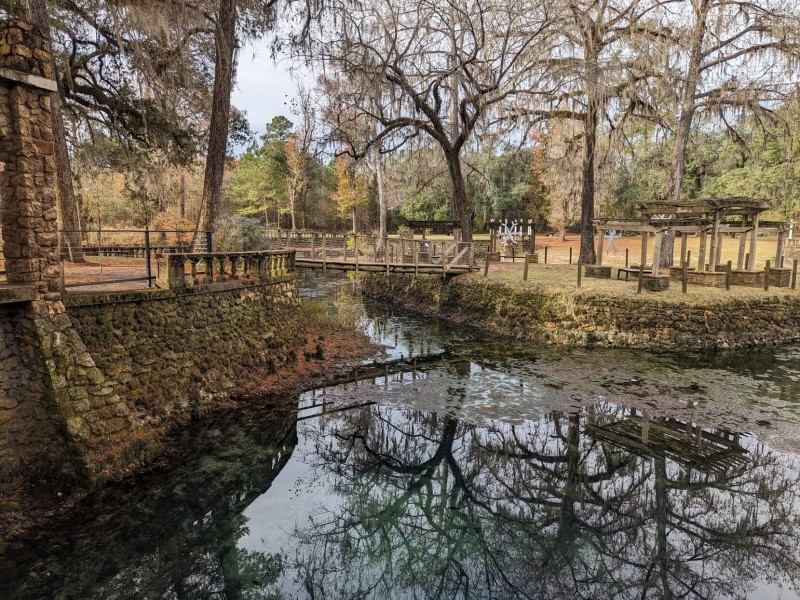
Staff Photo: David Dixon
By David Dixon
[email protected]
ALBANY — The draft environmental assessment on restoring flow at Radium Springs, funded through the USDA’s Natural Resources Conservation Service, was completed recently.
Radium Springs has at times had very low or even no flow during drought periods. And even during years with normal rainfall, the springs have ceased flowing for several months. Restoring flow to Radium Springs will require different management of water withdrawals for the Floridan Aquifer, which feeds to spring and creek run to the Flint River
A project, known as “Skywater,” which was organized to plan the restoration of Radium’s flow and then attract funding for the work, has been in the works several years. Skywater is locally sponsored by the Flint River Soil and Water Conservation District and is driven by a committee of farmers, scientists, policy experts, environmental advocates and representatives of Dougherty County government.
The Skywater project and team has undertaken segments that include setting up measuring devices for aquifer levels, spring output, and creek flow, plus retrofits of row crop and orchard operations in the springshed (the land surface area that feeds the spring). Funding has come from several sources, including the Bonneville Foundation, plus staff and volunteer time contributed by the Flint River Soil and Water Conservation District, the Flint Riverkeeper, and the Jones Ecological Center in Baker County.
The earlier work provided an opportunity for U.S. Rep. Sanford Bishop, D-Albany, to include funding for the project in the Bipartisan Infrastructure Law through the U.S. Department of Agriculture’s Natural Resource Conservation Service’s PL-566 Program. A number of other local entities provided input and data to this plan, including the Albany State University Water Planning and Policy Center, U.S. Fish and Wildlife Service, Georgia Environmental Protection Division, and the U.S. Army Corps of Engineers.
“This Watershed plan is a fitting next step in local efforts to revitalize and restore Radium Springs,” District Chairman Marty McLendon said. “The Flint River District has been proud to be a part of the Skywater Project for the past several years, and through that effort we have secured both private and public funding toward implementation of smart irrigation technologies for farmers in the Radium Springs springshed, plus research, monitoring, and development of new irrigation technologies.
“The dedication among Skywater Project partners has been a solid foundation on which to build this Watershed Plan, and once implemented it will truly and meaningfully amplify the impact and reach of these ongoing efforts.”
“Reaching this milestone in the watershed planning process has been incredibly rewarding,” Perri Cooper, the executive director of the Flint River Soil and Water Conservation District, said. “For over a year, we have engaged stakeholders, local government, Skywater Project partners and the public in ensuring we have created a comprehensive plan that will truly be a win-win-win for local residents, the local economy, and our local natural habitats.
“We’re so appreciative of the excitement and engagement in the development of this plan.”
Flint Riverkeeper Executive Director Gordon Rogers said implementation of the plan will have a positive impact locally and downstream.
“Working with the Skywater team, the local Flint River Soil and Water Conservation District folks, the Natural Resource Conservation Service folks, the engineering contractors and all of the other partners has been a labor of love for all involved,” Rogers said. “Any tedium or delay has been more than overcome by the creative energy of this large group of experts and public servants, always keeping the goals in mind: a healthy flowing spring that will strengthen the local community plus benefit those downstream of Dougherty County.”
Although Radium Springs is just one of many flow-restoration projects currently underway in southwest Georgia, it is the one most visible to the local community and visitors to the area. The most far-reaching recommended action in the plan is to use source-switching technologies that involve temporary cessation of the use of wells in the Floridan Aquifer that directly affect springflow. That cessation will be based upon drought measures and springflow triggers. Agricultural and industrial water needs will be met by new wells drilled into deeper aquifers funded in major part by project funds.
Based upon the scientific record, Radium Springs first ceased to flow in the early 1980s. Once the plan is approved by the national NRCS office, work to keep this from happening in the future could possibly commence in 2024.
Author

Related Articles

Dawson police arrest wanted suspect after Flock Safety camera alert
According to police, May drove into the yard of a nearby residence instead of complying with officers’ commands. He then exited the vehicle and ran into the home on foot.
Lee County stands alone without E-SPLOST. Here’s what that means for schools, taxpayers and the county’s future
Following the defeat of its referendum, Lee County became just the second of Georgia’s 159 counties without voter approval for an active ESPLOST, leaving the school system without the state’s primary local funding source for major construction, renovations, school buses and other capital improvements.
Chamber celebrates new businesses, invites community to Coffee and Connections event
The Terrell County Chamber of Commerce is continuing its efforts to strengthen local business relationships through community celebrations and networking opportunities, recently recognizing two new businesses with ribbon-cutting ceremonies and announcing its next “Coffee & Connections” event in Sasser.
