
Albany, Rails to Trails seek resolution on project tied up in court fight
File Photo: Carlton Fletcher
By Alan Mauldin
[email protected]
ALBANY — Nearly two years after a lawsuit was filed against the city of Albany over a nearly 14-mile rail trail stretching from downtown to Sasser, there could be some chance at resolution. And, officials with both groups say, the action is taking place outside the legal system at the moment as the sides seek common ground.
The city is looking at grant opportunities but last week declined to take action on a potential grant from the state for the 13.6-mile trail project that has been envisioned for some three decades.
Instead, it could seek funding through the federal Rebuilding America with Sustainability and Equity (RAISE) program. That program bolsters rail, road, port and other transit projects, and some of the money is earmarked for areas of persistent poverty or historically disadvantaged areas.
Projects approved have included dedicated bus lanes in Baltimore, highway and bridge repair in New Mexico, dock replacements in Alaska and a rail-to-trail project in Arkansas.
“The RAISE grant is something we’re going to look at in the next week or so,” Albany Mayor Bo Dorough said on Tuesday.
The commission voted last week to table a motion on a possible state grant that would have funded trail design.
“We’ve already got a design,” Dorough said. “It’s about a three-year process, so that’s not really appealing, you know, if you take three years to redesign it.”
The city purchased the former rail corridor in 2015 from South Georgia Rail to Trails. SGRT sued the city in August 2020 claiming breach of contract.
“They’re contending there’s a contract (to complete the trail within five years), and it binds the city to build the trail to certain specifications,” Dorough said. “We say there’s no contract and no specifications.”
The mayor said the two sides have been talking with an eye toward a resolution. He agreed the project would have a big impact on the region, but the cost is too exorbitant to absorb, especially since several miles of the project would stretch through two counties other than Dougherty County.
The most recent cost estimate was $7 million for the trail that would include seven miles in Lee County and three miles through Terrell County. And since the pandemic, construction costs have risen and would thus likely be greater today, Dorough said. Part of that cost includes trailheads providing access to water and restrooms.
“How can the city of Albany justify spending that kind of money to build a trail through two other counties?” he said. “We had no idea, when it was bid, that it was a $7 million contract.”
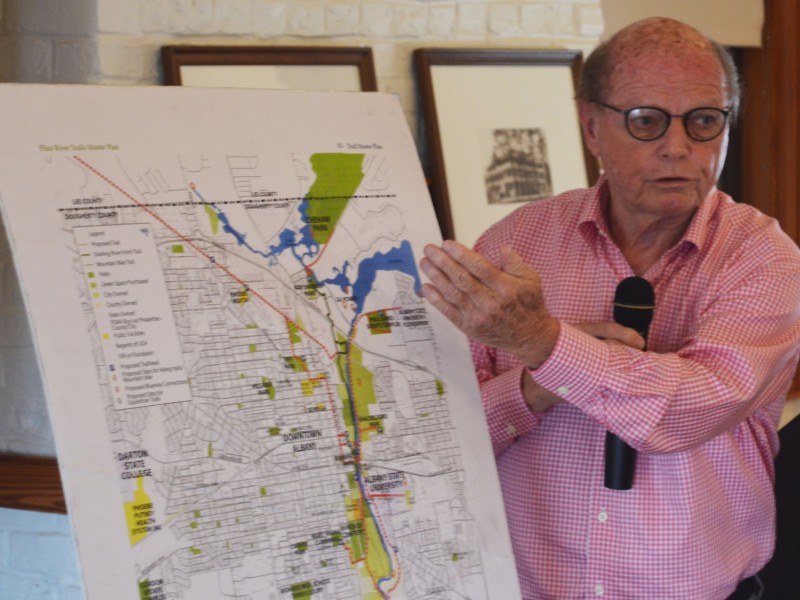
The Albany-to-Sasser trail is part of a trail system developed with multiple branches throughout Dougherty County. It includes a section from Radium Springs to the Flint Riverfront area, which is being developed by the county, and a section linking to Chehaw Park.
In the city, the section from the river to Monroe Street has been completed.
The RAISE grant would seem to present a “once in a lifetime opportunity” to secure funding for the job, said SGRT President Bo Johnson, who said he could not say much about the matter due to the pending litigation. However, he confirmed there is an effort to resolve the matter.
“The two slides are doing their best to come together and come to an agreement,” he said.
“There are good people on both sides, and they both have their motivations for doing what they’re doing. That said, the city of Albany is our partner. I think we just need a way to make it come together.”
If the city can secure funding to move the project forward, that would go a long way in resolving the issue.
“Hopefully, soon we’ll be able to find some funding, get a grant applied for and see where it goes,” Johnson said.
In order to submit a grant application, the suit will need to be dismissed or put on pause as funding agencies are not likely to hand money over for a project that is in litigation, Ward IV Albany Commissioner Chad Warbington said.
“There’s a lot of moving parts,” he said. “There’s obviously multiple grant opportunities. The problem is we’re tied up in litigation. At this moment, we have no agreement with them, so we can’t pursue any grants.”
With a $100 million sewage/stormwater separation project — including securing funds to pay for it — along with public safety issues and funding other recreation programs and construction on its plate, the trail project is not high on the list as far as he’s concerned, Warbington said.
“Those are our priorities. … But if we can be a conduit to get any federal or state money, it’s a great project,” he said. “I’m not opposed to the project.
“I would advocate for applying for any grants we can to get adequate funding. It’s hard to do that when you’re fighting a lawsuit.”
Author

Related Articles
Albany Herald – July 14, 2026
In Lee County, they saw it… Bigger budget will mean improvements at… Small actions can help save…

Classifieds – July 14, 2026
Albany Classifieds and Legals…
‘Just Africa’ festival scheduled for third weekend in September in downtown Albany
A taste of the Caribbean and Africa is coming to Albany with a fall festival that will also bring African dance, a parade of children’s fashions, as well as vendors, live bands, and arts and crafts.
