
D-Day veteran carries vivid memories of invasion
Albany resident James Tilton, 95, is one of the surviving participants of D-Day
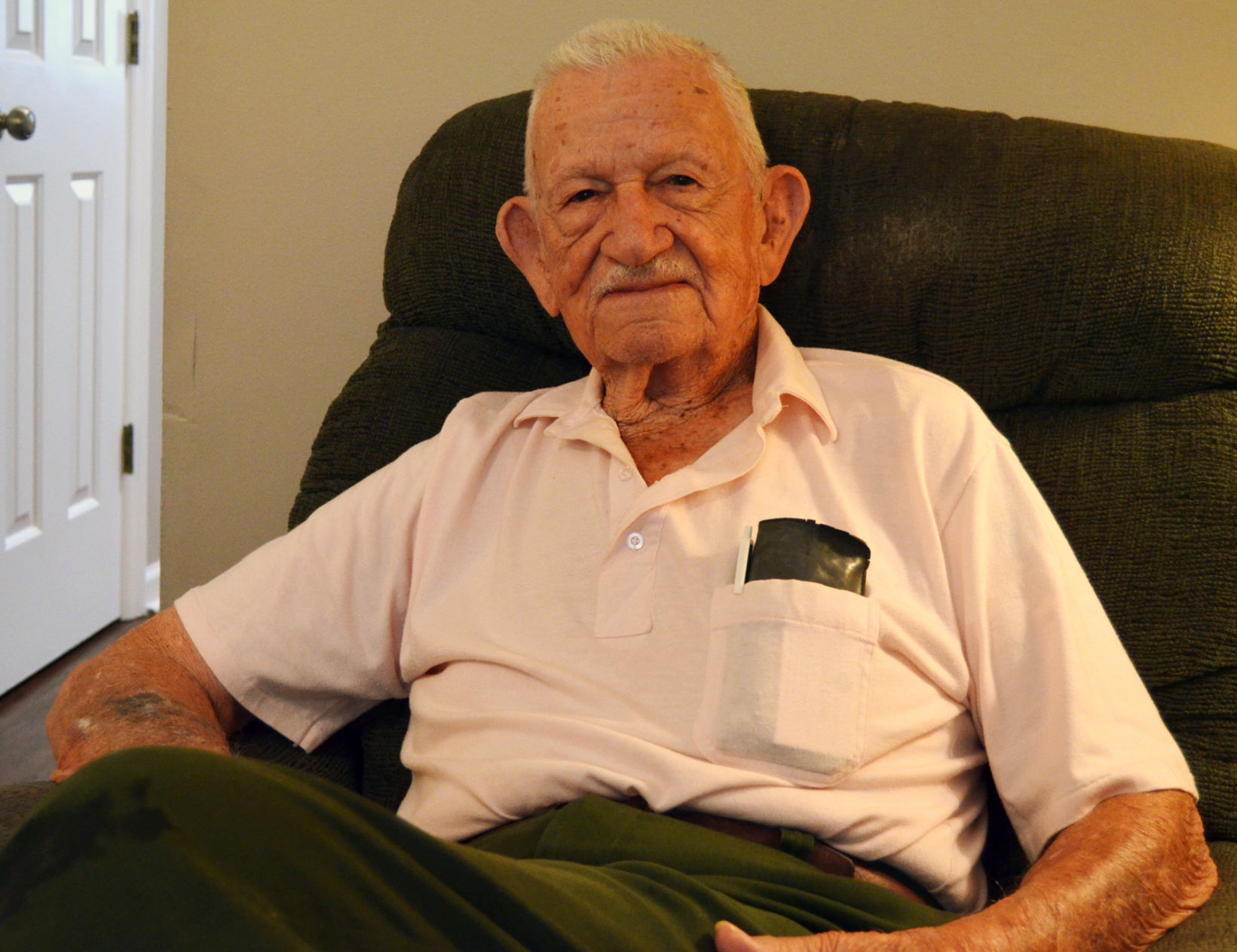
Staff Photo: Jennifer Parks
By Jennifer Parks
[email protected]
ALBANY — James Tilton, who turned 95 this week, still carries vivid memories of what has become known as D-Day, the largest seaborne military invasion in history.
Tilton is a native of South Carolina who settled in Albany after retiring from his military career. Asked by The Albany Herald about his memories from the beaches of Normandy, the first thing he did was pull out a journal entry he wrote in an England hospital while recovering from injuries he sustained in the invasion.
In it, he talks about preparations for the battle, which would result in more than 4,000 American fatalities. The mood of those knowing they were about to go into the mission was subdued.
“For three bitter cold months, as only the damp English weather can be, we had been couped up in the marshes and swamps of Southern England,” he wrote. “We had attacted (sic) and defended mock beach heads set up to scale and to minute details of the French coast. Any day now it was expected to happen. Still we sat and no word from the High Command. GHQ was strictly quit (sic) about the future actions of this ill fated outfit.”
On June 3, Tilton was in full combat dress and eventually was hustled onto a boat bound for the target. He and his comrades were attempting to distract themselves to keep their minds off the task ahead, standing by as the Navy dropped depth charges nearby and intelligence officials gave a briefing of what the mission would be.
“We learned that our particular battalion was to lead the assalt (sic) on Omaha Beach, which was later nicknamed bloody beach as you will learn later on,” Tilton wrote. “And for good reason.”
They continued to stand by as the weather worsened outside, eventually forcing a delay in the planned operation. When the weather improved, Tilton got some fresh air and a look at the English countryside. He learned the finer points of the upcoming mission while pre-assault bombing commenced.
“We also knew that somewhere up the (sic) were thousands of Glider and Paratroopers who were to spearhead the invasion,” Tilton wrote. “The long awaited operation had finally begun. No one seemed in the mood to talk about it or for that matter any thing else. Everything was deathly quite (sic), except for the churning of the ships props and the for (sic) off crashing of the bombs. We knew by the sound getting louder that we were now approaching our destination.”
Five of the six boats in Tilton’s company got knocked out before reaching the beach, reducing the number of men from 193 to 36. That made him the the acting commander. He had just turned 20 at the time. He had entered the military at 15, after misleading officials about his age.
“The shells were now coming down on us from the heights in what seemed to be an endless hail like rain,” he wrote. “It seemed to be impossible that any living thing could survive. Not many did. The losses from the Battalion of Rangers and ourselves were stagering (sic) on that fateful day, although I don’t think that the Rangers were as high as our own. The truth can only be told when and if we ever bring this conflict to a victorious end.”
The day and night that followed were spent climbing cliffs, while enemy guns were shooting with forces unloading in the channel. With only 19 of his men left, Tilton went back toward the beach to find the rest of his outfit.
”It was less than a mile, but I think that it was the longest one I have ever traveled,” he wrote.
Shelling was still heavy to prevent the Allies from building reinforcement, so Tilton and his men crawled for cover — losing two more. With the remainder of his outfit delayed due to weather conditions, he agreed to help direct troops and supplies streaming onshore.
Even then, the shelling carried on.
“None of us are looking forward to what is going to happen to us in the future,” Tilton wrote toward the end of a nearly four-page journal entry. “I think the general feeling is the same as mine, that is for the present I am content to sit here and thank God for keeping me and protecting me in what seemed like a hopless (sic) atempt (sic) to get ashore. If ever the truth can be told by myself or some other of the lucky few that were the first ashore, the public can well see why the men who died there and the other(s) who came through, some maimed for life, named Omaha Beach BLOODY BEACH.”
He closed out the entry by dedicating it to the men who died on the beach on the peninsula at Cherbourg June 6-7, 1944.
Fast forwarding 75 years, from his apartment off Ledo Road, Tilton said he wants people to remember the sacrifice involved in what was to eventually become the foundations for the final outcome of World War II.
The first things that come to mind when recalling the events of that day, he said, are the emotions, primarily fear.
“But I did it because I was expected to,” he said. “I would have let a bunch of people down if I didn’t.”
Like many others from the Greatest Generation, Tilton said his motivation to serve came from the belief that doing so was what every responsible person did at the time.
Tilton switched branches and joined the Air Force shortly after it was created. He was stationed at Turner Air Force Base in Albany for eight years. When he retired after 35 years in the military, he came back to Albany.
As the years have gone by, the courageous veteran said he still remembers the number of bodies he saw on the beaches in France.
“They were scattered over and over,” he said. “I think probably my mind was blank except for the survival instincts in me. There was no time to be thinking about anything else.”
On June 22, as he and his comrades worked furiously to cover each other, two grenades were thrown in a nearby pillbox. Tilton said the other guy took off while he was approached by a bayonet.
He was too injured to move.
“They didn’t find me for three days,” he said.
Tilton was airlifted to the hospital in England on June 27, where he remained — eventually getting a desk job there — until going back to the United States in October 1945.
“They never did get me well enough to get back to fighting duty,” he said.
His son, Buck Tilton, said his father was in the war from the first day, and the injuries he sustained in France marked the third time he had been wounded in the conflict. In those days, it was typical for service members to be patched up and sent back into battle rather than be rotated out.
Buck Tilton said he considers his father a hero, largely in that he remained so humble in his duty.
“He could have gone home, but he opted to stay and fight,” the younger Tilton said.
From his time in the military, and observing the impact of the conflicts the U.S. is engaged in now, the elder Tilton has been able to see how things have changed in the last seven-plus decades.
“I was in Vietnam, and that was so different from World War II, but completely different from what is going on now,” he said. “We had no (improvised explosive devices).”
James Tilton said he believes most people do appreciate the historical significance of D-Day, and that it is history well worth remembering — adding that he feels fortunate to live as long as he has.
“He is the most courageous man I have ever known,” Buck Tilton said.
Among the accolades James Tilton received for his service is the Distinguished Flying Cross. He tried watching the film “Saving Private Ryan” but said he walked out after the first five minutes.
“He didn’t talk about it for about 60 years,” Buck Tilton said of his father’s experiences on D-Day.
The elder Tilton said he is mostly happy to have lived through such a horrid experience.
“I can’t not believe there is a higher power that keeps an eye on (people) like me,” he said.
Related Articles
Albany Herald – July 18, 2026
Georgia Trust for Local News partners with… Adult leadership group spreads concept to… Lee County homeowners have until Aug. 1 to claim…

Classifieds – July 18, 2026
Classifieds; Legals;

Albany police make arrests in murder, robbery cases
Officials with the Albany Police Department have announced a number of arrests in cases that involved a homicide and a pair of thefts.
