
Dougherty County Commission to vote next week on property tax hike recommendation
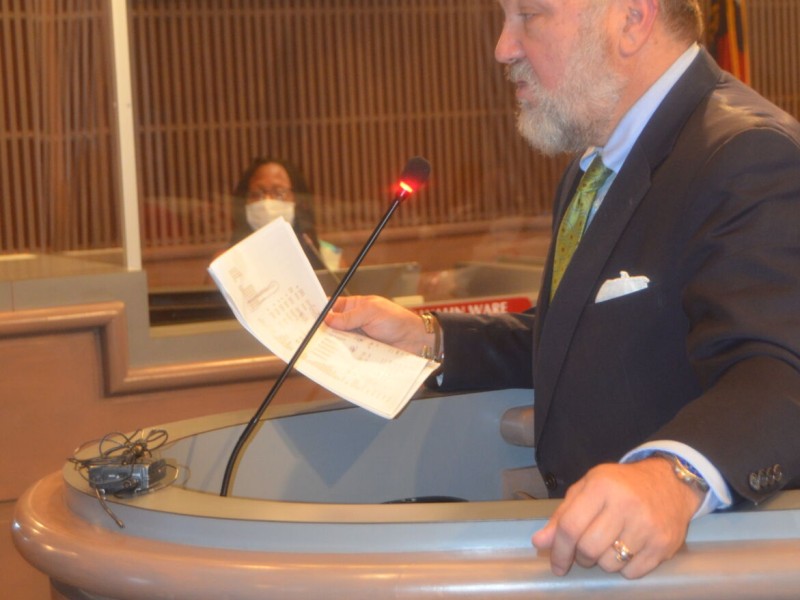
Staff Photo: Alan Mauldin
By Alan Mauldin
alan.mauldin
@albanyherald.com
ALBANY — Like a college student faced with the pizza delivery driver at the door, the Dougherty County Commission, looking to reduce an anticipated property tax increase, pulled the cushions off the couch, turned it over and gave it a good shake.
The results weren’t dramatic, though, and there was little change waiting to be discovered, leaving the group considering a millage rate increase of at least 3.5 mills.
After passing a general fund budget of about $58.6 million in June, a slight decrease from the actual $58.9 million allocated for the 2021-2022 budget year, commissioners later voted to approve implementation of a pay study for employee pay increases that will add another $3 million to the 2022-2023 spending plan.
The county’s financial advisor, Edmund Wall, actually was behind the search for more revenue, and of several ideas considered he found only one to have potential. That was an annual 10 percent transfer from the county’s solid waste fund to the general operating budget, which this year would amount to about $468,000.
Unlike municipalities, the county has few options other than property taxes, said Wall, managing director of Public Finance Investment Banking.
“My clients with (enterprise funds like utilities), nearly every one takes some of the profits from those profitable funds and shifts it over to keep property tax rates lower,” he said. “Most clients charge a franchise fee. I have proposed you implement a 10% franchise fee on your (landfill) enterprise fund. Your landfill fund is healthy. It is my advice that it can afford to pay a franchise fee of $468,000.”
After Wall recommended a 4.5-mill increase a week ago, the commission requested that he consider other sources of revenue, but none of the others seemed feasible. The ideas explored included a “commuter tax” levied on residents of other counties who work in Dougherty County and a special tax district established for properties whose owners get tax breaks for having them enrolled in conservation programs.
After exploring those options, and based on commissioners’ request that the tax increase be reduced, Wall’s recommendation was for a 3.5-mill increase for the 2022-2023 budget year that began on July 1 and an additional mill next year. Without an increase, Wall estimated the county would have a $7.5 million shortfall for the current budget year and $8.5 million the next.
An increase of 3.5 mills would increase taxes on a $100,000 home by about $12 per month. A 4.5 percent increase would be about $15 per month for the same property.
The driving forces behind the need for money are inflation, including the sharp rise in fuel prices for county equipment, and the pay increase for employees, whose salaries and benefits account for about 80 percent of the total budget.
The approved pay package will increase the minimum wage for county employees from $10 to $13 an hour and provide a cost-of-living adjustment of at least 2.5% for all employees effective Oct. 1, plus a one-time adjustment payment of $1,000 to all employees to be paid in December.
For Commissioner Gloria Gaines, one question was whether the increase for employees is taking money from taxpayers who earn less to pay for the raises.
The county’s average income is about $21,000, Wall responded.
Gaines also asked whether cost-cutting measures had been considered.
“Did we take a critical look?” she said. “I asked that question last week; are we providing the services we can afford? Are we providing Cadillac service with a Chevrolet budget? I still have issues with the expenditures, whether we have thoroughly looked at our expenditures. I don’t see voting for a tax increase.”
Commissioner Clinton Johnson, the only member of the three-member Finance Committee to vote against the recommendation of a 3.5-mill increase, and Commissioner Victor Edwards asked Wall whether it would be better to implement the earlier recommendation of 4.5 mills this year. That would make it unnecessary to vote to approve tax increases for two years in a row and provide a cushion to provide future pay increases if the commission decides to do so, Edwards said.
The last pay study implemented by the commission was 22 years ago.
“We have hurt the employees,” Edwards said. “I don’t want to hurt employees, and I don’t want to hurt taxpayers. If we’re going to take the hit, I’m not going to nickel and dime the 3.5. I’d rather do it at one time.”
The county’s budget contains very little in frills, Commissioner Russell Gray, who along with Commissioner Ed Newsome join Johnson on the Finance Committee, said. Much of the constitutional duties are mandated, from the sheriff’s office, jail and court system.
“These are all things we are constitutionally required to provide,” he said. “We are a middleman, and we’re a nonprofit middleman.
“We have to be conservative with our taxes, and we have to be conservative with our expenditures. We have to pay our employees enough. (But) we do have to provide these services. I think it is a balance.”
Chief among the concerns for Commission Chairman Chris Cohilas was public safety. He also was a strong supporter of raises for employees and said he understood the feeling to inflict the pain in a single year instead of stringing it out over two years, likening it to ripping a bandage off the wound.
“I understand the logic,” he said. “If you’re going to do it, then go ahead and do it. If it’s going to cost $15 more a month to keep my family safe, I’m willing to pay that. I hate spending $100 for gas, but I’m willing to pay that ($15).”

Author

Related Articles

New commander takes helm as Marine Corps logistics adapts to evolving battlefield
Brig. Gen. Kevin G. Collins assumed command of Marine Corps Logistics Command during a change of command ceremony at Marine Corps Logistics Base Albany, succeeding Maj. Gen. Keith D. Reventlow after four years leading the organization responsible for sustaining Marine forces around the globe.

Classifieds – July 2, 2026
Cemetery lots for sale: 5 burial plots in Riverside Cemetary… Health: Private Caregiver…Full-Time Job: Irrigation Tech needed…

Albany Herald – July 2, 2026
Dougherty schools prepare for bell-to-bell… From Ledo to Coston, Lee County’s summer road… Lee County moves another step closer to issuing…
