
Former Albany gang member attempts to break the cycle that leads to violence, prison
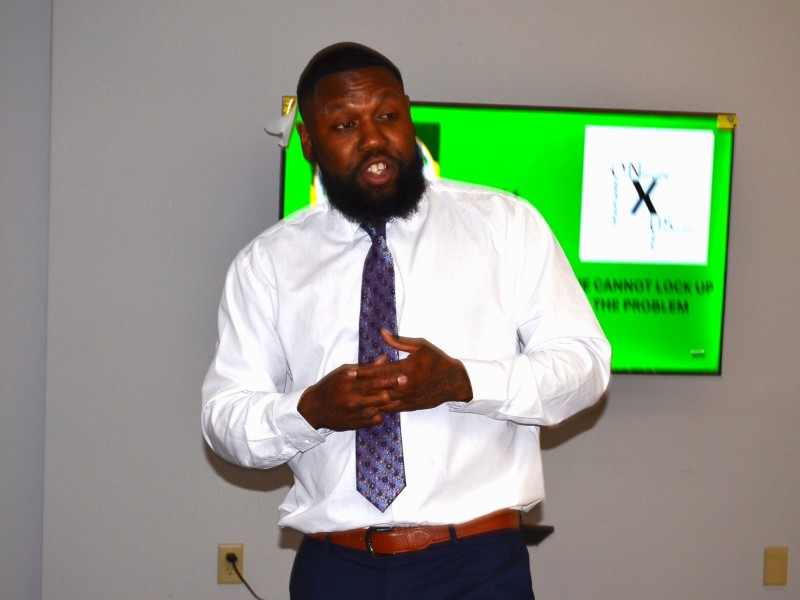
Staff Photo: Alan Mauldin
By Alan Mauldin
[email protected]
ALBANY – As a teenager, Travis Luke was cooking up crack cocaine, selling it and getting into fights. The former gang member did his time in prison, and now he is looking to help steer young people away from that life.
He’s also working to assist individuals who, like him, are trying to start a new life after being in prison. For many people, prison is a multigenerational part of life, something Luke is familiar with as at one time he, his dad and grandfather all were in separate prisons in the state.
“I’ve got a slogan: The prison system is raising the fathers; the streets are raising their kids,” he said. “With that going on, we’ll never get peace. We’ve got a problem.
“My grandaddy, my dad, me … I’m fortunate to have got home in time to save my kids. If I’m in prison, the streets are raising the kids. You can’t blame the system. The system is the system. Somebody’s got to stay out of prison to break the cycle.”
For himself, a breakthrough with a prison psychologist was what allowed Luke to get the message. Told that he didn’t fear death, he came to the realization that her observation explained why he didn’t have any regard for other people: He didn’t care about himself.
“I’ve been shot up multiple times,” he said. “I had multiple life sentences. My brother died; I lived. I was terrible in school. All I did was fight.
“The day I started caring about living I started going away from violence. I didn’t realize my lack of a fear of dying was what made me violent.”
At a restaurant where Luke spoke with an Albany Herald reporter, the server remembered her high school classmate, who was always getting into fights.
“He was bad,” she said. “I love him, but he was bad.”
The need to help young people in the community is great, according to Luke, who said probably 45 parents a day contact him asking for assistance with their children. And resources are not readily available for programs such as those he is offering. Those include Youth Build, for which Luke provides mentoring and instruction on how to build houses.
Another is ONXUS (pronounced like “onus”) which stands for Opportunities Naturally Unite Society, which Luke referred to as “my baby.”
The program is for youths as well as correctional officers and police, and it includes a gang intervention curriculum.
“I get into the psychology of gangs,” he said. “It’s a psychology. I want to teach people the psychology behind gangs. I’ve also got prevention for kids, teaching how not to commit gang violence (using) emotional intelligence.”
Luke dismissed some of the accepted dogma that law enforcement and prosecutors teach about gangs, one being that gangs start recruiting early by giving elementary school-age kids candy or shoes.
“I’ve been around this my whole life,” he said. “I ain’t never heard of nobody giving nobody a piece of candy, but that’s what they say.”
Prevention and interdiction are the best strategies for preventing young people from joining gangs and helping gang members leave the life, he said.
“You can’t lock up the problem,” Luke said. “You can lock up the person. I’m not saying don’t lock them up when they do something wrong.”
Young people also need more mental health care than is currently available, he said. Students who are traumatized by the death of a fellow student are less likely to react by arming themselves, and perpetuating the cycle, if they can talk about their feelings with a therapist.
“Mental health is our No. 1 problem,” he said. “It’s no way all this death doesn’t affect the city mentally. That’s where we need to be spending the money.
“That Radium Springs (Road) shooting recently; that negatively affected the city.”
Ultimately, the best anti-gang program is giving young people an alternative, the chance to make good money without making it on the streets, according to Luke. Again against the conventional wisdom, he said that giving young people a path to future success would be more beneficial than the millions of dollars the city is spending on recreational facilities.
“People keep saying we need to give kids something to do,” Luke said. “What we need to do is start thinking about what they’re going to do when they’re adults. What I do care about is when we’re going to bring some jobs, are we going to bring something with 300 jobs here? We don’t have any jobs. I have people every day asking me about jobs.”
The Southwest Georgia Offenders Alumni program that he recently started is assisting individuals returning to the community after a stay in prison to learn job skills, build resumes, learn interview skills, parenting skills and community skills. Mental health, including emotional intelligence, also plays a role.
“But I think the greatest aspect of it, I’m using people who have been in prison to keep kids out of prison,” Luke said. “It basically is them using their real-life experiences to keep somebody from going through the same things.”
For his part, the former gang member said he wishes he had had that person, his own “me” at his current age who could have instilled that message when he was young. He said working with the formerly incarcerated and young people is a way to help pay off a debt for making “gang-banging look cool.”
“The simple answer is not a simple answer,” he said. “I owe a debt to society. I owe a debt to my kids to grow up in a better place. I do it because – I don’t like to be too religious – but God put an anointing on my life to do what I’m doing.”
Community members interested in speaking with Luke can contact him at (229) 669-7290 or by email at [email protected].
Author

Related Articles

Chehaw looks to future that includes eagles, cougars, outdoor recreation
Chehaw Park & Zoo has plans for new exhibits, a play Park and creating an outdoorforest recreational area in the works.

Downtown Albany RiverQuarium to go through assessment process to address aging animal support system
“It’s not glamorous, but it has to be done. We understand that our place downtown is important, and all the things they have proposed are only going to help us.”
Dawson seeks estimates for possible ABR Trucking cleanup
A city inspection indicated the ABR Trucking property remained out of compliance with city codes, prompting officials to gather estimates for a possible cleanup.