
Hail to the ‘Master Chief’
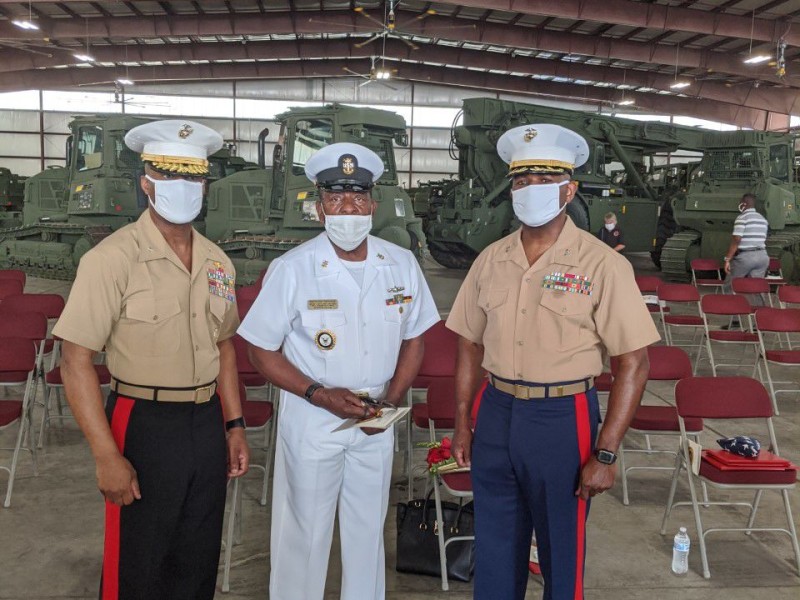
Staff Photo: Tom Seegmueller
By Tom Seegmueller
[email protected]
ALBANY – All it took Tuesday was a quick glance at front row of dignitaries attending the Change of Command and Retirement ceremony at Marine Corp Logistics Base-Albany to know something was out of the ordinary.
Sitting upright, centered on the front row, was an individual wearing the blindingly white uniform of the United States Navy.
Although the U.S. Marine Corps is a part of the U.S. Department of the Navy, it is not a part of the U.S. Navy and has not been since the National Security Act of 1947. Although sailors and Marines sometimes may sail on the same ship and be stationed on the same base, either branch is more likely than not to treat the other as an ugly cousin.
So how did this lone Naval officer score the best seat in the house beside retiring Col. Alphonso Trimble’s wife while Marine Corps officers of atmospherically higher rank sat on the end of the row? A little patience would lead to the answer and a very interesting story.
Immediately following the Change of Command ceremony, the Retirement Ceremony for Trimble, who had moments earlier been the Commanding Officer at MCLB-Albany began, bringing an end to his 33-year career in the Corps.
The press release for the ceremony stated that Trimble’s career began following his graduation from Jefferson Township High School in Dayton, Ohio. Immediately following graduation, he enlisted in the Marine Corps. He credits his company gunnery sergeant for encouraging him to consider going to college.
So, things were a little unusual. Trimble’s path to command did not start with a commission from a military academy or an ROTC program. He was a “Mustang,” an officer who started his career as an enlisted service member. Not the easiest path to a command position.
When Brig. Gen. Michael G. Carter rose to make his comments, formally retiring Trimble, he appeared to briefly make eye contact with the lone Naval officer who seemed to nod his head ever so slightly in acknowledgement. Definitely not a typical action at a ceremony with so many Marine generals in attendance.
Carter formally recognized the assembled generals, active and retired, then he went down the ranks before pausing, adding, “And to one of our mentors, Master Chief Jeff Hutchinson, a pioneer for what we do, not only in the Marine Corps but in the nation, thank you. Because of the likes of Master Chief Jeff Hutchinson, that is the reason that Col. Al Trimble and myself are here today. So, Master Chief, thank you very much for being here today. Now I bring greetings and messages from the Pentagon …”
Now things were really getting interesting. You have a Marine brigadier general putting his appreciation of a Navy Master Chief ahead of messages and well wishes to Trimble from the Pentagon.
Further clarity to the mystery would be obtained when Trimble addressed the audience and highlighted his mentors in the Corps.
“General Carter talked about how we first met,” Trimble said. “We met on the campus of Morehouse College. But the nexus for us is this gentleman here in this white uniform. He’s a sailor. A lot of times we Marines don’t like to give our sailors credit. But I’m going to give him all the credit.
“You know Master Chief Hutchinson served 30 years in the Navy. Thirty years … that’s when I met him. He had already been out of the Navy three years then. He was coming to the BOOST and MECEP programs and recruiting participants to make officers. Brig. Gen. Carter and I were the first two Marines he recruited. It was difficult for me to figure who I wanted to retire me because I have had so many great mentors. But I thought one of the best things I could do was have Brig. Gen. Carter here in your presence, sir, so you could see the fruits of your labor.”
Following the ceremony, a bit of research shows that BOOST is an acronym for for Broadening Opportunity for Officer Selection and Training. The program offered active-duty enlisted men and women between the ages of 18-24 the opportunity to receive 10 months of extensive academic preparation in order to become more competitive for selection to the Naval Academy, Marine Enlisted Commissioning Education Program (MECEP) and Navy/Marine Corps Reserve Training Corps scholarship programs.
Trimble explains that Hutchinson was more than a recruiter for the Morehouse Program.
“He made sure you had scholarships during the summer,” the retiring Marine said. “He made sure you had your academic hours. He made sure you had tutors. He made sure you did your homework. If he saw you on campus ‘hanging out,’ he’d ask, ‘What are you doing here?’ He constantly stayed on us. That is something we picked up on, and we have mentored other people in the same way, to continue that same legacy of service. Look at him; he looks great and he still fits in his uniform. He’s a godsend.”
Hutchinson began recruiting for the Morehouse NROTC program in 1987 and is still active in those efforts today. Following the ceremony, he said that his goal and that of the Morehouse NROTC program is not just to mentor officers and staff officers, but to mentor future officers on the Joint Chiefs of Staff.
Author

Related Articles
New commander takes helm as Marine Corps logistics adapts to evolving battlefield
Brig. Gen. Kevin G. Collins assumed command of Marine Corps Logistics Command during a change of command ceremony at Marine Corps Logistics Base Albany, succeeding Maj. Gen. Keith D. Reventlow after four years leading the organization responsible for sustaining Marine forces around the globe.

Classifieds – July 2, 2026
Cemetery lots for sale: 5 burial plots in Riverside Cemetary… Health: Private Caregiver…Full-Time Job: Irrigation Tech needed…

Albany Herald – July 2, 2026
Dougherty schools prepare for bell-to-bell… From Ledo to Coston, Lee County’s summer road… Lee County moves another step closer to issuing…
