
BARRY LEVINE: Large number of musicians took their own lives
THE OLD ROCKER: More than 80 singers’ cause of death listed as suicide
By Barry Levine
Editor’s note: First of a two-part series on singers who committed suicide. Part two will appear on July 2 and contain a list of more singers who committed suicide.
Suicide. It’s certainly not a new phenomenon. Far from it.
Greek philosopher Socrates committed suicide in 399 B.C. by drinking a cup of poison hemlock.
Since the beginning of the modern rock ‘n’ roll era in 1955, suicide has been a common occurrence among performers. According to Wikipedia, more than 80 singers have taken their own lives. In comparison, only five former NBA players have committed suicide.
Here are some of the singers who took their lives. Those mentioned are those whose death is listed as a suicide by a medical examiner or coroner. The deaths are listed in chronological order.
One of the founding members and original lead singer of The Temptations, Paul Williams was considered the group’s best dancer and doubled as choreographer. He was featured on some of The Temps biggest hits including “Cloud Nine,” “War,” “Psychedelic Shack” and “I Can’t Get Next to You.”
Williams’ health began to decline in the mid-1960s as he was suffering from sickle-cell anemia. On Aug. 17, 1973, in Detroit, Williams was found dead in an alley next to his car. He’d just left his then-girlfriend’s new house following an argument. A gun was found near his body. The coroner ruled his death a suicide by a self-inflicted gunshot wound to the head.
Phil Ochs, well-known folk-rock singer/songwriter and political activist, hung himself in April 1976 at age 35. He had long been plagued by severe alcohol and psychological problems.
In January 1976, Ochs moved to Far Rockaway, N.Y., to live with his sister, Sonny. He reportedly was lethargic, his only activities reportedly were watching television and playing cards with his nephews.
Ochs saw a psychiatrist who diagnosed his bipolar disorder. He was prescribed medication. On April 9, 1976, Ochs committed suicide by hanging himself in Sonny’s home. Although never charting an album or single, Ochs did have some memorable songs including “I Ain’t Marching Anymore” in 1966, “The War is Over” in 1968, “One-Way Ticket Home” in 1972 and “Here’s to the State of Richard Nixon” in 1974.
The Skyliners were best known for their 1959 Top 5 hit “Since I Don’t Have You.” They also hit the Top 40 with “This I Swear” and “Pennies From Heaven.”
The series of 13 “you-oo’s” at the end of “Since I Don’t Have You” was an accident. Janet Vogel, an original member of the group, did not realize the tape was still running and kept singing. The tape rolled for 13 repetitions of “you-oo” and was kept in the final mix.
Unknown to her bandmates, Vogel was unhappy at home, suffering from depression. On Feb. 21, 1980, Vogel was to receive an award recognizing her achievements with the Skyliners. She packed her car with Skyliners’ memorabilia to take to the awards ceremony. She never left the garage. She committed suicide by carbon monoxide poisoning.
Hubert Johnson was an original member of the The Contours.
The group’s first hit, “Do You Love Me?” in 1962 reached No. 3. The group also achieved success with the songs “Shake Sherry” in 1963 and “That Day When She Needed Me” in 1964.
Johnson began undergoing treatment for mental health problems in 1980, suffering from depression. On July 11, 1981, Johnson, 40, was found dead in his Detroit home. The official cause of death was ruled to be suicide by the ingesting of rat poison and a self-inflicted gunshot wound to the head.
The Singing Nun, born Jeanne Paule Deckers, was a Belgian singer-songwriter and initially a member of the Dominican Order in Belgium as Sister Luc-Gabrielle.
She acquired world fame in 1963 with the release of the French-language song “Dominique,” which topped the charts. “Dominique” is the only Belgian song to be a No. 1 hit single in the U.S. While taking theology courses at the University of Louvain in 1963, she reconnected with a friend from her youth, Annie Pécher, with whom she slowly developed a close relationship. They eventually shared an apartment.
She left the convent in 1966, to pursue a life as a lay Dominican of the order.
Citing their financial difficulties in a note, Deckers and Pécher died by suicide by taking an overdose of barbiturates and alcohol on March 29, 1985.
In their suicide note, Deckers and Pécher stated they had not given up their faith and wished to be buried together after a church funeral.
Canadian Richard Manuel was best known as a pianist, lead singer and occasional drummer for The Band. He was a member of the original group from 1967 to 1976 and the re-formed Band from 1983 until his death.
On March 4, 1986, after The Band’s show in Winter Park, Fla., Manuel committed suicide.
The Band returned to the Quality Inn in Winter Park, and Manuel talked with his close friend Levon Helm about music in Helm’s room. According to a statement Helm made, at 2:30 a.m., Manuel, a notorious heavy drinker, said he needed to get something from his room. Upon returning to his motel room, it is believed that he finished one last bottle of Grand Marnier before hanging himself. Manuel’s wife Arlie discovered his body along with an empty bottle of liquor and a small amount of cocaine the following morning.
Best known for inventing the technique of the “break-in,” Dickie Goodman died in Fayetteville, N.C., on Nov. 6, 1989, from a self-inflicted gunshot wound at age 55. Goodman reportedly was depressed because his betting on horse races had eaten his savings.
The “break-in” used brief clips of popular records to “answer” comedic questions posed on his novelty records. He also wrote and produced some original material, most often used on the B-sides of his break-in records.
In 1956, Goodman created his first record, “The Flying Saucer Parts 1 & II,” which he co-wrote with his partner, Bill Buchanan. It was Goodman’s highest-charting song, peaking at No. 3. Goodman had several other “break-in” hits: “Flying Saucer The 2nd” and “Santa and the Satellite, Parts I & II” in 1957 and “Mr. Jaws” in 1975.
Barry “The Old Rocker” Levine is an entertainment writer for The Albany Herald. He can be reached at [email protected].
Related Articles
Dougherty County residents experience sticker shock with tax notices
Dougherty County property owners are reacting to an increase in property values that are the result of a comprehensive revaluation of all 37,000 properties in the county. Dougherty County officials say that the increase in property valuation does not necessarily mean a higher overall tax bill.
As assessments climb, DCSS signals sizable millage cut
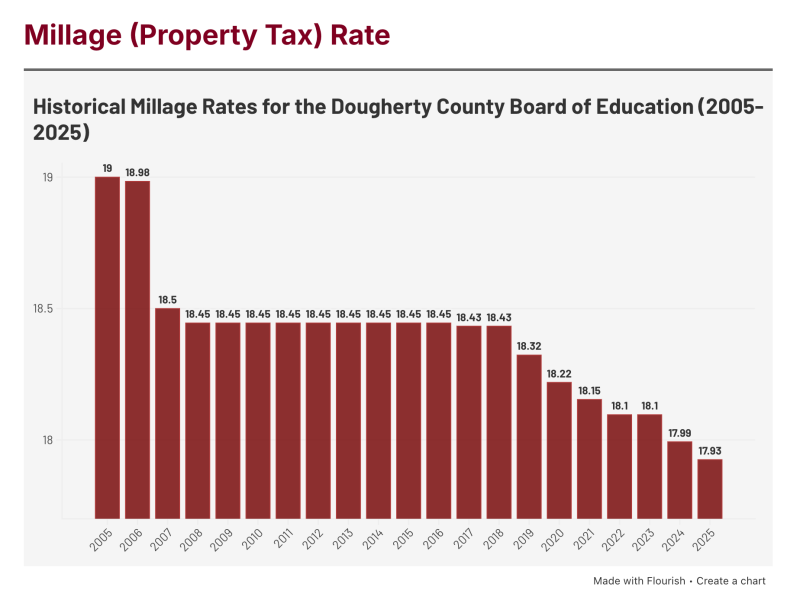
As Dougherty County property owners react to sharply higher reassessed values, school officials say the Dougherty County School System expects to substantially reduce its property tax rate for the ninth consecutive year.

Police seek identity of man killed in early morning shooting Wednesday
Albany Police Department officers responded at 2:45 a.m. Wednesday to an incident at 216 E. Oghetlorpe in which two men were shot, one fatally. The case remains under investigation.
