
Business leaders get economic updates at UGA summit
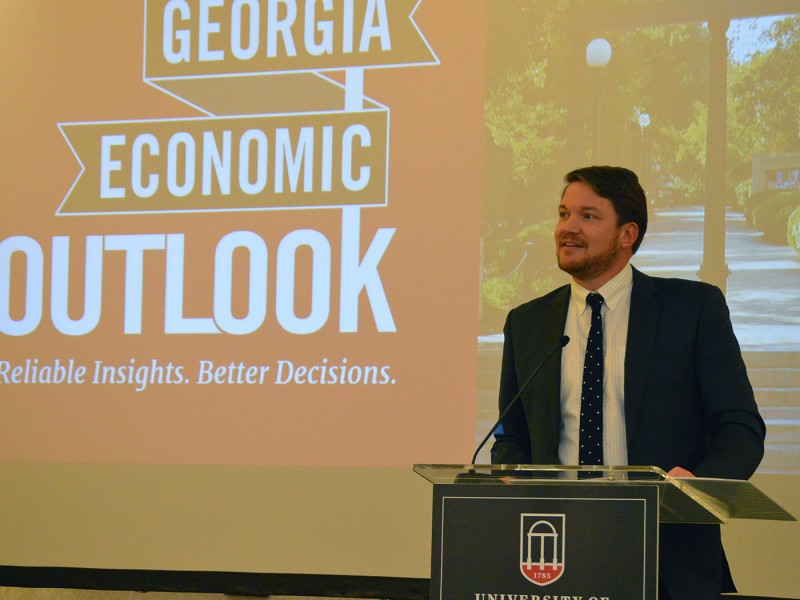
Justin Strickland: Area’s economy is slowly transforming itself
File Photo
By Terry Lewis
ALBANY — A University of Georgia expert predicted another good year for Georgia’s economy, with statewide growth expected to outpace the nation’s, during an annual economic summit in Albany Wednesday.
The UGA economists said Georgia’s economy will match its performance of last year, propelled by a pipeline of economic development projects, solid population growth and a housing recovery, while presenting the annual economic forecast from the Terry College of Business.
“Barring a full-blown trade war, Georgia’s economic outlook is good,” Terry College of Business Dean Benjamin C. Ayers said at UGA’s 36th annual Georgia Economic Outlook. “The pace of GDP will slow, but new jobs will be plentiful. For the sixth straight year, Georgia’s diverse economy will grow faster than the nation’s economy. Because Georgia’s economy is linked strongly to the national economy, the risk of a recession beginning sometime in the first half of 2019 is low, but it is higher in the second half of the year.
“The primary risks likely to trigger a new recession are external to Georgia: a trade war, financial panics and/or massive shifts in asset prices (such as equities and/or bonds), and a possible inversion of the yield curve.”
The forecast calls for Georgia’s inflation-adjusted GDP to increase by 3 percent, which is smaller than the 3.5 percent growth estimated for 2018 but 0.5 percent higher than the 2.5 percent rate estimated for U.S. GDP growth.
Ayers said the positive differences reflect many economic development projects underway, more leverage from the housing recovery, more supportive demographics, faster expansion of Georgia’s manufacturing industries, more competitive economic development incentives, more emphasis on customized work force training, and better prospects for Georgia military bases.
“Nominal personal income will grow by 4.9 percent in 2019, which is slightly lower than the 5.4 percent gain estimated for 2018, but higher than the 4.5 percent gain expected for U.S. personal income” Ayers said. “Georgia’s nonfarm employment will rise by 1.5 percent, which exceeds the 1.3 percent gain estimated for the U.S.”
Ayers predicted Georgia’s unemployment rate for 2019 will average 3.7 percent, or about 0.4 percent lower than the 4.1 percent rate estimated for 2018. He added the unemployment rate will not drop much because of in-migration of workers from other states, increases in labor force participation and a slowdown in job growth. In addition, the unemployment rate is already very low.
“In general, the fastest job growth will occur in construction, followed by education and health services, leisure and hospitality, professional and business services, and mining and logging,”Ayers said.
Locally, Albany-Dougherty Economic Development Commission President Justin Strickland said the Albany MSA will continue to see a slower pace of economic growth than either the state or the nation, so Georgia-Pacific’s announcement of its plans to build a lumber production facility in Albany was very good news. When completed, the state-of-the-art plant will support 130 direct jobs.
Other top employers include Phoebe Putney Health Systems, Marine Corps Logistics Base-Albany, Procter & Gamble, Albany State University, and the MillerCoors Brewing Company. The area’s leading high-wage industries include the federal government and medical offices.
Compared to the state and the nation, Albany’s economy is more dependent on government, retail and health care and less dependent on information, financial activities, manufacturing, and professional and business services. Increased spending on defense and on health care will help, but retail jobs will continue to decline.
“Within manufacturing, Albany is much more focused on the production of nondurable goods, so that sector is relatively stable,” Strickland said. “Compared to the nation, the metro area’s economy depends more on domestic markets and not as much on export markets. Exports — mainly food products destined for Asia — account for only 5.1 percent of the area’s GDP; therefore, Albany faces some direct exposure to a trade war and a retreat from globalization. But compared to the nation as a whole, the fallout should be manageable.”
Strickland also noted that Albany’s strengths include low business and living costs, good productivity per worker, and low employment volatility. The MSA also is a regional transportation hub. The area’s weaknesses include low educational attainment of the work force, few high-tech jobs, low per-capita incomes, and weak demographics.
“As economic conditions continue to improve, Albany will capitalize on its assets, including a low cost of living and doing business, an excellent telecommunications infrastructure, good highway access, the Marine Corps Logistic Base, Albany State University, an excellent technical college, the new 4C Academy,and a reputation as a good place to raise a family,” Strickland said. “The area’s economy is slowly transforming itself, moving away from traditional manufacturing and government to private-sector services-providing industries.”

Related Articles

Dougherty Jail graduates first class of female GED recipients
“It was an escape. I can say this has been challenging. I want to express my gratitude for being able to attend this program.”

From cotton to cloud: In the data center debate, is rural Georgia once again being asked to carry the cost?
Across much of rural Georgia, the abandoned cotton warehouses and shrinking tax bases remain — enduring reminders that industries built to serve distant markets do not necessarily stay rooted in the communities that first sustained them.

Dawson Council approves $400,000 lifeline in emergency meeting as financial accountability remains elusive
Less than a week after city officials publicly acknowledged the City of Dawson cannot continue operating without additional financing, the Dawson City Council convened a hastily called emergency meeting Tuesday evening and unanimously approved authority to borrow up to $400,000 through a tax anticipation note.
