
ON THE JOB: Cafe Campesino is not just a cool coffee shop
Cafe Campesino goes a long way to help rural farmers in Third World countries
By Cindi Cox
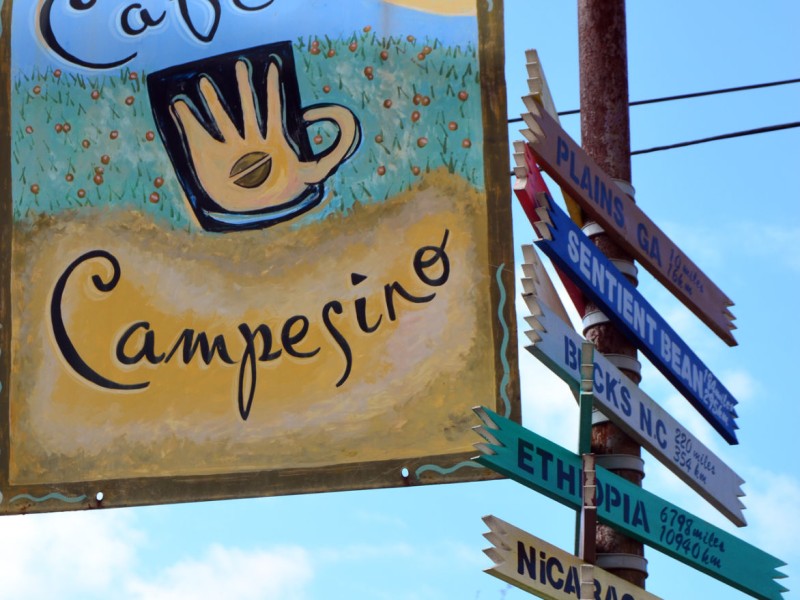
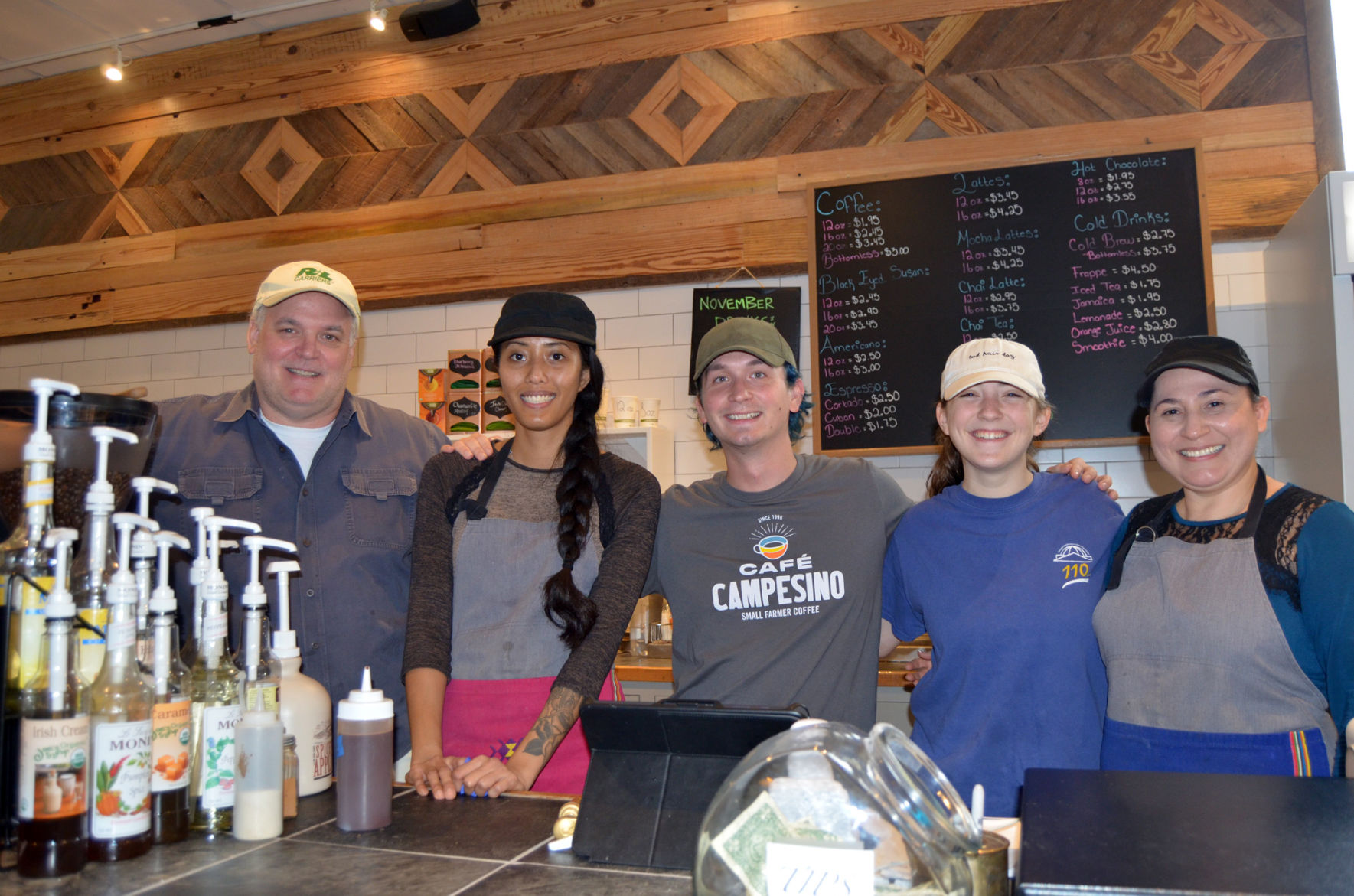
AMERICUS — Cafe Campesino, located in downtown Americus, is not just a cool coffee shop. It is a premier industry training center and the people running it are spearheading a growing network of like-minded roasters, sellers, distributors and consumers who share a global interest in supporting small coffee bean farmers.
For co-owner/CEO Tripp Pomeroy, it’s an opportunity play out his passion and driving devotion to social responsibility by building a chain supply network based on fair trade and the Golden Rule.
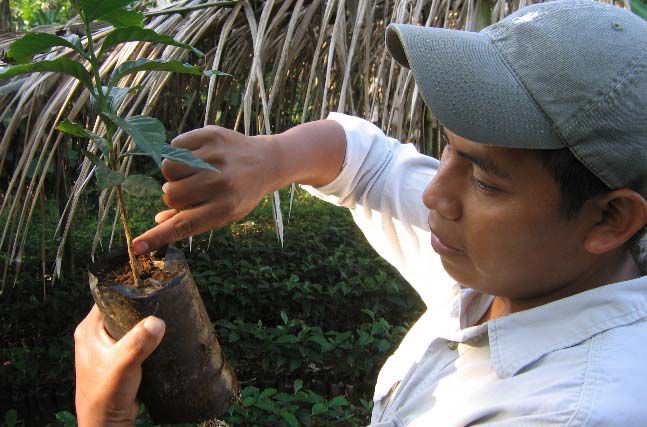
“Most coffee growers are small farmers who live in remote areas where there is high poverty,” Pomeroy said. “We contract with farmers from South America, Colombia, Honduras, Guatemala, Mexico, Sumatra, Africa and Ethiopia. All of our coffee is organic and growing it is very labor intensive. Most of these small farmers were selling their coffee beans at roadside stands and they were never given a fair price for their coffee.”
Pomeroy said the supply chain begins with a small cooperative of coffee roasteries buying the raw coffee beans for a fair price from these rural farmers.
“Most coffee buyers go to an import company, but we go directly to the farmers,” Pomeroy said.
The network of roasters and distributors began 20 years ago with six other co-op members. The company was founded by Pomoroy’s business partner, Bill Harris, a Georgia Tech graduate and an Americus native.
Although Cafe Campesino does not promote itself as a faith-based company, its roots run deep with Habitat for Humanity and the small Christian farm community in Sumter County called Koinonia Farm. Koinonia, a Greek word, occurs 20 times in the Bible and means “fellowship, sharing in common, communion.”
“It’s not about going to church on Sunday, but it is about how you do business on Monday; how you treat people in the store. When you buy and sell, do you give people a fair shake? It is about social responsibility and bringing people together,” Pomeroy said. “In the end, nobody is going to remember you for coffee. When you meet your Maker, He will want to know how did you treat people.”
According to corporate history, Harris was on a mission trip to Guatemala in 1997 with Habitat for Humanity’s Global Village program when a team member dumped a load of dirt on a farmer’s coffee bean bush. The ruckus from that gave birth to a strategic and growing cooperative supply chain based in Americus that links small farmers to roasteries, sellers and consumers in the U.S.
Harris’ research showed coffee farmers all over the world were being exploited, Pomeroy said.
“Coffee farmers get about a pound of green coffee from each bush they have. That means handpicking and selecting roughly 2,000 coffee cherries per bush. That doesn’t amount to much, because most farmers have fewer than 10 acres of coffee trees,” Pomoroy said. “It is so cool what one person can do that can snowball into a global community.
“At the time, the farmers received only about 50 cents per pound of coffee produced, and millions of families depended on coffee as their main source of income. This did not make for a very fair or sustainable relationship. Our core values tell us to help the underdog — to help these small farmers. The farmer is where the rubber hits the road.”
In November 1999, seven coffee roasters (including Cafe Campesino) met in Atlanta, forming Cooperative Coffees.
“Right now there are 22 members of the Cooperative Coffees network which will receive 110 shipping containers filled with raw coffee beans from about two dozen farming co-ops. Cafe Campesino is a founding member of that network,” Pomeroy said. “Most of the founders were Cafe Campesino customers and all embraced the idea of cutting out a middleman in favor of collectively owning an importing company that would only deal directly with small scale farmers.”
According to Pomeroy, serving the farmers, telling their story, building community and delivering a pure product are the heart and soul of Cafe Campesino.
“The message gets lost if our coffee can’t compete,” said Pomeroy.
Small farmers pool their resources to sell their coffee beans to Cafe Campesino and its network.
“Relationships formed two decades ago, still exist. For example, we have a long-standing relationship with 20 Guatemalan farmers,” Pomeroy said.
Cafe Campesino’s Americus roaster is set up behind the Habitat for Humanity Global Village and next to the Habitat Restore. The next closest roaster is in Gainesville, Fla.
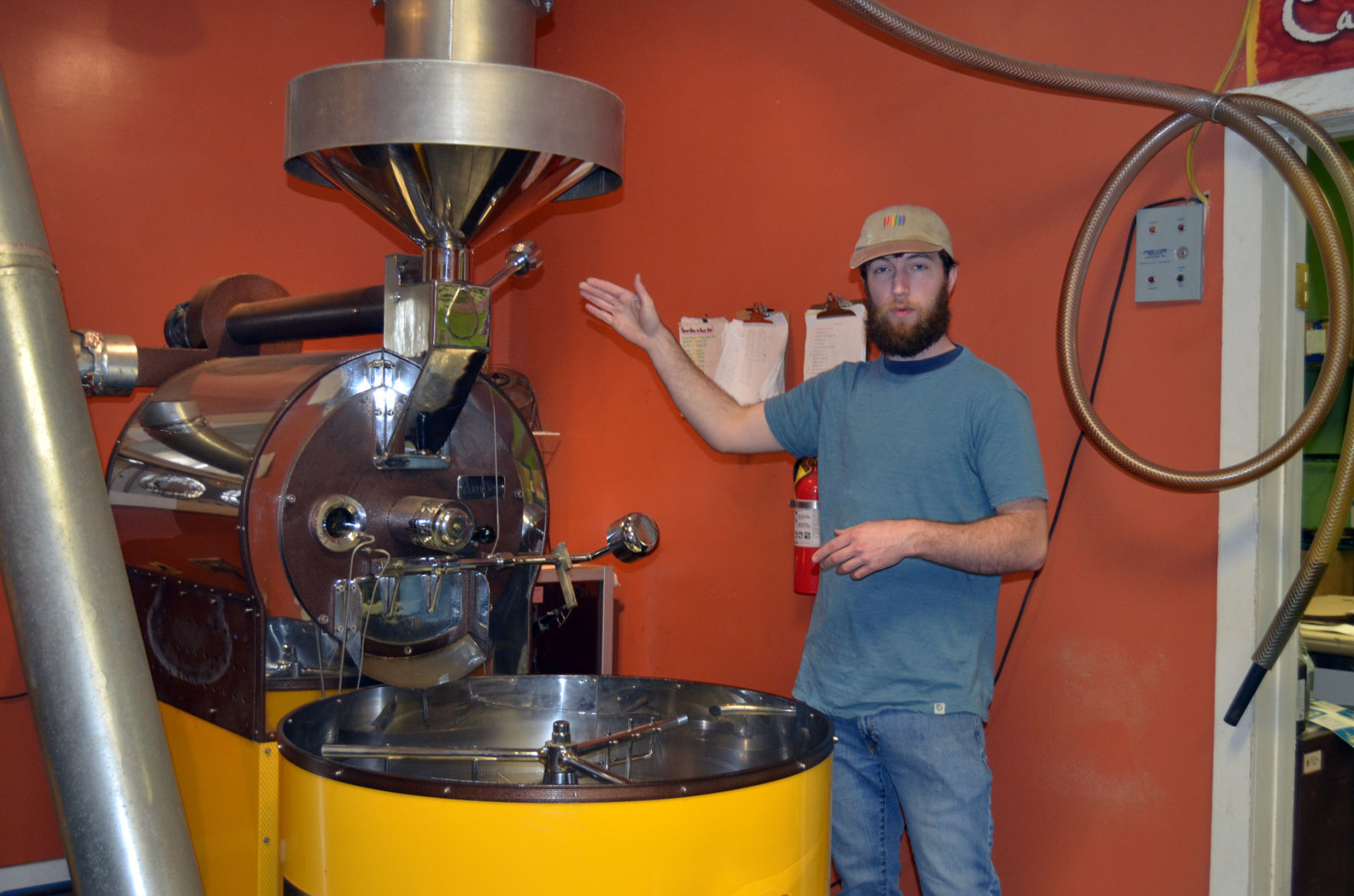
Raw coffee beans arrive in burlap sacks. A huge sack of green coffee beans is opened and poured into a roasting machine that’s so tall it towers to the ceiling. The roaster is set at 450 degrees, drops to 150 degrees and then it goes back up to 450 degrees. The process takes 20-30 minutes.
As they roast, coffee beans can be heard churning and a mild aroma fills the air, one not as strong as a coffee pot brewing.
Once the cooking is complete, a metal gate opens and beans pour into a huge spinning bowl near the bottom of the machine. Harris holds a large metal scoop, which he uses to stir the beans as they pass out of the chute into the revolving bowl where they remain until they cool. Once cooled and dried, the beans are bagged up in one-, two- and five-pound packages for wholesale and retail shipments. Freshly roasted coffee beans are also sent over to the Cafe Campesino coffee shop located a few blocks away.
Records show the Cafe Campesino roaster in Americus fills between 200 and 300 orders per day.
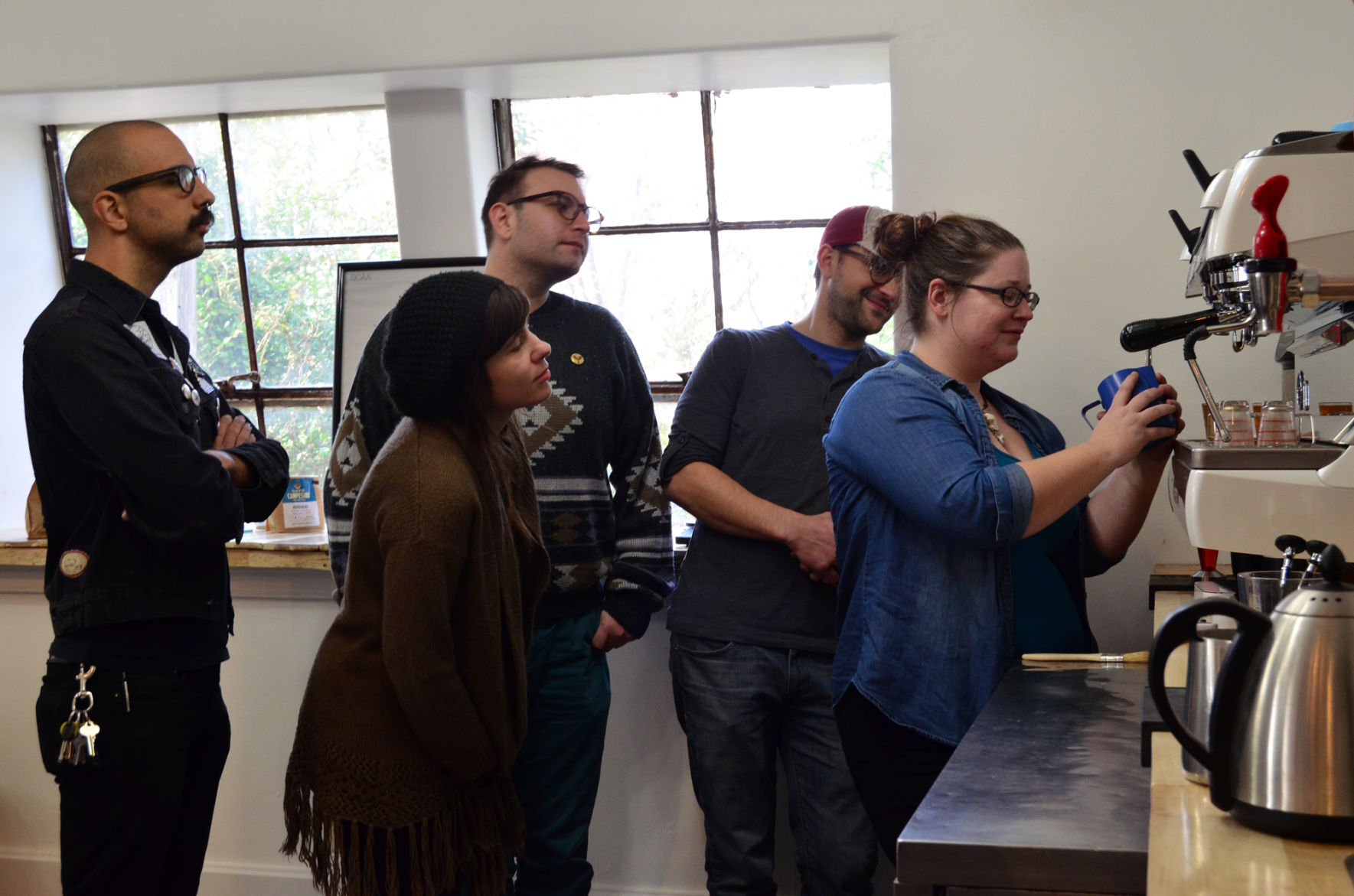
As Cafe Campesino prepares for its 20th anniversary, the growth and excitement continues. It recently joined an international network of coffee training facilities after the Specialty Coffee Association (SCA) certified it as a Premier Training Campus — the first in Georgia. The training lab opened on Nov. 20 after successfully demonstrating that it meets the SCA’s international standards and protocols for coffee-brewing and barista instruction. The site, adjacent to the company’s roaster, offers classroom and hands-on settings for the general coffee consumer, as well as baristas, coffee shop owners and industry professionals who need brewing techniques and supply chain theory to successfully operate their businesses.
“We are thrilled to collaborate with the SCA and provide this much-needed resource for Southern coffee professionals who are looking for training,” Hannah Mercer, an Authorized Specialty Coffee Association Trainer (AST) working with Café Campesino, said. Mercer, the instructor, led the company’s efforts to open the training lab in part because she had to travel across the country to get her own training.
There are 30 U.S. locations in the network of training centers, with 150 training sites exist outside of the U.S., including locations in Australia, Brazil, Canada, Colombia, China, Peru, Taiwan and Vietnam.
The SCA is an international association of coffee businesses and professionals formed this year when the Specialty Coffee Association of America merged with Specialty Coffee Association of Europe. Students currently pursuing an SCAA Pathways certification are encouraged to complete their training before the curriculum changes at the end of the year.
As for SCA industry standards training, Mercer said the Southeast is “incredibly under-served.” The nearest training center to the Americus one is in New Orleans.
Meanwhile, according to Pomeroy, organically grown specialty coffee is one of the fastest growing food and beverage industries in the country.
Cafe Campesino is at www.cafecampesino.com. Mercer can be contacted at [email protected].
Related Articles
Dougherty County police expect to present report on surveillance cameras within two weeks
The Dougherty County Police Department initiated an auditing system for its surveillance cameras in August. The department said on Monday that it will present a report on audits dating from January within the next two weeks.
Southwest Georgia Career Expo lets job seekers shine in Albany
“I’m just trying to get a career, just anything that might spark my interest, really. I just want to see what’s out there.”
Joshua Harrison pounds the pavement to provide shoes for Dougherty County children
“Being able to work with the H.E.A.R.T. organization and they work with me as one of their protege sons, it really made my life different. I want to let children feel better about themselves.
