
Randolph County board proposes closing multiple polls
‘No indication’ of poll closure proposal before Wednesday
By Jada Haynes
CUTHBERT — The American Civil Liberties Union of Georgia made national headlines this week when it came out against a proposal from the Randolph County Board of Elections and Registration to close seven out of nine polling places in the county.
Because the county is mostly populated by African-Americans, the organization called the proposal “discriminatory, unjustifiable and (said it) violates the Voting Rights Act.” There will be two public meetings — one was held Thursday and the other is planned today — about the proposal with a final action scheduled for Aug. 24.
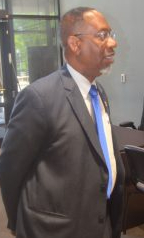
Bobby Jenkins, the county’s Democratic party chairman, provided more context on the matter.
Jenkins said the proposal first appeared in the legal section of a local newspaper last Wednesday. “That’s the first I knew about it,” he said. “I don’t know when they started.”
Jenkins said that there had been “no indication” that this proposal was coming down the line.
“No articles appeared in the paper prior to the legal notice that appeared in the legal section,” he said. “And, of course, we feel that that was deliberate. The timing of it is just bad. This is in the middle of the election cycle. People (are) voting in one place for the primary and then they would have to vote at another for the general, and that would just create mass confusion. If you combine those two things together, it would appear that this was a deliberate attempt to decrease the participants in the voting process. That’s why we said that it’s voter suppression.”
Jenkins said closing these polling locations would negatively impact the county’s citizens.
“It disproportionately affects the poor and the elderly,” he said. “If you live in Springvale, for example, you can walk to the polls. Well, if this plan goes through, then you’ll have to travel 8 miles to the poll. That would create a hardship on the elderly and the (poor). The county is 60 percent black. It’s a poor county in the state, so a lot of people live below the poverty line. So to do anything that would make it harder for them to vote is discriminatory.”
Randolph County covers a land mass of 431 square miles, with “polling places spread out in the communities.” Jenkins listed Benevolence, Springvale, Coleman, Carnegie, 4th District, Fountain Bridge and a voting precinct at Randolph-Clay Middle School as the polling places the county’s board are “supposing to close.”
Jenkins added that the middle school precinct is made up of approximately 98-99 percent black voters.
“The people from Benevolence, some of them would have to come to Cuthbert to vote,” he said. “The others would go to Shellman to vote. … They’d have to find transportation. They’re putting the burden on the people because they can no longer vote in person at the polling place in our community.”
Asked why he thought this proposal came in the midst of the election season, Jenkins responded, “That’s the million-dollar question.
“No one has shared that information as to why,” he added. “When you look at all of the factors, you have to draw the conclusion that it would have to be voter suppression.”
Jenkins said that the general election is approaching, and one of the candidates residents will be voting for is running for state representative of their district, District 151.
Jenkins defines voter suppression as “any strategy or attempt to influence the outcome of an election by confusing, preventing or discouraging a specific group of people from voting.”
“Think of it this way,” he said. “Rather than choosing the candidate and getting people to vote for a candidate, you choose the voters. So if you choose the right voters, you increase the chance that you’ll get the right person elected.”
According to Jenkins, Randolph County has had similar experiences with voter suppression before.
“I remember several years ago, there is a predominately black neighborhood that’s just outside of the city limits,” he said. “They’re about a mile, mile and a half away from the courthouse. They were allowed to vote there out of convenience. Then, there was a move made to make them go to a different polling place, which is 7 miles out of town (in) Springvale.”
Jenkins described the current two-member election board as “one person shy of a dictatorship.”
“Right now, there are only two members on the board because one resigned to run for an elected position,” he said. “But this board has a history of doing things of a discriminatory nature.”
Jenkins provided another example, referencing the Cook v. Randolph County, Ga. case of 2006.
“Several years ago, they were trying to draw a particular Board of Education member out of his district, Mr. Henry Cook,” Jenkins said. “At that time, there were different people on the Board of Registrars, but they had a meeting that was not advertised and they moved him from a predominately black district to a predominately white district. Of course, he challenged that. Voters challenged that in federal court and prevailed.”
In the face of the new proposal, Jenkins said that he feels the residents of Randolph County will challenge it as they have done before.
“We’re going to fight to get it stopped,” he said. “Let me put it that way. We’re going to fight to get this plan stopped.”
The ACLU of Georgia sent out a notice Thursday afternoon that its legal director, Sean Young, prepared remarks for his testimony at the Randolph County board’s first public hearing. Today’s meeting will be at the Shellman Train Depot, located at 58 Park Ave. in Shellman. It will begin at 6 p.m.
Related Articles
Albany police investigate suspicious Sunday death
A 21-year-old Turner Job Corps student who was found unresponsive on Sunday evening was later pronounced dead at Phoebe Putney Memorial Hospital. The death is under investigation.

James Rubino installed in new role at Marine Corps Logistics Command in Albany
James L. Rubino recently assumed the role as executive deputy of Marine Corps Logistics Command in Albany. In his new role he will oversee integrated logistics support.

Rain depresses voter turnout in Dougherty County
“A lot of people don’t vote when it’s raining. People don’t do a lot of things when it’s raining.”
