Research leads to Albany reconnection for Pratt
Native does his dissertation research on crime, violence in his hometown
File Photo
By Carlton Fletcher
ALBANY — When Joseph Holley founded Albany State University 116 years ago, surely he longed for a day when individuals like James Pratt Jr. would be sharing their knowledge with what has over the years become a diverse student body, something perhaps too incomprehensible for Holley to envision given the time.
A native of Albany who found his true self on the campuses of Atlanta’s Morehouse College and on the West Coast at the University of California-Irvine, Pratt is now back in Albany, teaching Criminal Justice classes at ASU while conducting research for his Ph.D. dissertation on crime and violence in his hometown.
Pratt’s low-key, dignified demeanor, a trait enhanced by his thoughtful and eloquent manner of speech, belies what he says was a “rambunctious” past that saw him “getting into a fight just about every day,” picked on by his classmates at Westover High School because of his relatively diminutive (5-foot-5) stature.
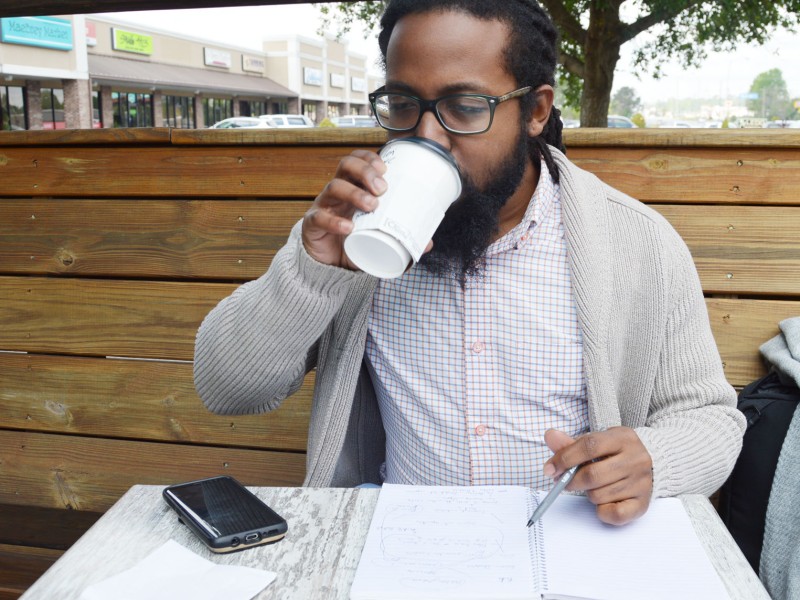
“I was a lot different then, getting into a fight almost every day because I was being picked on,” Pratt said as he went over his research and enjoyed a coffee at a local shop. “I think, in the long run, that may have been one of the reasons I developed an interest in the criminal justice system. I wanted to know why people did these kinds of things, to understand their motives.
“From a young age, I wanted to be a prosecutor, to lock up criminals.”
But Pratt’s horizons widened when he was exposed to research methods at Morehouse that allowed him to explore traits not just of African Americans in general but of black men specifically.
“I did not want to go to an all-black school,” he said. “I wanted to go to Oxford, and I thought the best way to get there was to go to Emory. I applied there, at Mercer University and at Morehouse, only because my mom told me she wanted me to go there.
“It was at Morehouse that I was involved in an interview that changed my life. Giles King Eady was a recruiter for the college, and one of the things I never forget from our interview was that he pointed out that I had written ‘Morehouse University’ on my application. He said taking note of seemingly insignificant details like Morehouse not being a university is important. That attention to detail made an impression on me, so I listened more closely to what he had to say.”
Pratt decided to attend Morehouse, and he quickly fell in love with the campus and what he called the mystique of the “Morehouse Man.”
“It definitely, 100 percent was the right choice for me,” Pratt said.
After earning his bachelor’s degree in Psychology and his advanced degree in Social Ecology — a discipline that takes into account the systems that govern an area and how those systems impact human relations — Pratt decided to seek a doctoral degree in Criminology from Cal-Irvine, a campus he’d become familiar with while taking part in a college research internship after his junior year at Morehouse.
With most of his studies behind him, it came time for Pratt to decide on and defend a subject for his dissertation. While others focused on more exotic parts of the world, Pratt chose to return to Albany and to delve deeper into the violence and crime that plague the city.
“A lot of crime has to do with misperceptions,” Pratt said. “For instance, I went to an Albany Gang Task Force meeting, and a city official — I won’t say who — mentioned the ‘gang problem’ at Albany State. He was surprised when the (ASU police chief) said, ‘No, we don’t have a problem with gangs on our campus.’ There’s just that widespread misperception.”
But, Pratt says, that doesn’t mean crime is not a key concern in Albany.
“Unfortunately, when it comes to violent crimes, Albany is at the top of the heap,” he said. “Most people don’t understand how crime and collecting crime data work. Crime happens in pockets, so when you look at data based on per-100 people samples, the crime is not as broad. And when you compare Albany’s crime stats to cities of similar size, it’s not a good comparison.
“People have spoken a lot about economic development, but if you look at crime in our community from four specific eras — the (Albany founder Nelson) Tift era, post-reconstruction, the Civil Rights Era and the present — you have to look at a lot of layers. There’s the general crime culture of the ‘Violent South’ as it was settled by the Scotch-Irish, slavery, vigilantism even among the elites in the region, class issues and the prevalence of single-parent homes. Layers.”
While gathering data and conducting research, Pratt has taught classes such as Race, Gender and Crime, Introduction to Criminal Justice and Introduction to Law Enforcement at ASU. He’s also found himself, gradually at first but moreso now that he’s “reconnected” with his hometown, drawn to the issues that impact the community.
At a recent Albany City Commission meeting at which citizens from a south Albany neighborhood were protesting the planned location of a liquor store nearby, some at the meeting offered up meaningless threats that were a thinly-veiled attempts to gain political ground. It was Pratt, though, who offered a thoughtful, commonsense take on the situation.
“It was kind of a last-minute thing; someone said, ‘You ought to go up there and speak,’” Pratt said.
He jotted a few notes, made his way to the front of the auditorium and suggested, without the histrionics that had been used by speakers before him, that the commission might develop a means by which the citizens impacted by their decisions have an opportunity to express their thoughts on the issues.
“It’s one of those institutional problems where the community is blamed for its ills,” Pratt said. “That frustrates me. I simply suggested that the citizens involved would become more invested in their communities if there was some sort of partnership created so that they’d have a say in the things that impact them.”
Pratt, an Alpha Phi Alpha fraternity brother, also speaks often at Boys and Girls Clubs, to school and church groups and he’s gotten deeper involved in the nonprofit clearinghouse SOWEGA Rising.
“I’m not the person to take over any sort of movement, but I think it’s important that I be involved,” Pratt said. “Because, yes, in my two years back in Albany I have rekindled the connection and the love that has always drawn me here.”
In a few months, Pratt will complete his research and begin the final work on his dissertation. After that? Perhaps that reconnection with Albany will take root.
“All of my work, even work on my dissertation is a product of my guiding philosophy: love for society, instilling compassion and mutual understanding,” the man with the professorial demeanor and the eloquent vocal skills declares. “I hope that somehow the work that I’m doing can spread and have an impact on this community. I really think Albany can transform itself.”
Author

Related Articles
Dougherty school board vacancy, election lawsuit leave voters facing uncertainty
Dougherty County School Board members acknowledged Thursday that they must address a District 4 vacancy after Melissa Strother resigned. Meanwhile, a court challenge to the May primary alleges scanner malfunctions, mishandled ballots and incomplete election records.

A great-grandmother’s influence inspires new Albany boutique
The giant pink azaleas painted on the bright white facade of Millie’s are a tribute to a woman who taught Sydney Kate Tye how to dress, how to work and how to care for people. Inside, a couch that belonged to Millie Daughtrty and her husband is part of the plan for a store built around relationships — past, present and future.

Lee commissioners back $200M hospital bond plan, separately OK $122K for utility engineering
Lee County commissioners approved a financing plan Tuesday allowing up to $200 million in revenue bonds for the proposed hospital at Grand Island and separately approved $122,000 for engineering work to extend water and sewer service to the site.