
Public Safety Committee continues work addressing Albany’s violent crime
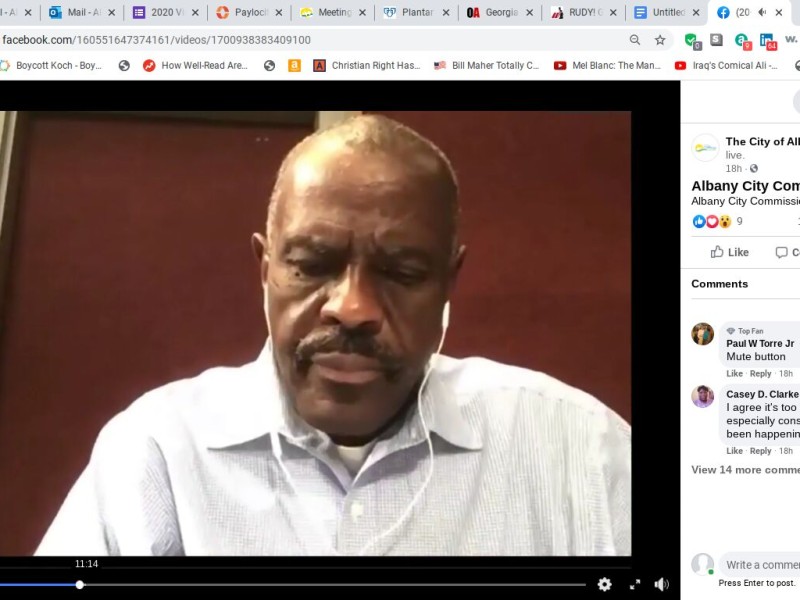
File Photo: Alan Mauldin
By Alan Mauldin
[email protected]
ALBANY — City leaders in Albany are looking at adding more police precincts in high-crime neighborhoods and gunshot-detection devices as they look to deal with a spike of violence in recent months.
The Albany City Commission earlier this year established a Public Safety Committee that has held several meetings. On Tuesday the committee will present some of its initial work to the full board and indicate some of the solutions under consideration.
There have been 17 homicides in the county for the year, 16 of which occurred in the city. All but one of those slayings was by firearm.
For Commissioner B.J. Fletcher, establishing a precinct at Carver Gym, which the city is renovating, should be a priority. The other committee members are Commissioners Jon Howard, Chad Warbington and Demetrius Young.
“If you look at your crime, Carver Gym is in the heart of the crime area,” Fletcher said. “I am pushing (that) we need a police presence over there. We need precincts in these communities to bring a police presence.”
Gunshot-detection devices are another potential recommendation. Fletcher said she receives a number of calls from constituents who say they think they heard gunshots in their neighborhood.
Howard said his phone calls are predominantly from residents who have fears related to crime and violence. Some are elderly women living alone who would move from their neighborhoods if they could afford to do so.
“My phone rings … it will start at 6 o’clock in the morning, and it will ring ‘til midnight,” he said. “A lot of our citizens, they are concerned. A lot of them have grandkids. They are paranoid and scared.
“You’ve got so many citizens who say they are not going to go out at night. They are not going to go to the store at night because of the neighborhood I live in. We are all tired of these crimes.”
In addition to Carver Gym, Howard said he would like to see the precinct in east Albany brought back to full operation. Currently, officers use the location to do paperwork, but it is not open to the public as a place where residents can go to speak with officers and report concerns.
Howard said he envisions officers interacting more with residents, perhaps knocking on doors and asking people how they’re doing and having a positive presence, like the community-oriented policing concept that was introduced several decades ago.
The city at one time had several precincts located throughout the city that were closed due to a previous city manager’s cost-cutting, said Howard, who added that he unsuccessfully fought against that decision.
“I’m in favor of having precincts located in high-crime areas — southside, eastside and the central part of the city,” he said. “Police in certain areas, sometimes just park your car and walk the neighborhood. It gives citizens the assurance that they are safe.”
Howard also said there is some validity in criticism from Dougherty County Commission Chairman Chris Cohilas, who in recent weeks has stated the city’s contribution to the Albany/Dougherty Drug Unit is inadequate.
The Albany Police Department has staffed only six of the 12 positions on the joint drug unit for the current budget year, Howard said.
The unit also is staffed by officers from the Dougherty County Sheriff’s Office and the Dougherty County Police Department.
Cohilas, a former prosecutor, said that the unit is designed to be proactive, to go out and knock on doors and make arrests for crimes in progress rather than responding to 911 calls about an armed robbery that already has occurred.
His criticism is not of Albany Police Chief Michael Persely, he said, and there is a long history of the department not adequately staffing the unit.
“Ninety-nine-point-nine percent of drug-related crime is in the city,” he said. “This is a management-level decision that continues to be made (by the city). It is not getting done. (The drug unit) was formed to be a collaborative effort between the city and the county.”
As the city’s committee continues its work, all potential solutions will be examined, Fletcher said. An outside consulting firm is currently performing an evaluation of the police department and will make recommendations on improving operations.
For James Pratt Jr., an adjunct criminal justice professor at Albany State University, some of the ideas mentioned at committee meetings make sense, but some do not.
During his run for mayor last year, Pratt advocated for gunshot-detection devices. However, he said more precincts may lead to “overpolicing” of neighborhoods whose issues extend beyond law enforcement to poverty and other factors that drive crime.
Too much policing, he said, can potentially lead to an increase in crime.
“The research shows in places with Albany’s culture and Albany’s history, we need more understanding,” Pratt said. “I think we need to think of other social mechanisms outside of police. I think they are doing things that are popular on the surface, but are they effective?
“(Precincts) may increase response time, but it does not deal with the root.”
Pratt is seeking funding to establish the Justice Propulsion Center at Albany State that will conduct research and provide training.
Author

Related Articles
Albany Herald – July 11, 2026
Putting on the Ritz… Food, mini menagerie provide… Albany City Commission set to vote on… Following Lee’s lead, Terrell County hits…

Classifieds – July 11, 2026
Albany Classifieds and Legals: Real Estate; Merchandise, Misc…
Small actions can help save big on utility bills
The high temperatures of July and August can bring scorching utility bills as air conditioners hum to keep houses cool. Albany Utilities Residential Conservation Auditor Willie Jackson offered some tips on making summer cooling bills more manageable.
