
Resora community will make public, private debuts Saturday – PHOTO GALLERY
Carlton Fletcher
ALBANY — For the better part of an hour, the generally soft-spoken Shirley Sherrod talks animatedly about the circumstances that led to the collective she and her husband, the civil rights activist Charles Sherrod, helped found that now owns the former Cypress Pond Plantation in southwest Dougherty County.
As she looks out from the beautifully restored plantation home that is the centerpiece of the soon-to-be-renamed Resora community, over the 1,638 acres of land that was formerly tended by African slaves, Sherrod becomes pensive, a touch of reverence in her voice.
“There are times, when I’m on certain parts of this land, that I get the feeling of the slaves who worked here,” she says. “It’s an incredible feeling.”
That the Sherrods and other founding members of New Communities Inc., established in 1968 to amass land holdings and create a community — based on the concept of the Israeli kibbutz — where individuals would live truly free, would one day have collective ownership of such a place is as truly amazing a story as it is ironic.
“It is pretty cool when you think about the beginnings of this place, a plantation that was worked by African slaves, and where it is now,” Sherrod said as she and Resora staff prepared for Saturday’s grand re-opening of the former plantation. “Knowing a little of the history, though, I often wonder if the slaves who worked here ever dreamed that there would be a day when things would be different.”
The grand opening of Resora, a word that incorporates the concepts of resilience and resourcefulness into the embodiment of the human spirit, includes multicultural activities from 9 a.m.-1 p.m. that are open to the public. An invitation-only event is planned from 7 p.m.-10 p.m.
“The morning events are designed to bring about healing,” Sherrod said. “We’re trying to connect the community, focus on existing together. We plan to open with a blessing of the land by representatives of the Lower Creek Indians and include African drummers and readings from the plantation era. It’s about inclusion: from Africans to Asian-Americans to Hispanics to whites.
“From 11 to 1, we’re planning ‘A Taste of Resora,’ which will include foods from a number of area restaurants. All of the early events are free, and we invite everyone in the community to come and take part in them.”
The genesis of New Communities’ ownership of the soon-to-be former Cypress Pond Plantation stretches back almost four decades, to the height of the civil rights movement. The Sherrods, Slater and Marion King, and five New Englanders went to Israel to study the kibbutz, a collective community that was traditionally planned and built around agriculture. They returned to America with the idea of creating their own such Shangri-La through a countrywide land trust.
The group made its initial purchase in Lee County, buying the 5,735 acres of the former Featherfield Plantation.
“It was such an empowering idea,” Shirley Sherrod said of New Communities’ early efforts. “The plan was to develop our own health system, farm our own food, create our own education system. We were connected to a railroad spur, so we were able to literally dream of a self-contained community.”
As might be expected, given the social unrest of the era, opposition to the plan surfaced immediately.
“Even during the planning process, there was opposition,” Sherrod said. “We were promised money from the OEO (Office of Economic Opportunity), but Lester Maddox was governor of Georgia at the time, and he vetoed any OEO money coming into the state. We held onto the land, but there were no loans coming in from the USDA.
“And there were people in the community who opposed our ownership. They would ride by and shoot into our buildings.”
Shirley Sherrod, through her work with the Southwest Georgia Project, helped farmers throughout this region obtain loans from the federal government after severe drought set in during the mid-1970s. She and her New Communities partners were painfully familiar with the circumstances.
“I was working to help area farmers get emergency loans through the USDA, and it dawned on me that we were going through the same things on our land that these farmers were going through,” she said. “We went to the Farmers Home Administration office in Dawson and applied for a disaster loan. The person in charge there told us, ‘You’ll get a loan over my dead body.’”
The partners challenged the decision in court and eventually did get an emergency loan. But it was three years later, long after irreparable damage had been done. (“No, the man didn’t die,” Sherrod laughed. “In fact, they moved him to another office. He wasn’t fired. I think I’m the only person who’s ever been fired by USDA.”)
In 1985, struggling under the weight of the ongoing drought, New Communities lost its land to foreclosure.
New hope for the collective arose in 1997 when word surfaced that Tim Pigford, a black farmer from North Carolina, had filed what would become a class-action lawsuit against U.S. Secretary of Agriculture Dan Glickman claiming that, between the years 1981 and 1996, black farmers were systematically denied disaster loans based solely on racial discrimination. A ruling in favor of the Pigford plaintiffs was handed down in 1999, but it would be a decade before money was disbursed in the case.
“A light went on one day when I was driving home from an area farm: We had been farming during the period mentioned in the Pigford case, and we had been denied loans for discriminatory reasons,” Sherrod, who was then working with the Federation of Southern Cooperatives, said. “We joined the suit just before the deadline, and then waited.”
And waited.
The black farmers learned they’d lost their case in July of ‘98, but in October they filed an appeal. A subsequent review revealed trial errors, so the case was returned to an auditor to rule on the new information. The auditor ruled in the farmers’ favor, but it would be a full decade before any settlement money was distributed.
In 2009, the Sherrods and their New Communities partners were notified that not only had the initial ruling been overturned, they would receive a staggering $12.789 million, the largest of what would be a billion-dollar settlement. The Sherrods also received $150,000 each for mental anguish.
“When we got the ruling, my husband and I sat up and cried that night,” Sherrod said. “One of the first things we did was call the other people involved, people who had lost their homes, and told them they were to get $100,000 each from the settlement.
“Even while all of this was going on, there had not been a moment that we had given up on our dreams. We immediately started talking about looking for more land and continuing our plan.”
The New Communities partners were days away from signing a contract on a parcel of South Georgia land when a Fed-Ex driver who had grown up on the Featherfield Plantation land told them that Cypress Pond was for sale. The property had initially listed for $21 million, but its price had dropped all the way to $6.9 million.
Charles Sherrod suggested the group offer $5 million for the property, and within days, the contract was signed.
“We closed on the property in June of 2011 and started work here in 2012,” Shirley Sherrod said. “The first thing we did was work to upgrade the 85 acres of pecan orchards. We started with the farmland and moved to the house.”
The sprawling plantation home, according to Resora Director of Planning Latoya Cutts, did not require a great deal of work.
“The previous owner (Gerald Lawhorn) had done such a tremendous job of restoring this place, there was not a ton of work to be done,” Cutts said. “There was stuff to be done on some of the cabins, some exterior painting (on the plantation home) and some wallpaper that had to be replaced. But, generally, it was in great shape.”
New Communities will work through Phase I of Resora’s incarnation, which includes upgrades to cabins in a large wooded area, upkeep of pecan and orange groves on the farmland, and planning events at the cultural center that includes the restored circa-1851 plantation home.
“My focus will be to bring these three units together,” said Danielle Blackwell, who will soon replace Cutts — who was on hand primarily for the early planning stages of Resora — as director of planning. “We want to make sure all three elements of the property are maintained, and we want the community to realize this is something for all of us.
“We hope to eventually include an inn, a conference center and maybe even a chapel. We hope the community will utilize these facilities.”
Already, New Communities has been granted an FCC license for a new radio station, WUTU (88.3 FM), which is accepting ideas for local programming.
“Even through all the struggles, all that we went through to get to this point, it seems surreal,” Sherrod said. “There were times when we wondered if a day like this would ever come. There are critics, of course, people saying, ‘Charles and Shirley Sherrod went out and bought themselves a plantation.’ It’s not like that. It was never like that.
“From the beginning, this whole concept has been about community. That’s the way it was in the beginning; that’s the way it is now.”
Related Articles
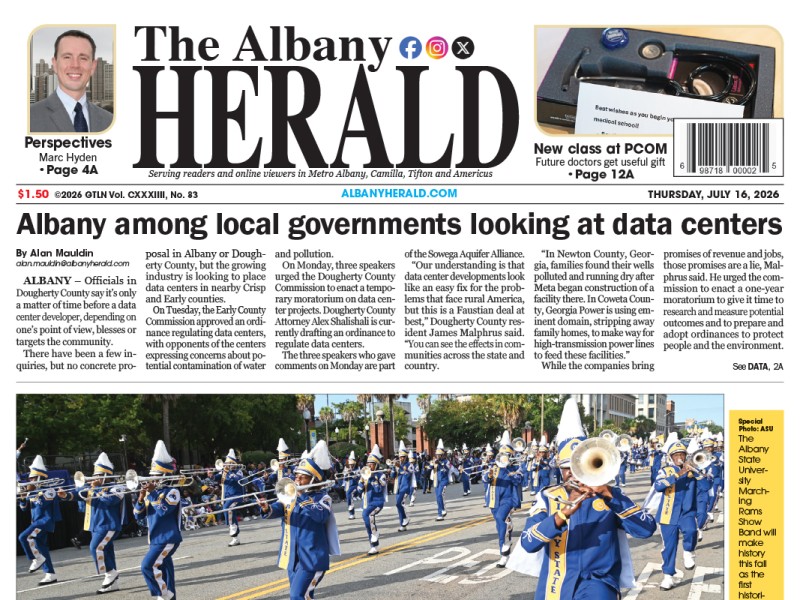
Albany Herald – July 16, 2026
Albany among local governments looking… ASU Marching Rams first HBCU band
invited…

Classifieds – July 16, 2026
Jobs; Cemetery Lots; Garage Sales; Public Aucitons; Etc…
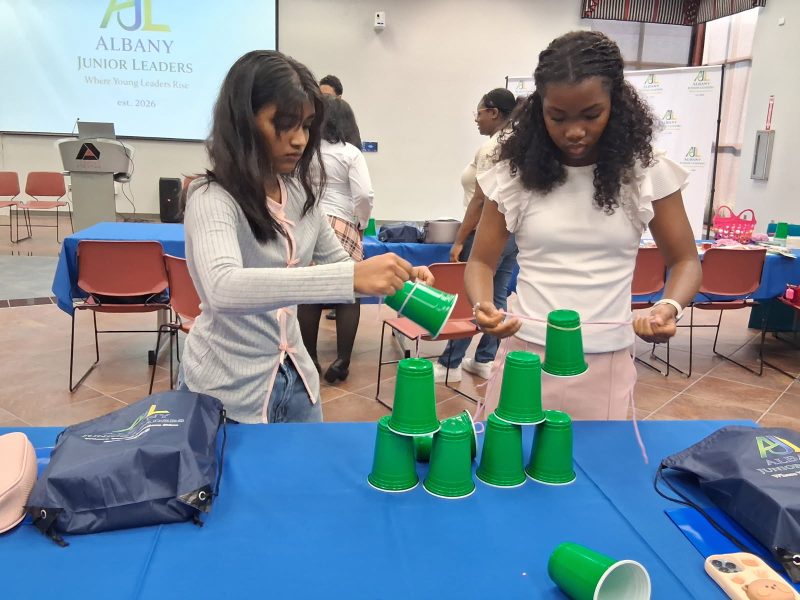
Adult leadership group spreads concept to high school students
“The purpose of Albany Junior Leaders is to pull together leaders from all over the community. We wanted to give these youth the same experience and the same exposure we’re getting in Leadership Albany.”
