
Southwest Georgia farmer leads the way in Georgia organic peanut venture
No more than 1,000 acres exist of these “wild” fields of organic peanuts, a relatively new venture, in Georgia.
ALBANY – The lush, green rows that make up expansive peanut fields are a familiar site for southwest Georgians, making up roughly 800,000 acres across the state.
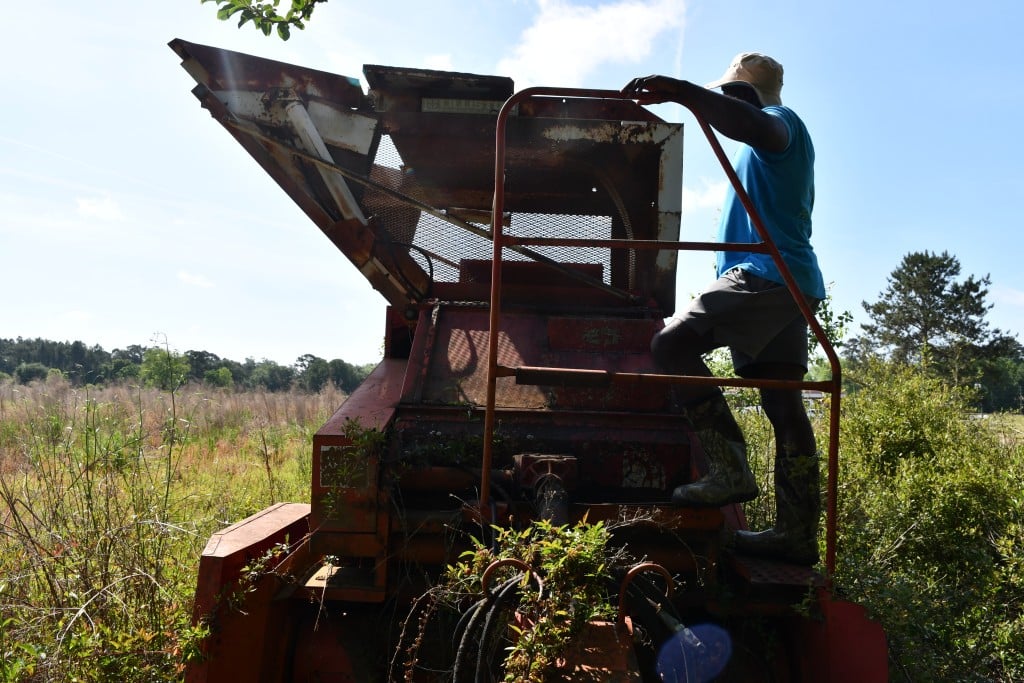
In much smaller fields, the rows are zigzagged with weeds and jagged mismatched crop heights. No more than 1,000 acres exist of these “wild” fields of organic peanuts, a relatively new venture in Georgia. They’re grown without the normal chemicals that keep weeds and other field invaders away.
“Conventional fields are pretty,” Sedrick Rowe, an organic peanut grower, said. “Organic is not a pretty sight most of the time … it’s high grass. You can make it a pretty sight, but it comes with a lot of intense labor.”
Rowe is a first-generation farmer and researcher. He graduated with a master’s degree from Fort Valley State University where he studied peanut barrel bugs and growing crops in a natural environment, using organic methods to control weeds and insects. It was through this work that he began growing his own organic peanuts – pioneering a crop that was only ever grown by a few Georgia farmers before.
Georgia is No. 1 in peanut production in the U.S.. Michael Wall, the Georgia Organics’ program director, said organic peanut farming is still a “drop in the bucket” of the state’s overall peanut production.
Wall said Georgia Organics began looking into organic peanuts because of the market potential.
Georgia Organics began focusing on organic blueberries 20 years ago, and has seen major success in the crop. Wall, who grew up in a Terrell County farming family, said Georgia Organics became interested in trying the same with organic peanuts.
“Wouldn’t it be cool if the certified organic peanut butter jars had that Georgia Grown sticker on them?” Wall said. “Some of us in agriculture are kind of competitive. It galvanizes a community so that we can point to something and say, ‘This used to be small, but now look at this mighty thing and look at the good it’s done for our economies and for our communities.’”
Pioneering organic peanuts
So a small group of growers, including Rowe, set out on this organic journey. They began working with farmers, including two from Baker County and Tifton, who had been growing the crop for years. It wasn’t as simple as just planting and farming organically. For something to be certified organic, the entire production and supply chain must also follow organic processes.
This involved going around to conventional shelling facilities and convincing them to shut down their operations to pressure wash and sterilize their facilities to process just a small amount of organic peanuts. Rowe said it involves a lot of record-keeping, documentation and evaluation.
“We heard a lot of ‘Nah, you can’t even do organic peanuts in Georgia,’” Wall said. “But the funny thing about Sed Rowe and the other growers, is if you tell them ‘you can’t do it,’ that just makes them work harder.”
Rowe began working with Perri Cooper, another first-generation farmer and the executive director of the Georgia Organic Peanut Association. The two would travel back and forth between fields, sharing equipment and learning how to grow the organic crop.
“It was a lot of long days and a lot of love put into trying really hard,” Cooper said.
The pilot year ended up with Hurricane Michael wiping out both trial fields. The farmers got together after the 2018 season and organized the Georgia Organic Peanut Association, a cooperative where they could put their product together and sell in a larger bulk. That same year, the cooperative met with Georgia Grinders, a nut butter company, which asked for a jar of organic peanut butter.
“2020 was the first year that we had a jar of certified organic peanut butter with peanuts grown, roasted and shelled in the state of Georgia,” Cooper said. “And that was really exciting.”
Weathering the challenges of a resilient market
The new venture hasn’t come without challenges. Currently the GOPA doesn’t own or operate its own shelling facility, and it’s a challenge finding shellers willing to put in the work for a small volume of peanuts.
“It’s been a challenge to really have a good, consistent supply chain,” Cooper said. “We really have to build relationships with third-party folks. If they want to shell a small volume of peanuts, then that requires going through the certification process, which takes time and money. If you don’t get it certified in time, then you have peanuts sitting, waiting, and every month that goes by and you haven’t had it finished, you’re losing the quality of those peanuts.”
Cooper said the cooperative also uses federal grants that experienced “a little back and forth” in the last few months. The first is the USDA’s Transition to Organic Partnership Program and the second is the Organic Market Development Grant.
“They’re active now, … but it was a confusing time, especially when planting is happening,” she said. “It becomes hard to plan when you don’t know what programs will be in place.”
Still, Cooper said interest for organic peanuts has only grown since the cooperative began. Wall said overall, the organic market has never slowed down – even during the pandemic it remained strong.
“In fact, more people went to organic produce and products than ever before,” Wall said.
This makes the product a good option for diversifying farming operations, creating more resilient income streams. Oftentimes, organic peanuts sell for as much as double the price of conventional peanuts.
“Prices are high because we don’t yield as much,” Rowe said. “So at the end of the day, you can grow 100 acres conventional, and I can grow 50 acres. Whatever you make it on 100, I can make out of 50.”
Breaking barriers in the field
Rowe plants his peanuts by mid-May, switching between different fields every two or so years to promote soil health. He uses old equipment to turn his fields and manage weeds. Any fertilizer he uses is organically approved, like gypsum or soy to promote root growth. He doesn’t use dyes.
The peanut-growing season is about 150 days – sometimes longer, depending on temperature and rainfall. When they’re ready, peanuts are harvested and left on the ground to dry up before they’re sucked up. Organic farming is strenuous, but to Rowe it’s a gift.
He grew up in Albany, surrounded by pecan orchards, peanuts and soybeans. He started working on an organic farm as a senior at FVSU and fell in love with the grind.
“Growing up in the area, I wanted to do something that typically you don’t see … a young, black man farming,” Rowe said. “I looked at it as a way to create a path for people to look at farming in a different way.”
In between his farming work, Rowe advocates for young and minority farmers at the Congressional level. He was appointed by former Agriculture Secretary Thomas Vilsack to be a part of the Advisory Committee on Minority Farmers, although this committee was paused by the Trump administration. He talked to Congress about the Farm Bill and what can be done to support young farmers, especially addressing the generational gap between farmers.
“Young farmers are innovative so we have to invest more into education; a lot of us come out with student loan debt,” Rowe said. “That is a bad look when you’re trying to go in and borrow money to start an operation. That’s taking on a lot of risk, and farming is a risk.”
To Rowe, organic farming is a lifeline for small and new farmers like himself. Cooper said one of the cooperative’s goals from the beginning was taking a niche opportunity that could support a small or beginning farmer.
Rowe’s tapped into other niche markets like organic sunflowers and hemp. He said niche markets are a lifeline for small farmers.
“I don’t have a lot of acres, so I have to do things I can profit from on a smaller scale,” he said. “That’s the only way someone like me, a black, young farmer, will be able to survive.”
Author

Related Articles
Albany Herald – July 14, 2026
In Lee County, they saw it… Bigger budget will mean improvements at… Small actions can help save…

Classifieds – July 14, 2026
Albany Classifieds and Legals…

‘Just Africa’ festival scheduled for third weekend in September in downtown Albany
A taste of the Caribbean and Africa is coming to Albany with a fall festival that will also bring African dance, a parade of children’s fashions, as well as vendors, live bands, and arts and crafts.
