
Southwest Georgia farmers still struggling with impact of Hurricane Michael
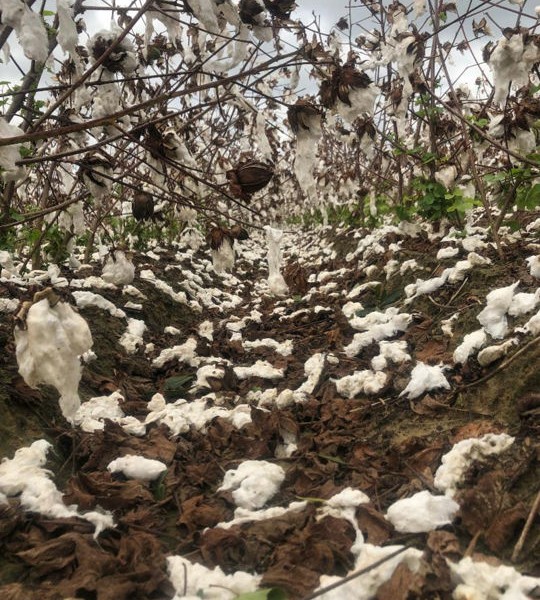
Special Photo
By Alan Mauldin
[email protected]
Editor’s Note: Final in a series of articles about the impact Hurricane Michael had — and continues to have — on southwest Georgia after its path of destruction a year ago.
MOULTRIE — The old adage about not counting chickens before they’re hatched also applies to pecans, cotton and cucumbers before they’re picked.
One year ago, southwest Georgia farmers were looking at a bumper crop of cotton with a seller’s market. It also looked like a good year for peanuts and other farm commodities.
Then came Hurricane Michael.
The storm was the first major hurricane of Category 3 or greater strength to hit the state since the 1890s, and brought winds recorded at 115 miles per hour to Donalsonville, according to the National Weather Service.
The storm took out some 40% of the region’s canopies of pecan trees, either through breaking limbs or ripping them out by the root. Cotton blown from the plants littered fields and couldn’t be harvested.
Since that time, farmers have not received any relief, other than $75 million in loans provided by the state government.
“I was just talking with the county agent, talking about how pretty the crop was, how much we were producing, how good the prices were,” Sam Watson, a Colquitt County farmer and state representative, said of how things were looking in fall 2018. “Here we are a year later: We haven’t received any disaster money. We’re all still stuck. Commodity prices are low.
“I just don’t know what people are going to do. People are struggling.”
In 2017 Worth County was the second-largest producer of cotton in the state, with farmers receiving $40.3 million for their crop, followed by Mitchell County at $36.3 million and Colquitt County at $32.2 million, according to the University of Georgia. The university has not released 2018 numbers.
As a vegetable grower, Watson said, he likely is not eligible for disaster payments that usually are earmarked for row crops like peanuts and cotton. He does know his neighbors are hurting, however.
“I think farmers are at that point where everybody is really struggling,” he said. “It’s not a good situation. It’s, like, I don’t know, it’s just struggling. Our biggest industry, you think there would be a little more concern, and there’s not.”
The application process for farm disaster relief is under way to seek funding from a pot of federal money earmarked for other 2018 natural disasters, including California wildfires and weather events in other states.
The entire package is about the amount of the losses Georgia farmers suffered, Watson said.
Estimates are that damage to the state’s agricultural sector totaled more than $2 billion, including $560 in damages to pecans, including direct losses of nuts in 2018, damaged and destroyed trees, and a decade of lost revenue while new trees grow to maturity.
Mitchell County and Dougherty County were the top producers of pecans in 2017, and they accounted for $40 million and $36 million, respectively, in revenue for growers that year.
Timber losses accounted for another $374 million in losses, and almost 100 poultry houses were destroyed.
The outlook for the future has not improved this year.
“This year, basically, we had really intense heat in May, really bad heat in August,” said Colquitt County extension agent Jeremy Kichler. “Then we had the extreme dry weather, the drought in September of ’19. This drought is deepening, and that’s not good.”
Dry weather has driven up production costs for farmers, who pumped water through irrigation systems and withered crops in fields where there was no irrigation systems.
Cattle producers have not been able to cut hay for winter feeding, Kichler said.
“Last year, we had Michael,” he said. “The previous year, we had Irma. It’s a normal year in that we have different production challenges than the last.”
For Watson, the year has brought challenges that include extreme heat that lasted into October and poor prices due to the importation of cheaper produce from Mexico.
“This year it was 100 degrees on Oct. 4,” he said. “These plants can’t take it. We only harvested about 50% of the crop, and the 50% we harvested wasn’t a (premium) crop.
“I was just thinking today how beautiful my crop was (last year) and what I’m looking at now. There’s nothing there, and what’s there is not looking good.”
Watson said it is too early to tell how many farmers may be forced out of the business until they look at their finances at the end of this year.
However, he thinks there will be some.
Banks and equipment dealers have helped out, but they can only afford to do that for so long.
“People will work with you for a year,” Watson said. “In agriculture, we’re in the third year of asking people to work with us. At some point they just can’t.
“We may not be feeling it right now, but we will when people try to get started next year and can’t or have to cut way back.”
Author

Related Articles
Congress weighs packaging bill with implications for Albany manufacturers
A congressional hearing this week on proposed national packaging-labeling standards could have implications for several of Southwest Georgia’s largest manufacturers, many of which produce or package products shipped across state lines.

Dougherty County Sheriff’s Office, GBI investigate inmate death
“The sheriff’s office will conduct an administrative investigation to determine if the staff response was appropriate. We have requested that the GBI conduct an investigation.”
Residents’ safety concerns defeat request to privatize Plantation Road
The Terrell County Board of Commissioners rejected a request July 7 to remove Plantation Road from the county road system after nearby residents warned that closing the roadway could leave them without emergency access when adjoining roads flood.
