
Study: Contact tracing can have positive impact on containing COVID
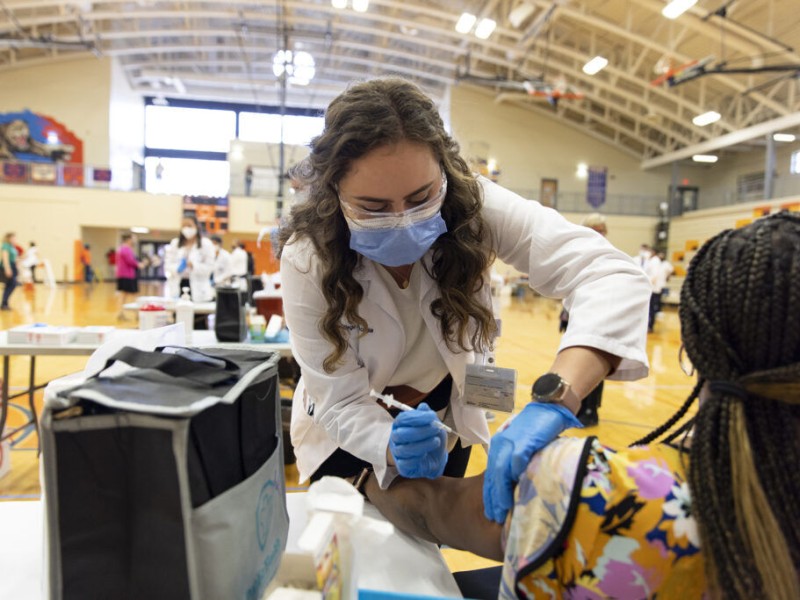
Special Photo: Andrew Davis Tucker, UGA
By Lauren Baggett
UGA News Service
ATHENS — The emergence of the delta variant and continued vaccine hesitancy have caused many health and government officials to revisit the need for non-pharmaceutical interventions (NPIs) like social distancing policies, mask wearing, contact tracing and isolating infected individuals to manage new COVID-19 surges.
The one thing everyone wants to avoid is another lockdown, but what intervention measures work best without the need for strict social distancing? New research from the University of Georgia suggests that officials should prioritize contact tracing and quarantine.
“When social distancing in the general population is hard to achieve, we could still rely on contact tracing and case isolation if we do a good job,” lead author Yang Ge, a doctoral student in the department of epidemiology & biostatistics in UGA’s College of Public Health, said.
The study, which was recently published in Epidemics, modeled the impact of three interventions – social distancing, contact tracing and case isolation – on containing COVID-19 using both real patient data from China’s Zhejiang province and computer simulations.
The database included more than 1,200 symptomatic cases reported between Jan. 7 and Feb. 22, 2020, and the model accounted for their daily contact activities with other people before, during and after the epidemic. As a result, the researchers were able to evaluate the contribution of each intervention, rather than only the combined effect of all three strategies.
They found that the outbreak in Zhejiang was suppressed by isolating cases within five days with 36.5% of infected contacts quarantining. This scenario was only achieved when robust contact tracing was in place.
“Social distancing, case isolation and contact tracing are all critical in suppressing the epidemic, and they interact with each other in the sense that if you fail in one area, the other efforts need to be strengthened,” lead co-author Ye Shen, an associate professor of epidemiology & biostatistics at UGA, said. “In particular, we noticed that contact tracing is very important despite not being part of the major conversation in current control efforts.”
In addition to testing the impact of each intervention, they also modeled scenarios where certain interventions were weaker than others, for example, if it took more or less time to isolate a positive case.
“We found that even with a low prevalence level, a gradual re-opening is challenging without further strengthening NPIs,” Shen said. Specifically, the curve was steeper when contact tracing was less efficient.
These findings take on new meaning as areas of the U.S. and elsewhere are seeing major case spikes, while many lower income countries are still waiting on vaccines to arrive and continue to rely on these interventions to keep their citizens safe.
“Slow tracing and delayed isolation could easily increase the outbreak size by tens of folds,” the said. “We should allocate sufficient resources to support such efforts, for example, funding contact tracing forces, allowing people to work or study from home when exposed to COVID-19 cases, and at the minimum, encourage everyone to wear a face mask indoors.”
Related Articles
From Ledo to Coston, Lee County’s summer road projects are underway
Updates provided during recent meetings of the Lee County Board of Commissioners show projects are underway or scheduled to begin on several county roads, while additional transportation improvements funded through the Local Maintenance and Improvement Grant (LMIG) program and Transportation Special Purpose Local Option Sales Tax (T-SPLOST) are expected to begin shortly after the July Fourth holiday.

PSC candidate Peter Hubbard makes case for election to full term
The reason why voters should pick me is I’m a rare breed in that I read everything that comes across my desk. I’m asking hard questions at the meetings. I want to get to the bottom of are data centers paying their fair share, are residential customers getting their fair share.
Dougherty Schools prepare for bell-to-bell student cell phone ban
As Georgia prepares to expand its statewide ban on personal electronic devices in public schools, Dougherty County School System leaders say they are working to balance compliance with the new law while giving individual schools flexibility in how they implement the policy.
