
White Oak Pastures continues to grow its business | PHOTO GALLERY
Brad McEwen
BLUFFTON — Jenni Harris, Southwest Georgia farmer and marketing manager for White Oak Pastures in Bluffton, says one of her father’s favorite sayings is “nature abhors a monoculture.”
And it’s that mindset that drove Will Harris III’s decision in 1995 to change the direction of the family farm. He had no idea that it would grow into not only the largest organic farm in Georgia and the only one of its kind in the United States, but into a thriving, multifaceted business venture.
“There is no one else in the country doing this,” said Jenni Harris. “Are there other really great farmers that know what they’re doing and do it well? Absolutely. (But) we are the only farm in the United States that has both red meat and poultry processing abattoir on the same property, under USDA inspection.”
Harris also could not have predicted that his family farm would grow from a humble, yet profitable, business with $2 million in annual sales and three employees, to a growing company with annual sales around $25 million and more than 120 employees, all making above minimum wage.
Jenni Harris said the core values of animal welfare, environmental stewardship and helping the local economy developed by her father are the roots of everything at White Oak and the catalyst for the farm’s transformation over the last 20 years.
Jenni Harris and her sister, Jodi, are the fifth generation of Harrises at White Oak, which was started by James Edward Harris in 1866. By the time their father, Will, took the reins, the farm was the model of industrialized farming, which relied on machines, chemical fertilizers, insecticides and growth hormones to drive large-scale production.
Despite White Oak’s profitability at the time, Will Harris made the almost prescient decision to certify the farm as organic and head in a different direction.
“He always says there was no burning-bush moment,” said Jenni Harris. “It wasn’t like he saw Moses or Jacob or anybody else from the Bible. It was more that he became disgusted with the excesses in the market: shipping cattle in large truckloads, to large plants, processing 400 head an hour. The masses were just disgusting to him. He decided that he wanted to sell to a different consumer. So in the mid-90s he started reading about grass-fed beef.”
As Jenni Harris tells it, some of the real changes occured once the farm began raising grass-fed cattle on organic land and had to deal with some of the challenges.
“(Becoming organic) was great and emotional and perfect and wonderful and he thought ‘now that I’ve certified my farm as organic I’m the best that I can be, this is the best farm in the world,’” Harris recalled her father saying. “Well, he then realized that having a monoculture of cattle was resisting nature. You know green grass is great, but now that I’m not using fertilizer what’s going to fight off this red-rooted pig weed and smut grass and fennel and all these other types of invasive weeds? So we started (adding) things like sheep and goats. They browsed things that cattle turned their noses up at. It was a wonderful investment for us. So we started selling grass-fed beef and grass-fed lamb.”
Not long after that, and true to his nature, Jenni Harris said, Will Harris faced another quandary as the farm continued to grow.
“So then he said, ‘Great now we’ve got a multispecies farm, we’re the best farm in the world,’” Harris said. “’That’s all I need to do, this is the gold star, we’ve reached it, I’ve peaked.’ Well then our processor, who was processing our grass-fed beef, was overflowed.”
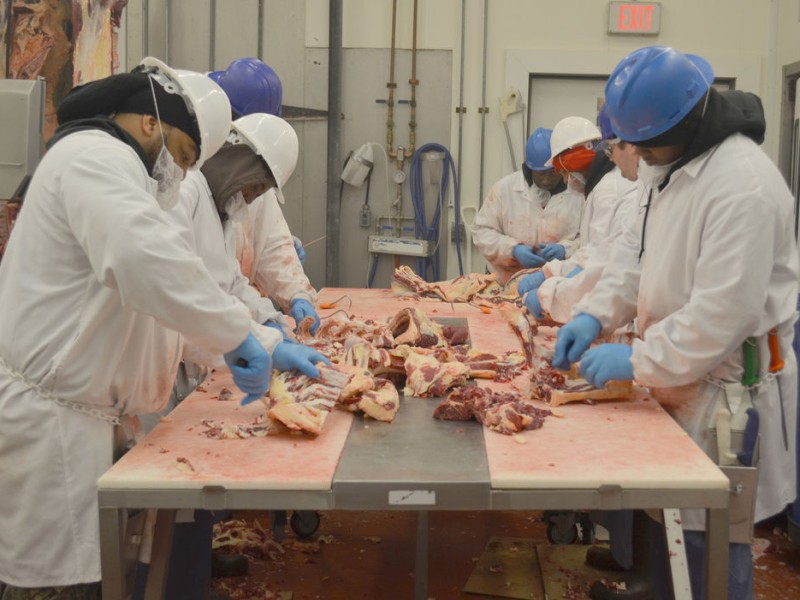
Tackling that problem made building an on-site slaughterhouse necessary and created a new business with a new revenue stream for the family-run operation. As the slaughterhouse grew and the farm picked up increased business, Will Harris felt the company needed to use the profits to further diversify and protect the company’s future.
It’s also at this time that Harris began studying the Serengeti Rotational Model for cattle being used in Africa and saw in it the natural course the business should take in order to adhere to the value of environmental stewardship. It also opened another new business as the farm opted to add poultry production to its farm.
“(The Serengeti model) basically models grazing your large ruminants (animal species), followed by your smaller ruminants, followed by your birds, your poultry,” Jenni Harris explained. “For us, we graze our grass-fed beef cattle, followed by our sheep and goats, followed by our chickens, turkeys, ducks, geese and guineas. So we have five poultry species today that we raise and slaughter on our farm that help us complete the last leg of the Serengeti rotational species model. And it’s wonderful.
“The Africans figured it out a lot sooner than we did. It’s fertilized in three different manners; it’s grazed in three different manners. The cattle prefer a certain type of grass, the sheep and goats prefer weeds and brushes and shrubs, and then poultry peck and scratch though the bugs and the roots and the grubs in the soil. So it is an incredible operating system.”
With the new model in place, profits continued to rise as the eating priorities of many Americans changed and White Oak was able to start doing business with two major partners: Publix Supermarkets and Whole Foods Markets, which remain the company’s two largest customers.
As has proven to be the case throughout the development of White Oak Pastures, things didn’t stop there, though. Still acting on the idea of environmental stewardship, the farm adopted a “zero-waste” policy where every part of the animals they raise is put to use.
“One of our heroes is George Washington Carver,” said Jenni Harris. “He says, ‘In nature there is no waste.’ If a tree falls it decays, decomposes and there’s better soil 10 years later. So that’s the way we feel. We compost all of the inedible materials — the bones, the blood and the guts — in our composting method that was developed by Cornell University, and we then re-apply that back to the farm after it’s been cooked in the sun for a certain period of time or ‘turned’ and put into the farm as organic fertilizer.”
One thing that isn’t used in the fertilizer process is animal fat, which has also turned out to have many other uses, some of which have led to growth and to new a business for White Oak.
“In the cutting room when we’re cutting steaks, we try to cut off a certain amount of fat. Because it’s grass-fed beef, it’s not a tremendous amount of fat, but there is some fat,” Jenni Harris said. “We use the fat in a couple of different ways.”
One such use is the farm’s foray into bio-diesel. Although they don’t sell it at this point, the farm’s chemist, Mary Bruce, is currently developing a formula which can be used effectively in the farm’s operations and beyond.
“We’re sort of in that research and development phase,” said Jenni Harris. “We’re still working on our recipe, but we are making a certain amount of bio-diesel that’s powering our tractors.”
In addition to the bio-diesel, the fat is powering other business ventures for White Oak based around rural life of the past.
“My grandmother used to always talk about lye soap, and that’s, of course, made from tallow, or lard,” said Harris. “We have a lot of tallow, so we make our own soaps here on the farm. They’re great. It’s just tallow, coconut oil, olive oil and water, and peppermint essential oil, just five ingredients. We’ve had a lot of success with that.
“We also make our own candles out of the fat, tallow candles.”
The farm now also grows vegetables on 6.5 acres of the property, a good portion of which is sold to the public. In fact, White Oak’s biggest foray into the Albany market has been through its Community Supported Agriculture program. Each week White Oak ships a variety of vegetables, along with various meat products, to a central location in Albany to be picked up by CSA participants.
The farm also grows mushrooms and produces honey from its bee hives. Additionally, as one would imagine with a farm that produces poultry, White Oak has a large egg business as well.
Anyone who takes the time to tour the White Oak facility and talk with Jenni Harris will hear an almost endless list of product lines.
“The reason why that is is because my father refuses to let anything go to waste,” she said. “We’re too poor to throw anything away. He makes byproducts mainly for subsidiary, auxiliary businesses.”
While the core value of environmental stewardship has propelled the farm into a variety of new business ventures, White Oak’s mission to support the local economy of the Bluffton area is being fulfilled by byproducts of farm production as well.
Jenni Harris said that as the staff continued to grow, it became apparent that the farm needed to make changes to accommodate the growth. One such accommodation was the creation of an on-farm restaurant run by professionally trained chef Reid Harrison. The restaurant feeds the farm’s 120-plus employees.
“We’ve got a restaurant on the farm that feeds our employees,” Harris said. “We’re open Monday through Saturday for lunch and then Friday and Saturday evenings for supper. (Harrison) makes everything from hot meals, cafeteria style, for us at lunch because there’s 120 of us that have to eat from noon to 1 p.m. He also does plated meals on the weekend. The suppers are more so like guinea breast and duck leg quarters and filet mignon and some of the things you can’t get everywhere all the time.”
Where the restaurant was originally designed to provide meals for employees White Oak made the decision to open the restaurant to the public. Visitors may dine with the White Oak Pastures family.
In addition to offering daily tours of the property, including the fields, restaurant and processing facility, the farm now offers overnight lodging for visitors who want to stay on the farm and experience things up close.
“We are becoming so experience-based and so educationally centered,” Harris said. “We have four one-bedroom/one-bathroom cabins and then one two-bedroom/two-bathroom cabins that we rent out, and it’s really surprised us because they’ve been occupied more than they’ve been vacant. That’s been a really great experience.”
The Harrises believe that by bringing people to the farm, they are also helping Bluffton, something that subsequently lines up with their mission to support the local economy.
Click here to learn more about White Oak’s efforts in Bluffton
If the recent past is any indication, the future of White Oak Pastures should be exciting as Harris and her family believe things will continue to evolve and expand. Regardless of that expansion and the innovation that has driven it, Harris said she and her father take things in stride and don’t really feel like they are doing anything revolutionary.
“He is a very pragmatic businessman,” Harris said of her father. “People say, ‘Oh you’re a pioneer, you’ve changed farming for the better for the United States.’ I believe some of that is true; he probably has been an inspiration for some of these things, and he’s obviously very happy we transitioned the farm. But I don’t care how much my daddy loved cows and diversified agriculture and vegetables, if it wasn’t financially viable, I wouldn’t come home. It’s got to be a lucrative business model in order to be sustainable.
“I think what he would say is, ‘No I haven’t changed the way America farms, I’ve proven that it’s financially possible to be done on this scale and not prostituted out as just another marketing term.’”
Jenni Harris says she believes Will Harris would agree that he made a good decision for the right reasons, which has proven to be something that works, something that might inspire others.
“He’s changed the mindset that organic or pastured or green products are just for hippies, ” she laughs. “One thing he has done is taken that 1-acre diversified farm in somebody’s backyard and scaled it up on a level that nobody else has ever been able to do and made it financially workable.”
To learn more about White Oak Pastures and its various products, visit the farm’s website www.whiteoakpastures.com or contact the farm directly at (229) 641-2081.
Related Articles
Albany/Dougherty County among local governments looking at data centers
“Our understanding is that data center developments look like an easy fix for the problems that face rural America, but this is a Faustian deal at best. You can see the effects in communities across the state and country.
Albany Herald – July 14, 2026
In Lee County, they saw it… Bigger budget will mean improvements at… Small actions can help save…

Classifieds – July 14, 2026
Albany Classifieds and Legals…
